
We’ve all been there. You finally pull the trigger on a new pair of sneakers, only to be haunted by ads for the exact same pair for the next two weeks. A generic recommendation of product isn’t just a missed opportunity; it’s an experience that can actively erode the trust you’ve built with your customers. It feels like the brand isn’t listening.
In a world overflowing with choices, your customers are looking for a guide, not just a catalog. They want you to understand their style, anticipate their needs, and show them things they’ll genuinely love. When you get this right, it’s magic. It’s the difference between a one-time sale and a lifelong fan. This shift from generic algorithms to truly helpful guidance is the single biggest opportunity for Shopify stores in 2025. It’s about creating those “aha!” moments that make a shopper feel completely seen.

Why Shoppers Crave Trustworthy Guidance
Today’s shoppers are smart and skeptical. Before they click “buy,” they’re looking for signals that tell them they’re making the right choice. Research looking ahead to 2025 shows just how much they rely on validation.
- A staggering 78.1% of shoppers say customer reviews influence their decision to buy.
- 51% head to online marketplaces to research products before committing.
- 45% still rely on recommendations from friends or family—the original trusted source.
What’s fascinating is how quickly generative AI is becoming a go-to resource. Already, 43% of consumers consider tools like ChatGPT a reliable place for product research. The message is clear: customers crave confident, well-informed guidance, whether it’s from a peer review, a best friend, or a smart algorithm.
This is why your on-site strategy is so critical. By fine-tuning your store’s recommendations, you position your brand as that trusted expert. It’s not about overwhelming them with more options; it’s about presenting the right options at the perfect moment. Because when you get it right, powerful ecommerce personalization tools don’t just sell products—they build relationships.
The best recommendations don’t feel like an algorithm at all. They feel like a thoughtful suggestion from someone who truly gets your style.
When you get this right, you stop wasting your customer’s time and start earning their loyalty for the long haul.
Let’s Move Beyond ‘Customers Also Bought’
Let’s be honest: the old “Customers Also Bought” widget just doesn’t cut it anymore. It’s time to graduate from generic, often irrelevant suggestions. An effective recommendation strategy is built on a genuine understanding of your shopper, feeling less like a machine and more like a trusted friend who just gets their style.
The goal here isn’t just to boost AOV. It’s to create a seamless experience that guides people toward products they’ll not only love but also keep. This isn’t about slapping a widget on a page; it’s about thoughtfully weaving recommendations into the entire customer journey.
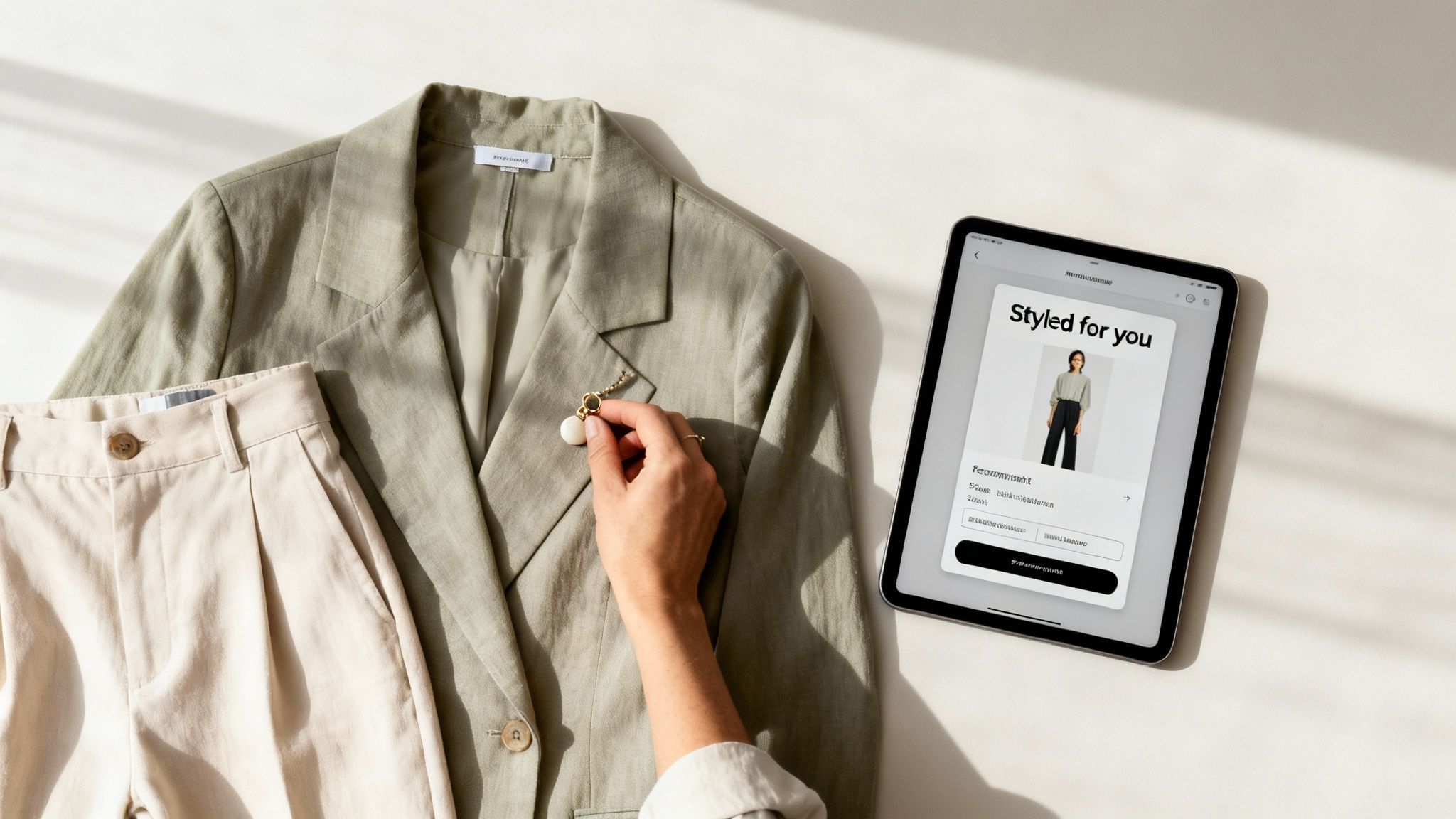
Weaving Recommendations into the Customer Journey
A powerful recommendation of product strategy isn’t about carpet-bombing your site with suggestions. It’s about surgical precision—serving up the right kind of recommendation at exactly the right moment.
Think about the different stages of the shopping experience:
- Homepage: This is your digital storefront window. Capture attention instantly with “New Arrivals” or “Trending Now.” It’s your first chance to establish your brand’s voice and show off what’s exciting.
- Product Pages: Here’s where context is king. Instead of a vague “You Might Also Like,” try something more inspiring like “Complete the Look” or “Pairs Perfectly With.” This helps shoppers visualize the entire outfit, not just a single item.
- In the Cart: This is the perfect spot for a gentle nudge. A simple “Don’t Forget These” suggestion for a matching belt or the right cleaning kit can feel genuinely helpful and significantly increase the average order value.
- Post-Purchase: The conversation doesn’t end at checkout. A follow-up email a week later with the subject line “Styled With Your New Jacket” feels personal and continues to build the relationship.
Understanding how to guide customers through each phase is a game-changer. For a deeper dive, our guide on the eCommerce marketing funnel is a great resource for mapping out these interactions.
Let’s look at how this new way of thinking stacks up against older methods.
Modern vs. Traditional Recommendation Tactics
The table below contrasts outdated methods with modern, personalized strategies that build trust and drive conversions.
| Tactic | Traditional Approach (Low-Impact) | Modern Approach (High-Impact) |
|---|---|---|
| Product Page | Generic “Customers Also Bought” based on popular items. | “Complete the Look” with curated, complementary products. |
| Homepage | Displaying “Best Sellers” to everyone. | Personalized “Trending for You” based on browsing history. |
| Shopping Cart | Last-minute, unrelated impulse-buy suggestions. | Smart suggestions for accessories or care items related to cart contents. |
| Post-Purchase | Sending a generic “Shop Our New Arrivals” email. | A personalized follow-up email with styling tips for their recent purchase. |
| Core Data | Relies solely on past sales data. | Blends purchase history, browsing behavior, and fit feedback. |
As you can see, the shift is from a one-size-fits-all sales push to a one-on-one styling session.
The Data That Actually Fuels Good Recommendations
To make these personal moments happen, you need the right fuel. And that means looking beyond what someone bought last month.
A smart recommendation engine listens to what customers do, not just what they buy. It pays attention to clicks, views, and even what they ignore.
So, where do you start? Focus on gathering these crucial inputs:
- Purchase History: This is your foundation. What have they bought from you in the past?
- Browsing Behavior: What are they clicking on? Which collections do they keep coming back to? This is the digital equivalent of window shopping.
- Style Preferences: If you offer a style quiz or let customers save their preferences, that data is pure gold for refining recommendations.
- Fit & Return Feedback: Don’t overlook this. When a customer returns an item because it was “too small,” that’s an invaluable piece of information. You now know not to recommend that same cut or size again.
By blending these different data streams, you can build a rich, nuanced profile for each customer. This allows you to make recommendations that feel less like a guess and more like a genuinely insightful suggestion from someone who knows their style.
Closing the Confidence Gap with Visual AI
Let’s be honest about the biggest hurdle in online fashion. It’s not just about helping shoppers find a style they love; it’s about quieting that nagging voice of uncertainty in their head.
“Will this actually fit me?”
“How will this fabric really drape on my body, not a professional model’s?”
A simple text-based recommendation, no matter how smart the algorithm, can’t answer those deeply personal questions. It can point a customer to the perfect dress, but it can’t close the critical gap between seeing something online and believing it will work for them. This is where visual AI completely changes the game.
From Suggestion to Experience
Picture this: a shopper lands on a dress your system recommended. Instead of just scrolling through standard product photos, they can instantly see it on a hyper-realistic AI model that mirrors their specific body type. Or even better, they can virtually “try it on” themselves using nothing more than a photo.
This isn’t some far-off concept; it’s happening on Shopify stores right now.
When you weave visual AI into your recommendation strategy, you’re doing more than just showing a product. You are turning a passive suggestion into an interactive, confidence-building experience. It tackles the customer’s number one doubt—fit—head-on, before it has a chance to cause cart abandonment or a costly return.
The Power of “Seeing is Believing”
Think about the difference. Traditional recommendations suggest what a customer might like. Visual AI shows them exactly how they will look and feel. That shift is everything.
- It Answers the Fit Question Instantly: No more poring over confusing size charts. Visual try-on gives immediate, personalized feedback.
- It Creates an Emotional Connection: Seeing a garment on a body they relate to (or their own!) helps a shopper envision wearing it in their own life. It pulls the product out of the sterile world of a product page and into their reality.
- It Builds Unshakeable Trust: Offering this transparency shows you care about their happiness, not just the sale. You’re empowering them to make a confident choice, and that’s the bedrock of real customer loyalty.
This approach is so effective because it gets to the root cause of nearly 40% of all fashion returns: poor fit. Instead of just tweaking the suggestion algorithm, you’re solving the real-world problem that stops customers from clicking “buy.”
Visual commerce stops being about selling a product and starts being about selling confidence. When you solve for confidence, conversions naturally follow.
Making It Real on Your Store
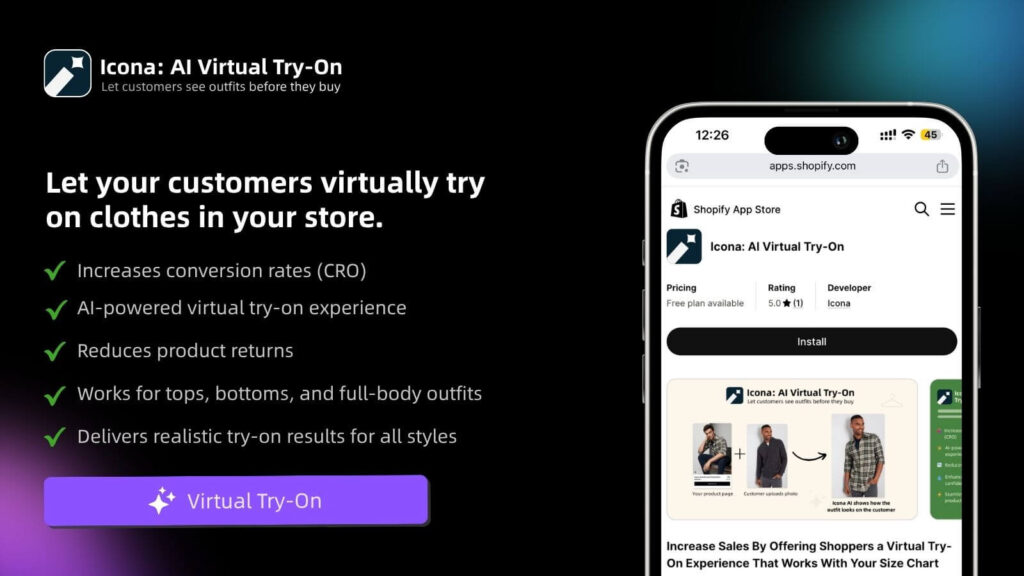
The great news is that tools like TryIcona are built to make this incredibly accessible for Shopify merchants. You don’t need a massive development team to bring this to life.
The whole idea is to embed this technology right where the buying decision happens—on your product detail pages. By simply adding a virtual try-on button next to your “Add to Cart” button, you give customers a direct path to resolving their biggest uncertainty at the most crucial moment.
To see how this works in practice, you can explore the ins and outs of virtual try-on technology and see how it integrates seamlessly into the shopping journey.
By arming your recommendations with visual proof, you’re not just improving an algorithm. You’re fundamentally upgrading how customers engage with your brand, making them feel seen, understood, and truly confident in every single purchase.
Putting Your Smart Recommendation Engine to Work on Shopify
A brilliant strategy is one thing, but execution is everything. Let’s get into the playbook for bringing an intelligent recommendation system to life on your Shopify store. This is where we move from ideas on a whiteboard to a living engine that guides customers and grows your business.
First, a quick audit. Before you add a new app, take an honest look at what you’re already doing. Where are you currently showing recommendations? Are they just the generic widgets that came with your theme? You can’t measure progress if you don’t know your starting line.
Pinpointing Your High-Impact Moments
Not all recommendation placements are created equal. The key is to be surgical, placing the right suggestions exactly where they’ll make the biggest impact. It’s less about blasting customers with options and more about perfect timing.
Let’s break down the most crucial touchpoints:
- On the Product Page: This is your prime real estate. A customer is already showing clear interest, so your job is to build on that momentum. Instead of a random grid of products, think “Complete the Look.” If they’re eyeing a linen shirt, show them the perfect trousers and sandals. A brand that nails this is Taylor Stitch; they create a cohesive story around every single item.
- Inside the Cart Drawer: The moment an item hits the cart, purchase intent is sky-high. This is the perfect spot for a gentle, helpful upsell—not a hard sell. Think small, complementary items. If they’ve added a dress, why not suggest the matching earrings or a special garment care kit? It feels less like a sales pitch and more like a thoughtful tip from a friend.
- Post-Purchase Emails: The conversation doesn’t end when the order is confirmed. A follow-up email a week later showing them new ways to style their purchase with other items from your store is an incredibly powerful way to bring them back. It builds loyalty and shows you care about their experience beyond the sale.
The world of e-commerce is only getting more crowded. Projections show it hitting a staggering $7.5 trillion in 2025, with the AI-powered tools behind this growth becoming a $16 billion market. It’s crystal clear that getting personalization right is no longer just a nice-to-have. Discover more insights into the future of digital commerce and see what’s coming.
Your goal is to make every recommendation feel like a natural next step in a conversation, not an interruption. Guide, don’t just sell.
This is all about turning a shopper’s initial doubt into a confident purchase, and visuals are your secret weapon.
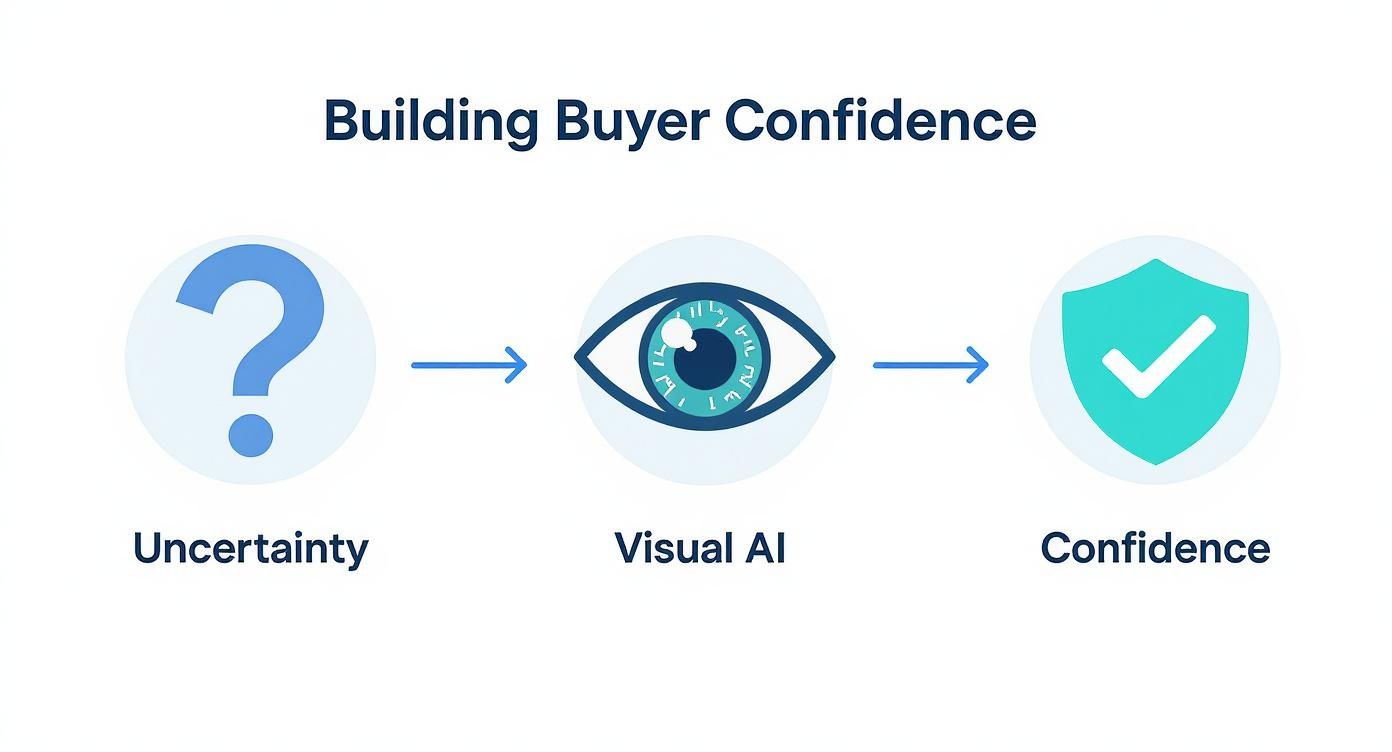
This simple flow shows how visual AI can act as the bridge between “I’m not sure” and a confident “yes,” directly answering the fit and style questions that so often stop a sale in its tracks.
Choosing the Right Tools for the Job
Once you’ve mapped out your strategy, it’s time to find the right tech to make it happen. The Shopify App Store is a treasure trove, but you need a tool that aligns with your specific goals, not just the one with the most reviews.
For instance, if fit-related returns are your biggest headache, a tool like TryIcona can be a game-changer. By integrating virtual try-on directly into your recommendations, you’re not just suggesting a product; you’re offering visual proof that it will look great. This tackles the confidence gap head-on.
When you’re vetting an app, here’s what to look for:
- Deep Segmentation: Can you create different rules for different customer groups, like first-time visitors versus loyal VIPs?
- Strategic Placements: Does it give you granular control over where and how the recommendation widgets appear on your site?
- Performance Focus: Is it built for speed? The last thing you want is a powerful app that slows down your site and kills conversions.
With the right strategy and tools, you can build a system that doesn’t just boost sales, but elevates the entire shopping experience. You’ll make your customers feel seen, understood, and confident—and that’s how you earn a customer for life.
Measuring the Metrics That Actually Matter
Alright, you’ve put in the work and your smart recommendation strategy is live. But how do you know if it’s actually working? It’s easy to get distracted by clicks, but the real story is in the numbers that impact your bottom line and make customers happy.
To get a true read on performance, you have to look past the surface-level stuff. We need to track the metrics that spell out real growth, profitability, and the kind of loyalty that keeps people coming back.
Beyond Clicks and Impressions
An effective recommendation engine does more than just grab attention—it inspires action. There’s a reason the global recommendation engine market is projected to hit a staggering USD 7.34 billion in 2025. Smart brands know its value runs deeper than engagement. For a glimpse into what’s next, these insights on the future of AI recommendation engines are worth a read.
Here’s what you should be laser-focused on:
- Conversion Rate from Recommendations: Isolate the conversion rate specifically for shoppers who click on your recommendation widgets. This is direct proof of how well your suggestions are turning browsers into buyers.
- Recommendation-Influenced Revenue: This is a big one. Track the total revenue from any shopping session where a customer interacts with a recommended product. It shows you the direct financial footprint of your entire strategy.
The Metrics That Reveal True Value
Driving sales is fantastic, but the best recommendation strategies also boost your profitability and keep customers satisfied long-term. This is where the real magic happens.
A great recommendation doesn’t just sell another item; it sells the right item. This simple shift is the key to reducing returns and building lasting customer relationships.
To see that deeper impact, keep a close eye on these two critical areas:
- Lift in Average Order Value (AOV): Are your “Complete the Look” carousels getting people to add more to their cart? A rising AOV is a crystal-clear sign your cross-selling and upselling ideas are hitting the mark.
- Reduction in Return Rate: This is the ultimate test. When you give shoppers better guidance—especially with visual AI that helps them see the fit—they buy with more confidence. A falling return rate translates directly to happier customers and healthier profit margins.
To really grasp the long-term impact, it’s essential to measure performance indicators like Customer Lifetime Value. You can learn more about how to calculate Customer Lifetime Value (LTV) and see why it’s often a more telling metric than AOV alone.
The best way to start is with simple A/B tests. Pit different algorithms against each other, try out new widget placements, and experiment with visual styles to find out what your audience loves. This isn’t a one-and-done setup; it’s a constant process of refining. With a data-backed approach, you can ensure every recommendation of product gets smarter and more powerful over time.
Answering Your Top Questions About Product Recommendations
Jumping into a new strategy always brings up a few questions. I’ve heard them all from Shopify merchants, and they usually circle back to data, site speed, and how to actually use these tools in the real world. Let’s clear those up.
How Much Data Do I Really Need to Get Started?
Honestly, you can start sooner than you think. While more data fuels better personalization, you can get the ball rolling with just a few hundred orders. That’s enough to power simple but effective recommendations, like a “Best Sellers” carousel.
When you’re ready for the advanced stuff—like a “Recommended for You” section that feels like it’s reading your customer’s mind—you’ll want to have at least 1,000 orders and consistent traffic. The key is to start simple and let the system get smarter as your store grows. Don’t wait for perfect data; start with what you have today.
Will Recommendation Widgets Tank My Site Speed?
This is a huge—and totally valid—concern. Site speed is everything in e-commerce. The good news is that modern, well-built recommendation apps are designed with performance in mind. They typically use asynchronous loading, which means they load in the background, separate from your main page content. Your customer sees the important stuff first, without any delay.
My advice? When you’re picking a tool, make sure speed is a top feature. And it never hurts to run a quick speed test before and after you install a new app, just to see the impact for yourself.
The right recommendation tool should feel invisible to your site’s performance but incredibly visible to your customers’ experience.
Can I Use Recommendations to Clear Out Slow-Moving Stock?
Absolutely! This is one of my favorite, and most overlooked, ways to use a recommendation of product system. It’s a brilliant strategy for moving older or overstocked items without having to slash prices.
Think about it: you can set up a rule that showcases these items alongside your best-sellers or new arrivals. For instance, create a “Styled With” widget that pairs a popular new top with a skirt that’s been sitting around for a while. This puts the less-seen item in the spotlight, giving it a relevant context and a much better chance of being discovered. To see how other brands pull this off, you can find some great inspiration from these various product recommendation examples.
Ready to turn recommendations into your store’s superpower? With Icona, you can add AI-powered virtual try-on to your Shopify store in minutes, giving shoppers the confidence to click “buy.” Start reducing returns and delighting customers today. Explore Icona and start your free plan.