

In eCommerce, your product photos are your most valuable asset. A high-quality photography background cloth is the secret weapon behind stunning images that stop the scroll, build trust, and drive conversions for your Shopify store. This simple tool is the foundation for creating professional, compelling visuals that turn casual browsers into loyal customers.
Why a Simple Backdrop Is Your Most Powerful Sales Tool
Stop thinking of a backdrop as just an accessory; it’s the stage where your product becomes the star. For Shopify store owners, the mission is to showcase your products with absolute clarity to build credibility and encourage that “Add to Cart” click. A clean, professional backdrop isn’t just a good idea—it’s the first and most critical step in that journey.
This is about more than aesthetics; it’s about customer psychology. A busy, distracting, or unprofessional background can instantly make a shopper question your brand’s quality. Conversely, a smooth, neutral backdrop sends a powerful signal of professionalism and care before they even zoom in on the product. It frames their perception of your entire business.
How a Backdrop Builds Your Brand and Boosts Conversions
Choosing the right backdrop isn’t an expense—it’s a strategic investment in your brand’s success. The global photo backdrop market was valued at around USD 1.32 billion in 2024 and continues to grow, a trend fueled by the explosive rise of eCommerce. This statistic alone proves how vital this tool has become for online sellers who want to compete effectively in 2025. You can discover more insights about the photo backdrop market and its projected growth.
The right background sets the visual tone for your entire store. It creates a consistent, polished look across your product catalog, which is essential for building a recognizable and memorable brand.
Actionable Step: By removing all distractions, a clean backdrop forces the customer’s eye to focus on what matters most—the details, texture, and quality of your product. This single element can dramatically improve your entire Shopify product page customization efforts, leading to higher engagement and more sales.
It also simplifies your post-production workflow. Editing becomes faster, color correction is more accurate, and you have a perfect canvas for creating lifestyle shots or using advanced AI tools for virtual try-ons, where a consistent background is key to achieving realistic results. For any serious eCommerce brand, it’s simply non-negotiable.
Choosing the Right Photography Background Cloth for Your Products
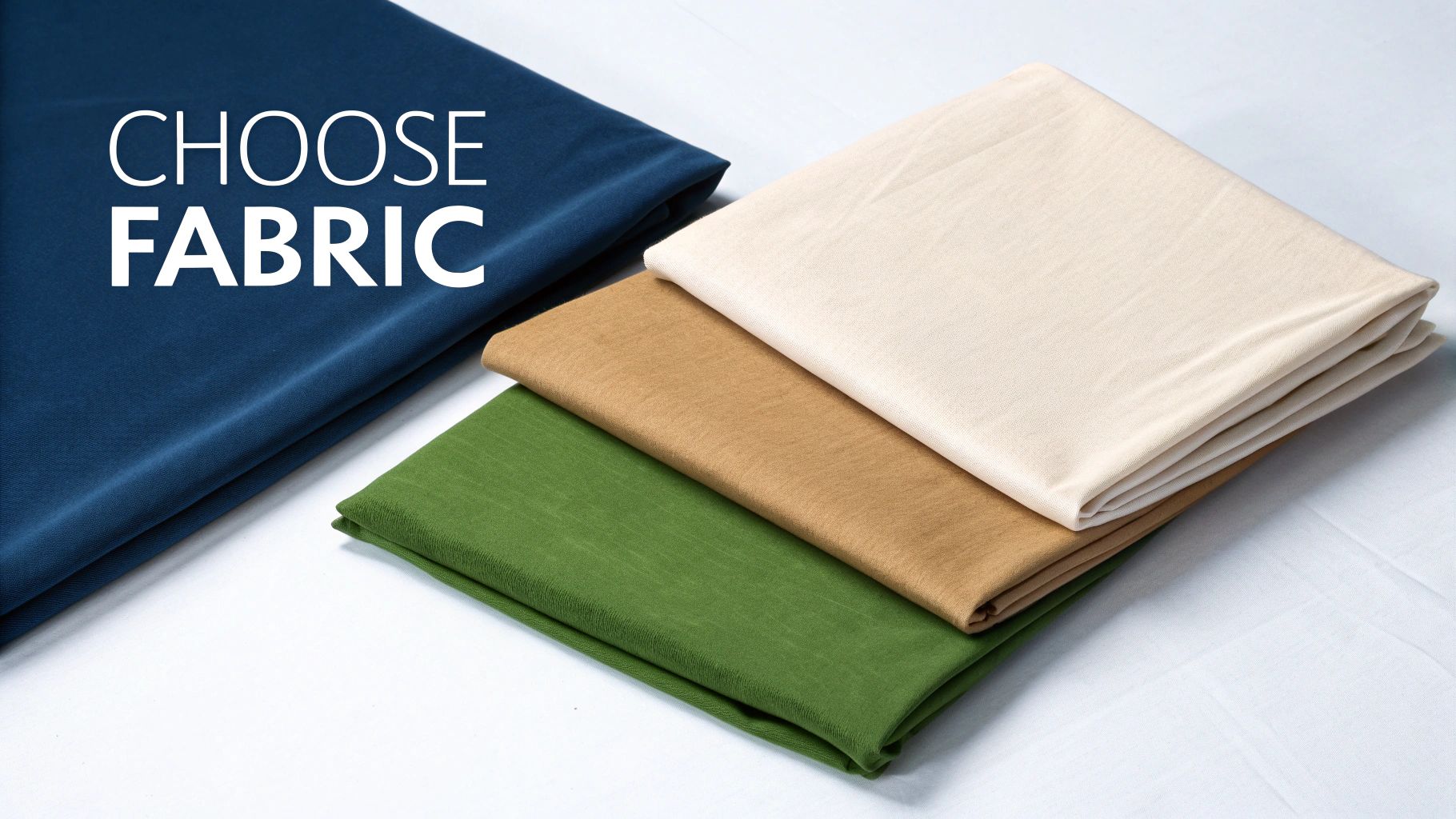
The material of your photography background cloth is a critical choice that directly impacts how customers perceive your products. The right fabric can make your colors pop and textures feel tangible, while the wrong one can create distracting glare or make your brand look amateur.
Think of it this way: a delicate necklace appears more precious against soft, light-absorbing velvet. Rugged hiking boots look ready for adventure on a textured canvas. Your backdrop sets the mood before a shopper even focuses on the product itself.
A Practical Comparison of Backdrop Materials
Let’s walk through the most common materials available. Each has unique strengths, and understanding them will help you make a smart investment for your Shopify store.
| Material | Best For | Pros | Cons | Price Range |
|---|---|---|---|---|
| Muslin | Apparel, portraits, soft goods | Lightweight, non-reflective, drapes beautifully | Wrinkles easily, can be thin | $25 – $70 |
| Canvas | High-end goods, furniture, food | Highly durable, paintable, rich texture | Heavy, stiff, can be expensive | $60 – $200+ |
| Polyester | Electronics, cosmetics, anything needing a clean look | Wrinkle-resistant, durable, easy to clean | Can have a slight sheen if not lit properly | $20 – $60 |
| Velvet | Jewelry, watches, luxury items | Deeply non-reflective, adds instant opulence | Attracts dust/lint, can be delicate | $40 – $150 |
Example in action: A dropshipper selling high-tech gadgets would benefit from a wrinkle-resistant polyester cloth for a clean, modern look that requires minimal setup time. Meanwhile, a fashion entrepreneur selling bespoke silk scarves should invest in a velvet or muslin backdrop to convey luxury and quality.
The demand for high-quality visuals has caused the photography props market to skyrocket, with over 200 million units of props produced annually. Fabric backdrops are a huge part of this trend. If you’re curious, you can explore the full report on the photography props market to see what’s driving the industry in 2025.
Selecting the Right Size for Your Space: An Actionable Guide
Once you’ve chosen a material, the next step is size. This decision comes down to what you sell and how much space you have.
Pro Tip: When in doubt, go bigger. It’s always easier to crop an image or have extra fabric to work with than to digitally fix a background that’s too small. A poorly extended background is a clear sign of an amateur photo.
Here’s how to choose the right size:
For Small Products (Jewelry, Cosmetics, Accessories): A tabletop size of 5 x 7 feet is perfect. It provides ample room for creative flat lays and detailed close-ups without taking over your workspace.
For Medium Products (Handbags, Shoes, Apparel on Mannequins): Step up to 6 x 9 feet for more flexibility. This size is large enough to cover the floor and sweep up into a seamless curve behind a mannequin, creating the classic “infinity” look.
For Full-Body Model Shots (Fashion, Apparel): Don’t compromise here. You’ll need a 10 x 20 feet backdrop at a minimum. This ensures you have enough fabric to cover the entire frame from head to toe, giving your models freedom to pose without you worrying about the background edges showing.
How to Create a Flawless Backdrop Setup
You’ve chosen your photography background cloth. Now comes the critical part: the setup. How you hang and prepare your backdrop is what separates an amateur snapshot from a professional, studio-quality image that drives sales. Your goal is to create a perfectly smooth, seamless surface that makes your product the undeniable hero.
Even on a tight budget, a flawless setup is achievable. You don’t need a massive studio—just a reliable way to hang your backdrop and pull it taut. This is the secret to eliminating distracting wrinkles and folds, giving your products the polished, high-end look they deserve.
Step 1: Build Your Support System
The foundation of a great product shot is a sturdy support system for your backdrop. While a dedicated stand is the professional standard, you can get creative, especially when you’re starting your business in 2025.
- Professional Stand: This is your best long-term investment. A good kit includes two adjustable stands and a crossbar, offering stability and flexibility. They are portable and make on-the-fly adjustments easy.
- DIY Solution: On a budget? A trip to the hardware store is all you need. You can build a support system with two sturdy light stands and a PVC pipe or wooden dowel. For a permanent setup, strong, removable wall hooks can be used to clamp the backdrop directly against a wall.
Whatever method you choose, the objective is the same: ensure the fabric is held taut without sagging in the middle.
A sagging or wrinkled background is one of the fastest ways to signal “amateur” to a potential customer. Investing a small amount of time to get this right pays huge dividends in brand perception and trust.
Step 2: Achieve the Perfect Smooth Surface
Wrinkles are the enemy of professional product photography. They cast tiny shadows and create lines that pull the eye away from your product, cheapening the overall image. Getting rid of them is non-negotiable.
Here’s the actionable process:
- Hang your backdrop: Secure it on your stand or support system.
- Use a garment steamer: This is your most valuable tool. Working from top to bottom, the steam will relax the fabric fibers and release creases. This works wonders on both muslin and polyester.
- Stretch and clamp: For a final, professional touch, use A-clamps (spring clamps) to pull the sides of the cloth taut against the stand’s vertical poles. This adds tension to eliminate any remaining ripples and keeps the backdrop perfectly flat.
This simple two-step process—steam, then stretch—is the most reliable way to create that coveted seamless “infinity cove” look that makes products pop. It’s a small effort that delivers a massive visual upgrade.
Mastering Light to Make Your Products Shine
Your photography background cloth and your lighting are a team; one can’t succeed without the other. Mastering your lighting is how you transform a good product photo into a great one—the kind that creates depth and dimension, making customers stop scrolling and pay attention.
Think of light as a sculptor’s chisel. It carves out the shape of your product, highlights its best features, and sets the mood. Get it right, and your products will leap off the screen. Get it wrong, and you’re left with flat, unappealing images plagued by harsh shadows and distracting glare.
The Power of Three-Point Lighting: A Simple How-To
One of the most effective techniques for eCommerce photography is three-point lighting. It sounds technical, but the concept is simple and delivers incredible results. Here’s how to do it:
- Key Light: This is your main, brightest light source. Place it to one side of your product (at about a 45-degree angle) to create shape and define its form.
- Fill Light: Positioned on the opposite side, this light is softer and less intense. Its job is to “fill in” the dark shadows created by the key light, revealing details that would otherwise be lost.
- Back Light: Placed behind your product and pointing toward it, this light is your secret weapon. It separates your item from the background, creating a subtle halo that adds depth and prevents it from looking like a flat cutout.
This classic setup gives you complete control to sculpt your product with light. You can achieve this with professional studio lights, but affordable LED panels work just as well. Once you understand these principles, you can use any light source more effectively, even natural window light.
The goal is to illuminate your product and your background independently. A common mistake is blasting everything with light from the front, which flattens the scene. By lighting your backdrop separately, you create a sense of space that makes your product the clear hero.
The infographic below shows the simple steps to prep your backdrop before you even think about lighting.
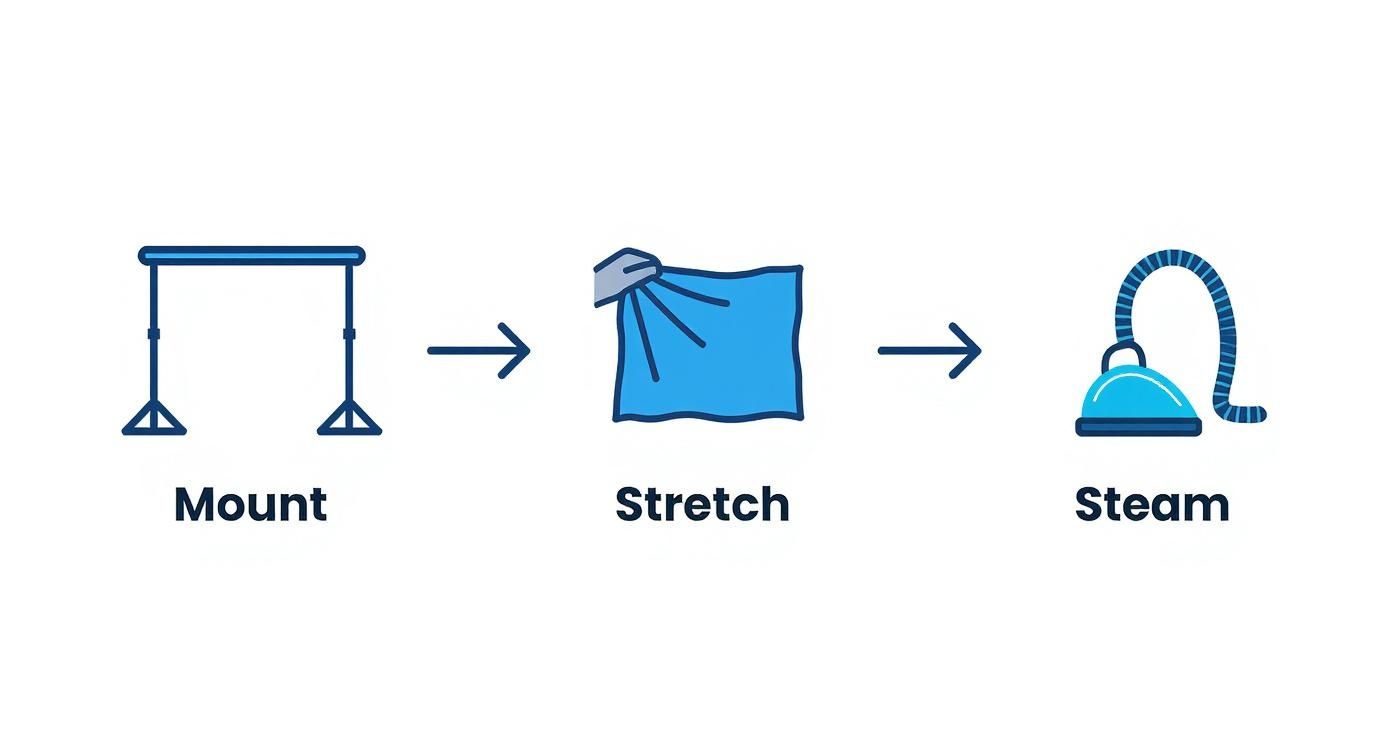
This mount, stretch, and steam process is the foundation for a professional shot. It ensures your light falls on a perfectly smooth surface, which makes all the difference. The global photography services market was valued at $55.6 billion in 2023 and is projected to hit $81.83 billion by 2032, showing just how vital high-quality images are for brands in 2025.
Even small lighting adjustments can have a huge impact, so experiment! For more hands-on guidance, check out our tips for selling clothes online.
Unlocking AI and Post-Production Potential
Think of your photography background cloth as the clean canvas your digital tools need to perform their magic. A smooth, evenly lit backdrop is the secret ingredient that makes post-production faster, easier, and more powerful. It’s the difference between effortless editing and hours of frustrating work.
When your backdrop is free of wrinkles and shadows, tasks like background removal become nearly instant. Your software can easily identify the uniform color and perfectly isolate your product with a single click. This saves a staggering amount of time, especially when processing hundreds of photos for your Shopify store.
Fueling the AI Revolution in eCommerce for 2025
The real game-changer in 2025 is how a clean backdrop prepares your images for artificial intelligence. AI tools are no longer a novelty; they are a competitive advantage for eCommerce brands. But here’s the catch: these powerful tools require clean, simple input to deliver incredible results. A consistent, professional background provides exactly that. It acts as a green screen for your products, giving the AI a perfect starting point.
For an AI, a busy or inconsistent background is just noise. By providing a clean slate, you’re telling the algorithm, “Ignore everything else and focus only on the product.” This leads to cleaner, more accurate, and more believable results.
This is especially crucial for fashion entrepreneurs. When you photograph a model against a clean cloth and remove the background, you create a perfect digital asset. That asset can then be used in countless ways to market your products.
The Foundation for Virtual Try-On and AI Models
This is where your initial effort pays off exponentially. A clean digital asset unlocks next-level customer experiences that were once reserved for major retailers. For apparel stores, the benefits are immediate and powerful:
- Virtual Try-On: A perfectly isolated product image allows technologies like Icona to map a garment onto a customer’s photo with stunning realism. The AI can accurately find the product’s edges and drape it naturally—a feat that’s impossible with a cluttered background. This directly helps reduce returns and improve the shopping experience.
- AI-Generated Lifestyle Shoots: Forget booking expensive photoshoots. You can take your isolated product and place it into any AI-generated scene imaginable, creating an endless supply of on-brand lifestyle images for a fraction of the cost and time.
For dropshippers and Shopify store owners looking to get ahead, mastering the physical backdrop is the first step to winning in the digital arena. Starting with a flawless photography background cloth prepares your brand for the powerful tools shaping the future of online retail. A great next step is to see how an AI fashion model can generate incredible on-model imagery from your product photos.
Your Top Photography Backdrop Questions, Answered
Starting with product photography can bring up a few questions. Here are straightforward answers to common queries from Shopify merchants, so you can start shooting with confidence.
What’s the Best Background Color for My Products?
For eCommerce beginners, a neutral color is your safest and most effective bet.
Pure white is the industry standard for a reason. It creates a clean, distraction-free canvas that makes your product the hero. It’s also a requirement for selling on major marketplaces like Amazon.
A light grey is another excellent choice. It offers a slightly more modern, sophisticated feel and can make colorful products pop. Sometimes pure white can cause glare, and light grey is a great way to avoid that while maintaining a professional look. Stick with a neutral, and you’ll have a versatile setup that works for nearly any product.
How Do I Get Wrinkles Out of My Fabric Backdrop?
Nothing signals “amateur” faster than a wrinkled backdrop. A smooth background is essential, and the best tool for the job is a handheld garment steamer.
Actionable Step: Hang your backdrop on its stand and steam it from top to bottom. It’s quick, easy, and removes most creases in minutes. For very stubborn folds, you can use an iron on a low heat setting, but always test it on a small corner first to avoid damaging the fabric.
The best way to fight wrinkles is to prevent them. When you’re done shooting, roll your backdrop carefully around a cardboard tube instead of folding it. This simple habit will save you a ton of time and frustration.
Can I Just Use a Bedsheet for a Backdrop?
While tempting for a quick DIY solution, using a bedsheet is a bad idea. Bedsheets are typically too thin, slightly transparent, and hold onto wrinkles tenaciously. You’ll spend far more time trying to fix the image in post-production than you would setting up a proper backdrop.
Even worse, most bedsheets have a subtle sheen that creates hotspots and ugly glare under lights. Investing in a proper, non-reflective material like muslin or polyester will pay for itself many times over in saved editing time and will give your Shopify store the polished, professional look it needs to succeed.
By mastering your photography background, you’re not just taking better pictures—you’re building a stronger brand and creating assets that can fuel next-generation shopping experiences. Ready to take those crisp product shots to the next level? Try Icona’s virtual try-on to boost your conversions.
Explore Icona and see how it works
SEO Meta Description:
Discover how to choose and use a photography background cloth to create stunning product photos that boost sales. This 2025 guide for Shopify stores covers materials, lighting, and setup.
Featured Image Idea:
A split-screen image. The left side shows a cluttered, unprofessional product photo taken at home. The right side shows the same product looking polished and premium against a smooth, grey photography background cloth with perfect lighting.