
Ready to turn your passion for fashion into a thriving online business? Fantastic. You’ve got the vision, and this guide has the roadmap. Building a successful clothing brand from the ground up comes down to three key pillars: nailing your brand identity, picking the right business model, and getting your legal setup squared away. Get these right, and you’re not just starting a store—you’re building an empire.
Your Blueprint for a Thriving Online Clothing Brand
Selling clothes online isn’t a niche hobby anymore; it’s a dominant force in retail. The global apparel market is on track to hit a mind-boggling $1.84 trillion in revenue in 2025, with almost half of all fashion sales happening online.
That’s a fundamental shift in how people shop, and it’s a massive opportunity for you. If you want to understand just how big this is, digging into the latest online clothing shopping statistics is a real eye-opener. This guide cuts through the noise and gives you the actionable steps to launch your brand and claim your piece of the pie.
Let’s get past the “what if” and dive right into the “how-to.”
1. Carve Out Your Brand Identity
Before you touch a single fabric swatch, you need a story. Your brand identity is the soul of your business. It’s the reason a customer will choose your hoodie over the ten thousand others out there. This goes way beyond a cool logo—it’s about defining who you are, what you stand for, and who you’re speaking to.
To get there, ask yourself these critical questions:
- Who is your ideal customer? Don’t just say “women aged 20-30.” Get specific. Are they eco-conscious minimalists living in urban apartments? Are they streetwear fanatics who line up for the latest drops? Or are they busy parents looking for durable, stylish kids’ clothes? The more you know them, the better you can serve them.
- What problem are you solving? Maybe you’re creating truly inclusive sizing that big brands ignore. Perhaps you’re using innovative, sustainable materials. Or maybe you’re crafting designs for a passionate subculture that nobody else is serving. Your “why” is your competitive edge.
- What’s your brand’s personality? Is it irreverent and loud? Quietly confident and sophisticated? Rugged and built for adventure?
Your answers will become your compass, guiding everything from your website’s color palette to the tone of your Instagram captions. When you’re consistent, you build brand recognition and, more importantly, customer loyalty.
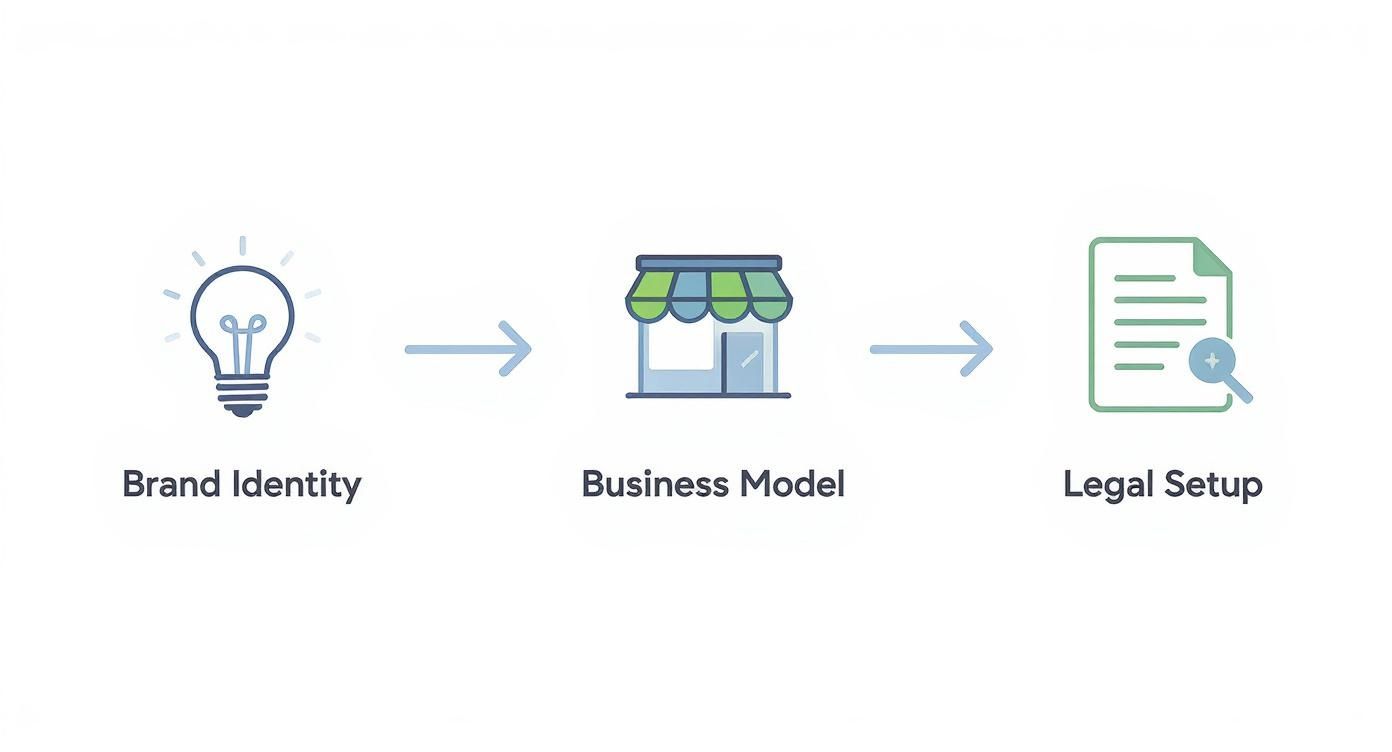
This process flows in one direction. You need that strong brand concept firmly in place before you can meaningfully choose a business model or tackle the legal paperwork.
2. Choose Your Business Model Wisely
How you make and sell your clothing will dictate your startup costs, daily operations, and how fast you can grow. There isn’t a single “right” answer here—just the one that’s right for your vision, budget, and risk tolerance.
To help you decide, let’s break down the most popular paths for new Shopify merchants.
Choosing Your Online Clothing Business Model
| Business Model | Upfront Cost | Inventory Management | Best For |
|---|---|---|---|
| Print-on-Demand (POD) | Very Low | None—handled by a third party. You pay per order. | Artists, designers, and influencers testing new ideas with zero inventory risk. |
| Dropshipping | Low | None—you’re a curator. A supplier handles stock and shipping. | Entrepreneurs who are great at marketing and want to offer a wide variety of styles without buying stock. |
| Private Label/White Label | Medium | You buy and manage bulk inventory from a manufacturer. | Brands wanting to sell proven products with their own branding, but without designing from scratch. |
| Design & Manufacture | High | Full control. You manage everything from production runs to warehousing. | Visionary founders who want complete creative control, unique products, and the highest profit margins. |
Each of these models has its pros and cons, but the key is to be realistic about your resources. Many incredible brands started with a simple print-on-demand or dropshipping setup to test the waters and build an audience before leveling up.
Your action step: Don’t feel pressured to start big. Many successful brands begin with a print-on-demand model to build an audience, then reinvest those profits into creating their own custom collection down the line.
3. Handle the Essential Legal Setup
Alright, let’s tackle the less glamorous but absolutely non-negotiable part: setting up your business correctly. This is what separates a hobby from a legitimate business that’s built to last.
Taking care of the legal stuff from day one protects you personally and builds a solid foundation for growth. This means choosing a business structure (like a sole proprietorship or an LLC), registering your business name, and securing any permits or licenses required in your city and state.
It might seem tedious, but getting these details sorted out now will save you from massive headaches and potential legal trouble later on. Think of it as laying the groundwork for the fashion empire you’re about to build.
Bringing Your Digital Boutique to Life with Shopify
Think of your Shopify store as more than just a website. It’s your digital storefront, the curated home for your brand, and the engine that will ultimately drive every sale. This is the moment your brand vision transforms into a real, professional online space where people feel confident and excited to shop.
Getting this part right is absolutely critical. A clunky, confusing, or amateur-looking store will send potential customers running. On the other hand, a beautiful, intuitive, and fast-loading site builds instant credibility and guides shoppers smoothly from their first glance to the final click of the “buy” button.
Choosing Your Shopify Theme
Your Shopify theme is the visual blueprint for your entire store. It sets the tone, dictates the layout, and defines your customer experience. It’s easy to get distracted by a flashy design, but you have to put yourself in your customer’s shoes. Can they easily find what they’re looking for? Does the site load in a snap, especially on a phone? Most importantly, does it make your product photos look incredible?
For any clothing brand, visuals are everything. You need a theme that puts your high-quality imagery front and center and includes features designed for fashion. Look for things like:
- Quick View: This lets customers peek at product details without ever leaving the main collection page. It’s a game-changer for smooth browsing.
- Image Zoom: Shoppers want to see the texture of the fabric and the quality of the stitching. High-resolution zoom is non-negotiable.
- Mega Menus: If you have a lot of products, these are perfect for organizing your collections by style, season, or clothing type, preventing customer overwhelm.
Themes like Broadcast, Pipeline, or Colorblock are fantastic starting points. They were built with fashion brands in mind and provide that clean, modern aesthetic that lets your apparel do the talking.
Your theme isn’t just about looking good; it’s a powerful conversion tool. One study found that 38% of people will simply leave a website if the layout is unattractive. You need a theme that’s the perfect marriage of beauty and brains.
Customizing Your Store for a Seamless Experience
Once you’ve landed on a theme, it’s time to make it your own. This is where you inject your brand’s unique personality into every pixel. It’s about more than just uploading your logo—it’s about crafting an effortless and enjoyable shopping journey for your customers.
Begin by building out the essential pages every customer instinctively looks for. These pages build trust and answer questions before a shopper even has to ask.
- About Us Page: This is your chance to tell your story! What’s your mission? Why did you start this clothing line? A compelling story creates an emotional hook that can turn a casual browser into a loyal fan.
- Contact Page: Make it ridiculously easy for people to reach you. A simple contact form, a clear email address, and prominent links to your social media accounts are a must.
- FAQ Page: Get ahead of the curve by answering all the common questions about shipping, returns, sizing, and garment care. This not only saves you time on customer service emails but also removes any hesitation a customer might have before buying.
Nailing the Checkout: Payments and Shipping
This is the operational backbone of your store, and there’s no room for error. A frustrating checkout experience is the number one killer of sales and the leading cause of abandoned carts. Your mission is to make paying for and receiving your products an absolute breeze.
Shopify Payments is the simplest way to hit the ground running, letting you accept all major credit cards right out of the box. You should also consider adding other popular options like PayPal, Apple Pay, and “buy now, pay later” services like Shop Pay Installments, which can give your conversion rates a serious lift.
When it comes to shipping, start by defining your shipping zones—the countries or regions you’ll be delivering to. An app like Shopify Shipping is a lifesaver, giving you access to discounted rates from major carriers and letting you print labels right from your dashboard. At checkout, keep it simple. Offer clear options like Standard Shipping and Express Shipping so customers know exactly what they’re getting and when to expect it. That transparency is the bedrock of the trust you need to close the sale.
Creating Product Visuals That Actually Sell
In online fashion, your photos do all the talking. They are your storefront. Since shoppers can’t feel the fabric or see the drape in person, your product visuals have to build that bridge. High-quality imagery isn’t just a nice-to-have; it’s the single most powerful tool you have for turning a curious browser into a confident buyer.
Think of this as your masterclass in creating visuals that make your apparel fly off the digital shelves.
The opportunity here is massive. The global apparel e-commerce market was valued at $779.3 billion in 2025 and is on track to hit a staggering $1.706 trillion by 2034. And with mobile commerce projected to make up 46% of all online sales in 2025, your visuals need to look incredible on every screen. This isn’t just about pretty pictures; it’s about creating an experience that builds trust and drives action. You can dig into more apparel e-commerce revenue statistics on bestcolorfulsocks.com to see just how big this wave is.
Start with High-Quality Product Photography
Before you even think about creative angles, you have to nail the fundamentals. Crisp, clean product photos are non-negotiable. These are the workhorses of your product pages, showing customers exactly what they’re getting.
Every single item in your store needs these three essential shots:
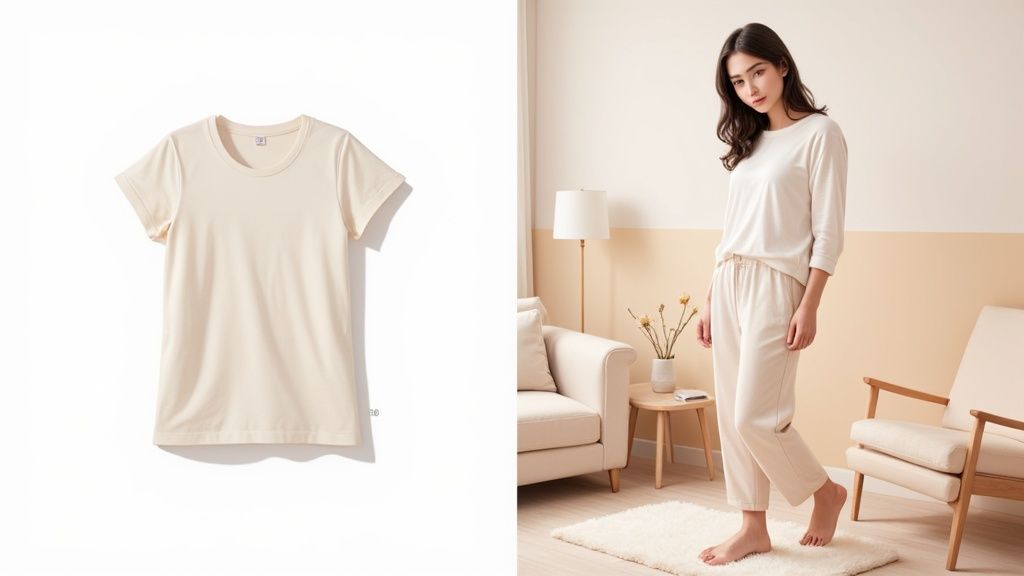
- The Studio Shot: This is your hero image—clean, clear, and set against a simple white or light gray background. It’s all about the product, with zero distractions.
- The Detail Shot: Get up close and personal. Show off the texture of the fabric, the quality of the stitching, or a unique button. These shots scream quality and craftsmanship.
- The On-Model Shot: This is an absolute must for clothing. Seeing a garment on a real person is the only way for customers to truly understand its fit, drape, and scale. A flat-lay just can’t compete.
Your action step: You don’t need a pro studio to get pro results. A modern smartphone, a simple backdrop (like a white wall), and good natural light from a window can work wonders. The real secret is consistency. Use the same lighting and background for all your main product photos to give your entire store a polished, cohesive look.
Tell a Story with Lifestyle Photography
If studio shots inform, lifestyle photos inspire. This is where your brand’s personality comes to life. Lifestyle photography helps shoppers see themselves wearing your clothes in their own lives, transforming a simple t-shirt into a coveted part of a whole vibe.
Put yourself in your ideal customer’s shoes. Where do they hang out? What do they love to do? A brand selling breezy linen dresses would feel right at home with a shoot at a sunny beach or a local farmer’s market. An urban streetwear line, on the other hand, would thrive against a backdrop of graffiti-covered walls and dynamic cityscapes. These are the images that will light up your homepage, social media feeds, and email campaigns.
The Rise of AI in Product Imagery
Not long ago, getting professional-looking on-model photos meant shelling out big bucks for photoshoots and models. That’s not the only game in town anymore. AI is completely changing the landscape, especially for new brands working with a tight budget.
With modern tools, you can now generate incredibly realistic on-model images without ever stepping foot in a studio. This approach can save you thousands of dollars and countless hours, giving you the power to create a diverse and compelling set of visuals in a fraction of the time.
Curious about how it works? Our complete guide on AI product photography shows you exactly how to create stunning, professional-grade images with just a few clicks.
Boost Conversions with Virtual Try-On
Let’s be honest: the biggest headache in online fashion is that shoppers can’t try things on. That “I wonder how this will actually look on me” moment is where most sales are lost. It fuels cart abandonment and, even worse, expensive returns.
This is where virtual try-on technology becomes your secret weapon.
Apps like TryIcona plug right into your Shopify product pages, letting customers see how an item might look on a model that reflects their own body type. Just like TryIcona helps customers visualize products before purchase, popups help them take the next step. This one feature can have a huge impact on a buyer’s confidence, pushing them to click “add to cart” and drastically reducing your return rate.
By blending crisp product shots, inspiring lifestyle photos, and smart tools like AI and virtual try-on, you build a visual experience that does more than just show off your clothes—it builds the trust you need to make the sale. Your images stop being just pictures; they become your most effective salespeople.
Designing Product Pages That Convert
Think of your product page as your best salesperson. It’s working 24/7 to turn a casual browser into a loyal customer. This is the moment a shopper’s curiosity tips over into a real desire to buy. You need to move beyond just listing specs and start crafting an experience that makes them feel excited and, most importantly, confident.
Your mission is to anticipate every question and squash every hesitation before it can form. A killer product page is a masterful blend of compelling storytelling, crystal-clear information, and undeniable proof that you’re the real deal. It’s all about guiding your shopper smoothly to that “Add to Cart” button.
Write Product Descriptions That Resonate
A product description is not a spec sheet. It’s a conversation. You need to use vivid, sensory language that helps your customer feel the fabric and picture themselves in the outfit.
Don’t just say, “Made from 100% cotton.”
Try this instead: “Crafted from impossibly soft, breathable 100% cotton that feels like a dream against your skin.” See the difference? One sells a material; the other sells an experience.
A structure that consistently works well includes:
- A Killer Hook: Start with a sentence that grabs them and speaks directly to what they want.
- A Little Storytelling: Paint a picture. Is this the perfect dress for a sun-drenched summer wedding? The go-to hoodie for a lazy Sunday?
- Scannable Key Details: Use bullet points for the nitty-gritty stuff—material, fit, and care instructions. This makes the practical info easy to digest.
This one-two punch of emotional appeal and practical information is incredibly effective. For a deeper dive, our complete guide on Shopify product page customization has even more advanced strategies to build pages that truly perform.
Nail Your Pricing Strategy
Pricing your clothes can feel like walking a tightrope. Go too low, and you cheapen your brand and kill your profit margins. Go too high, and you might send potential customers running. The right price reflects the quality of your materials, the uniqueness of your designs, and the overall value your brand brings to the table.
First, calculate your Cost of Goods Sold (COGS). This isn’t just the fabric; it’s the manufacturing, shipping to your warehouse, and any special packaging. Once you have that number, you can set a retail price that gives you a healthy profit. Aim for a 50-70% margin—this will cover marketing, overhead, and paying yourself.
Don’t be afraid to experiment with your prices. Sometimes a slightly higher price can actually increase how much people value your products.
Build Unshakeable Trust and Social Proof
When you sell clothing online, trust is your most valuable asset. Customers can’t touch the fabric or try on the fit, so they’re relying completely on you to be their eyes and ears. This is your chance to eliminate every ounce of doubt.
A Baymard Institute study found that 18% of shoppers abandoned a cart simply because they didn’t trust the site with their credit card info. Every single element on your page needs to be a trust-builder.
Here’s how you can build that rock-solid confidence right on your product page:
- Crystal-Clear Sizing Guides: A generic chart isn’t enough. Add specific model measurements (“Our model is 5’9″ and wears a size Medium”) and fit notes (“Runs true to size” or “Size up for a more relaxed fit”). This is your single best weapon against returns.
- An Easy-to-Find Return Policy: Don’t bury it. Link to your return policy from every product page and make it ridiculously simple. A customer who knows they can make a hassle-free return is far more likely to take a chance on you.
- Customer Reviews and Photos: Social proof is a powerhouse. Seeing real people wearing and loving your clothes is more persuasive than anything you could write. Use an app like Loox or Judge.me to automatically gather and display photo reviews. Highlighting this user-generated content can boost conversion rates by up to 90%.
By transforming your product pages from simple listings into high-performance assets, you’re not just selling clothes—you’re building a brand that customers trust, love, and keep coming back to.
How to Sell Clothing Online by Marketing Your Brand Effectively
You’ve built a stunning digital boutique with incredible product pages. Now, it’s time to swing open the doors and invite your ideal customers inside. A great product doesn’t sell itself; you need a smart, targeted marketing plan to build buzz and drive consistent traffic. This is the moment you transform from a store owner into a brand builder.

The opportunity in front of you is massive. The global online fashion retail market is on track to hit $1.08 trillion in 2025 and keep climbing. With so many stores vying for attention, standing out requires marketing that truly connects with your shoppers. For more details on this growth, you can check out these global fashion retail trends on marketresearch.com.
If you’re just starting out, it’s easy to feel overwhelmed. Where should you even begin? Focusing on a few key channels done well is far more effective than spreading yourself too thin.
Here’s a look at the most effective marketing channels that pack a punch for new fashion brands.
Beginner-Friendly Marketing Channels for Fashion Brands
| Marketing Channel | Primary Focus | Your First Action Step |
|---|---|---|
| Social Media | Brand building, community engagement, and visual storytelling. | Choose one visual platform (like Instagram or TikTok) and consistently post high-quality lifestyle content, not just product shots. |
| SEO | Attracting long-term, high-intent organic traffic from search engines. | Optimize your product titles and descriptions with keywords that real shoppers would use to find your items. |
| Email Marketing | Nurturing customer relationships and driving repeat purchases. | Set up a “welcome” email automation for new subscribers that introduces your brand and offers a small incentive. |
Each of these channels plays a unique role, and when they work together, the results are incredible. Let’s dig into how to make each one work for your brand.
Master Social Media for Fashion
For a clothing brand, social media is your runway, your community hub, and your sales floor all rolled into one. Platforms like Instagram and TikTok are visual playgrounds, making them the perfect place to show off your apparel and build a tribe of loyal fans.
Your goal is to create a lifestyle around your brand, not just post product shots.
- Showcase User-Generated Content (UGC): When customers tag you in photos wearing your clothes, feature them! This is the most authentic social proof you can get.
- Collaborate with Influencers: Partner with micro-influencers whose personal style genuinely aligns with your brand’s vibe. Their endorsement often feels more like a recommendation from a trusted friend.
- Run Targeted Ads: Use Meta’s ad platform to reach users based on their interests and online shopping habits. You can create dynamic ads that show people items they’ve already viewed on your site—a gentle nudge that is incredibly effective.
Climb the Ranks with SEO for Fashion
While social media delivers instant engagement, Search Engine Optimization (SEO) is your long game. This is how you attract customers who are actively looking to buy. When someone searches for a “black linen midi dress” on Google, you want your product to be one of the first things they see. That’s the magic of SEO.
Start with the basics. Focus on writing product titles and descriptions that include the keywords your ideal customer is actually using. Put yourself in their shoes: what words would they type into that search bar?
SEO is a marathon, not a sprint. Consistently optimizing your pages and creating relevant blog content will build your authority over time, leading to a steady stream of free, high-intent traffic.
Creating blog content like “5 Ways to Style a Classic White Tee” or “The Best Jackets for Fall 2025,” can also draw in new audiences, where you can naturally link back to your own products.
Build Loyalty with Email Marketing
Your email list is one of the most valuable assets your business will ever own. Unlike social media followers, you own your email list. It’s a direct line to your most engaged customers, completely free from the whims of unpredictable algorithms.
Your email strategy should be all about building relationships.
- The Welcome Series: When someone new subscribes, create an automated three-part series that introduces your brand story, showcases your bestsellers, and offers a small discount on their first purchase as a thank you.
- Exclusive Offers & Early Access: Make your subscribers feel like VIPs. Give them early access to new collections or exclusive discounts. This simple act builds incredible loyalty.
- Abandoned Cart Reminders: This is a must. Set up an automated email that goes out to shoppers who add items to their cart but don’t finish checking out. A friendly reminder can recover a huge percentage of otherwise lost sales.
Understanding these channels is the first step, but seeing how they work together is the real key. You can explore how each piece fits into the bigger picture in our guide to the eCommerce marketing funnel, which maps out the complete customer journey. By combining the appeal of social media, the power of SEO, and the personal touch of email, you’ll create a marketing engine that fuels your brand’s growth for years to come.
Your Top Questions About Selling Clothes Online, Answered
Jumping into the world of online fashion is a huge thrill, but it can also bring up a lot of questions. Think of this as a quick chat with a mentor who’s been there. We’ll cut through the noise and get you the clear, straightforward answers you need to move forward with confidence.
How much money do I actually need to start?
The honest answer is: it completely depends on your business model.
You could get a print-on-demand or dropshipping store off the ground with just a few hundred dollars. That’ll cover your Shopify plan and a small marketing budget. It’s the perfect low-risk way to test your ideas and see what resonates with customers.
On the other hand, if you’re dreaming of designing your own collection from scratch, you’ll need a bigger budget. Costs can easily run into the thousands once you factor in buying inventory, product design, and professional photography. The key is to map out a realistic budget before you spend a dime.
What clothing niches are profitable in 2025?
Profitability isn’t about a specific product; it’s about finding your people—a dedicated audience that’s hungry for what you have to offer.
While staples like graphic tees and leggings are always in demand, they’re also incredibly crowded markets. The real magic often happens in niches where you can become the go-to brand.
Consider communities built around:
- Sustainable and eco-conscious apparel
- Adaptive clothing designed for people with disabilities
- Carefully curated vintage or retro fashion finds
These aren’t just product categories; they’re communities with passionate, loyal customers.
Your action step: Use a free tool like Google Trends to see what people are actually searching for. Your mission isn’t just to sell a t-shirt; it’s to spot a gap in the market that only your brand can fill.
This research lets you validate your gut feelings with real data before you invest in a single piece of inventory.
How do I handle shipping and returns?
Nailing your shipping and returns process is non-negotiable. It’s one of the biggest trust signals you can send to a new customer. For shipping, start by integrating an app like Shopify Shipping. It’s a game-changer, giving you instant access to discounted rates and letting you offer clear choices like standard or express shipping right at checkout.
When it comes to returns, your policy needs to be simple and fair. A 30-day return window is standard and what most online shoppers expect. Decide from the get-go whether you’ll offer full refunds, exchanges, or store credit, and make it crystal clear on your site.
Remember, a seamless return experience can transform a one-time buyer into a lifelong fan. It shows them they can shop with you risk-free, and that kind of confidence is priceless.
Ready to give your customers that ultimate shopping confidence? Icona adds a virtual try-on button to your Shopify store, letting shoppers see how your clothes look on their own bodies. It’s the game-changing tool that boosts conversions and slashes return rates.