
We’ve all been there. You launch a new collection you’re obsessed with, and… crickets. Or a bestseller suddenly starts getting returned more often. It feels like you’re trying to navigate in the dark.
But what if the map to better decisions was right there, held by the very people you’re trying to serve? This is where modern, thoughtful customer feedback forms become your superpower. They’re not just about satisfaction scores; they’re your direct line to understanding why your customers do what they do, uncovering truths that raw data will always miss.
Why Feedback Is Your Most Valuable Asset in 2025
Let’s get one thing straight: this isn’t about those clunky, ten-page surveys from a decade ago. In 2025, gathering feedback is all about starting smart, personal conversations at scale. Your Shopify store is packed with moments where a single, perfectly timed question can reveal a game-changing insight.

These forms aren’t just another tool; they represent a fundamental shift in how you connect with your community. They’re your secret weapon for:
- Finding hidden friction: Pinpointing those annoying little snags in the shopping journey that your analytics reports will never show you.
- Validating new ideas: Testing the waters for a new collection or feature before you sink a ton of money into it.
- Building real loyalty: When you show customers you’re actually listening, you turn casual shoppers into brand advocates.
Think of it this way: Analytics tell you what happened, but your customers tell you why. That “why” is where the magic lives. It’s the difference between guessing what works and knowing for sure.
This guide is your roadmap to asking better questions. We’re going to dive into how weaving feedback opportunities directly into the shopping journey can give you the kind of insights that truly transform your business. You’ll learn how to ask questions that uncover not just what people think, but the emotions and motivations that drive their decisions.
To make sure you’re getting the most out of every interaction, it’s worth learning how to design truly high-converting customer feedback forms that get you the data you need without annoying your customers.
Weave Feedback into the Customer Journey
The real genius of these forms comes to life when you integrate them seamlessly into your customer’s experience.
Imagine asking for a quick opinion right after someone uses a virtual try-on tool. Instead of a generic rating, you’re capturing their immediate, gut reaction to seeing your dress on their body. Some of the best insights come when you ask for feedback in context, for example after a shopper uses TryIcona to see how an item fits.
This kind of contextual feedback is pure gold. It helps you see every part of your marketing funnel through your customer’s eyes. You’re no longer just guessing; you’re having an active conversation that helps you fine-tune everything from product descriptions to your return policy based on real input. When you start treating customer voices as your most valuable asset, you stop making assumptions and start building a brand that people know is listening.
How to Ask Questions That Spark Real Insights
The difference between a generic answer and a game-changing insight always comes down to the question you ask. “Rate your experience” is easy, but it won’t tell you why a customer ditched their cart right after a virtual try-on. To get real answers, you have to ask real questions.
Forget vague queries. Your goal is to start a conversation that reveals the hidden thoughts and feelings behind every click. For apparel brands, this is everything. You’re not just selling a product; you’re selling a feeling, a fit, an entire experience. Your questions have to reflect that.

This is your guide to crafting strategic questions that feel less like a survey and more like a personal stylist genuinely asking for an opinion. It’s all about knowing what to ask—and more importantly, when to ask it.
The Power of Open vs. Closed Questions
Think of your questions as a toolkit. You’ve got different tools for different jobs, but the two most important are closed-ended (like multiple-choice or ratings) and open-ended (those inviting free-form text).
- Closed-Ended Questions: These are your scalpel—perfect for getting quick, quantifiable data. Use them to measure satisfaction, confirm a choice, or let users quickly categorize their experience. They are fast to answer and a breeze to analyze.
- Open-Ended Questions: This is your conversation starter. An open text box is an invitation to tell a story. It’s where you’ll uncover the “why”—the emotional, detailed context that raw numbers can never give you.
The real magic happens when you pair them up. Kick things off with a simple closed question for a quick response, then immediately follow up with an open-ended one to dig deeper. For instance, “Did the virtual try-on help you decide?” (Yes/No), followed by, “What could have made the experience even better?”
This simple blend gets you incredibly rich data without causing the dreaded survey fatigue. You respect their time while still making it easy for them to share what’s really on their mind.
Questions for Every Stage of the Journey
Your customer’s mindset shifts as they move through your store, so your questions need to shift right along with them. To make sure your questions are hitting the mark, it can be a huge help to review proven customer feedback survey templates to see what works.
To get you started, here’s a simple matrix to help you match your questions to the right moment in the customer journey.
Feedback Form Question Matrix for Apparel Stores
Tailor your questions to the specific customer touchpoint to gather the most relevant insights for your Shopify apparel store.
| Customer Journey Stage | Goal of Feedback | Sample Question (Multiple Choice) | Sample Question (Open-Ended) |
|---|---|---|---|
| After a Virtual Try-On | Understand fit perception and purchase confidence. | How confident do you feel about the fit after using the virtual try-on? (5-star rating: 1=Not confident, 5=Very confident) | What was the one thing you noticed about the fit that helped you make a decision? |
| On the Order Confirmation Page | Uncover the final trigger that led to a purchase. | What was the main reason you decided to buy today? (Options: The style, The virtual try-on, A special offer, A recommendation) | We’re so excited for you to get your order! What are you most looking forward to about this item? |
| Post-Delivery Follow-Up Email | Measure product quality, real-world fit, and overall satisfaction. | Now that you’ve tried it on, how did the actual fit compare to your expectation? (Options: Better than expected, As expected, Worse than expected) | How did you feel when you wore it for the first time? We’d love to hear the details! |
By asking the right questions at the right time, you’re not just collecting data; you’re building a brand that listens, adapts, and grows right alongside its community.
Finding the Perfect Moment to Ask for Feedback
Timing is everything. Ask for feedback at the wrong time, and it’s just noise—an annoying interruption. But ask at the right moment? It feels like you’re reading your customer’s mind.
The secret is to stop treating feedback as a separate, formal event. Instead, you need to weave it directly into the natural flow of the shopping experience. The goal is to make your request feel so intuitive and helpful that customers actually want to share their thoughts.
This isn’t about blasting every visitor with a generic popup the second they land on your site. It’s about spotting those small but critical moments where a customer has just formed a strong opinion and making it incredibly easy for them to voice it.
Pinpoint Your High-Impact Touchpoints
Every Shopify store has these little “golden windows” for feedback—those moments when a customer is most engaged and most likely to have something powerful to share. You just have to know where to find them.
These are the spots where a single, well-placed question can deliver a goldmine of insight:
- Right After a Virtual Try-On: This is your prime opportunity. Don’t miss it. The customer has just seen how your garment looks on their own body. A simple, non-intrusive prompt here captures that raw, unfiltered reaction to the fit, style, and their overall confidence in the item.
- On the Order Confirmation Page: They just said “yes!” The excitement is fresh, the credit card is away. This is the perfect time to hit them with a forward-looking question like, “What was the one thing that sealed the deal for you today?” Their answer might be the virtual try-on, a specific product photo, or a customer review you never realized was so impactful.
- In Your Post-Purchase Emails: Once the package lands on their doorstep, the experience shifts from digital to physical. An email a week or so later asking how the clothes actually fit and feel in the real world is crucial. This is how you find out if your virtual try-on and product descriptions are truly aligned with reality.
Think of these moments as a natural conversation. You wouldn’t interrupt a friend mid-story to ask what they think of you. You’d wait for a natural pause. Your store’s customer journey is full of these pauses—learn to use them.
Get Creative with Your Channels and Triggers
While your website is home base, your customers are interacting with your brand all over the place. By using smart triggers and creative placements, you can capture valuable feedback from every corner of your brand’s world without ever feeling pushy.
Let’s move beyond the basic email survey or the predictable on-site popup. In 2025, shoppers are surprisingly open to sharing their thoughts, but only if the process is seamless and they feel like you’re actually listening. The data backs this up: 60% of customers have posted a business review when prompted by a brand. To dig deeper, check out the full report on customer service trends from Nextiva.
This willingness opens up some really exciting new ways to connect.
Fresh Ideas for Feedback Collection
Ready to meet your customers where they are? Give these modern approaches a shot:
- Smart Behavioral Triggers: Don’t show your feedback form to everyone. Set it to appear only after a shopper takes a specific action, like viewing three dresses from the same collection or adding a second item to their cart. This shows you’re paying attention to their individual journey.
- QR Codes on Packing Slips: This is a brilliant, low-tech tactic that too many brands sleep on. A simple QR code on the packing slip can link directly to a mobile-friendly form. Ask about the unboxing experience or their first impression of the fit right out of the box.
- SMS Follow-Ups: For customers who’ve opted into your SMS list, a quick, friendly text a few days after delivery feels incredibly personal and gets fantastic response rates. Something as simple as, “Hey [Name], how are you loving the new jeans? We’d love your thoughts!” can work wonders.
By mastering the art of the perfect moment, you turn a simple feedback form into a powerful engine for building real relationships, uncovering game-changing insights, and creating a brand that people are genuinely excited to be a part of.
Making Your Feedback Work for You: A Shopify Integration Guide
Collecting feedback is one thing. But letting those golden insights sit untouched in a spreadsheet? That’s a missed opportunity. The real magic happens when you plug that customer voice directly into the tools you use to run your store every single day.
Think of it this way: your customer feedback is a live conversation. Your Shopify ecosystem is where you make all your big decisions. You need that conversation to be front and center for everyone—your marketing team, your product designers, your customer service heroes.
When your data flows freely between your tools, you can stop just reacting to issues and start getting ahead of them. This is how you build a brand that people truly feel connected to.
Choosing Your Feedback Hub
First, you need a way to build and manage your forms. The Shopify App Store is packed with great options, and the best one for you really depends on what you want to ask and how deep you want to go.
Here are a few of the most trusted players in the game:
- Shopify Forms: This is Shopify’s own tool, and it’s fantastic for getting started. It’s clean, simple, and perfect for creating on-brand email sign-up forms or basic contact pages right from your admin. No fuss, no muss.
- Typeform: If you want your forms to feel more like a friendly chat than a survey, Typeform is a beautiful choice. Its conversational style and smart “logic jumps” are perfect for guiding customers through more detailed feedback sequences without it feeling like a chore.
- Jotform: For those who need a true workhorse with near-limitless customization, Jotform is a powerhouse. It has a massive template library and can handle anything from a quick poll to a super-detailed post-purchase questionnaire.
The most important thing? Pick a tool that not only looks great but also integrates smoothly with the rest of your tech stack.
Creating a Single, Unified Customer View
Now, let’s get to the exciting part. Integrating your forms with other platforms is what transforms scattered comments into a powerful intelligence engine. You’re trying to marry the qualitative “why” from your feedback with the quantitative “what” from your analytics.
This is where you see the complete story. Imagine a customer leaves a comment about “the sleeves being shorter than expected.” By connecting your feedback tool to an analytics platform, you can see that comment right alongside their virtual try-on session for that exact product. Boom. You’ve just found a concrete, actionable insight.
This connected system becomes your single source of truth. It’s how you spot trends that would otherwise be invisible, like realizing that shoppers who use the virtual try-on and leave positive feedback are 50% more likely to become repeat customers.
To make this happen, start by focusing on these key integrations:
- Sync with Your Email & SMS Platform: Connect your form to a tool like Klaviyo. When a customer leaves feedback, you can automatically tag their profile. You could create a “Fit Confident” segment for everyone who gave a 5-star rating on fit and send them a special campaign for new arrivals.
- Connect to Your Help Desk: Hook your feedback into Gorgias or Zendesk. If a customer reports a problem, a support ticket can be created instantly. Your team can then jump on it, solve the issue, and turn a potentially negative experience into one they’ll remember for all the right reasons.
- Feed Data into Your Analytics: Most importantly, make sure your feedback data is flowing into your core analytics platforms. Seeing a customer’s comments next to their try-on data is how you finally connect the dots between how they thought something would fit and how it actually does.
Building out this connected ecosystem is a fundamental part of modern commerce, and there are many powerful eCommerce personalization tools that can help you create these kinds of seamless experiences. When your tools talk to each other, you’re not just collecting data—you’re building a smarter, more responsive business.
Turning Customer Insights into Fewer Returns
This is where it all comes together. The effort you put into gathering feedback is about to pay off—big time. The comments are rolling in, your data is synced, and now it’s time to transform those raw customer thoughts into tangible, bottom-line results for your Shopify store. Think of yourself as a detective for your own brand.
You’re hunting for patterns. You’re listening for the quiet whispers that, when grouped together, become a roar. Is one specific fabric consistently called “scratchy”? Are a dozen different shoppers saying your bestselling dress “runs small”? These aren’t just complaints; they’re a goldmine of opportunities just waiting to be dug up.
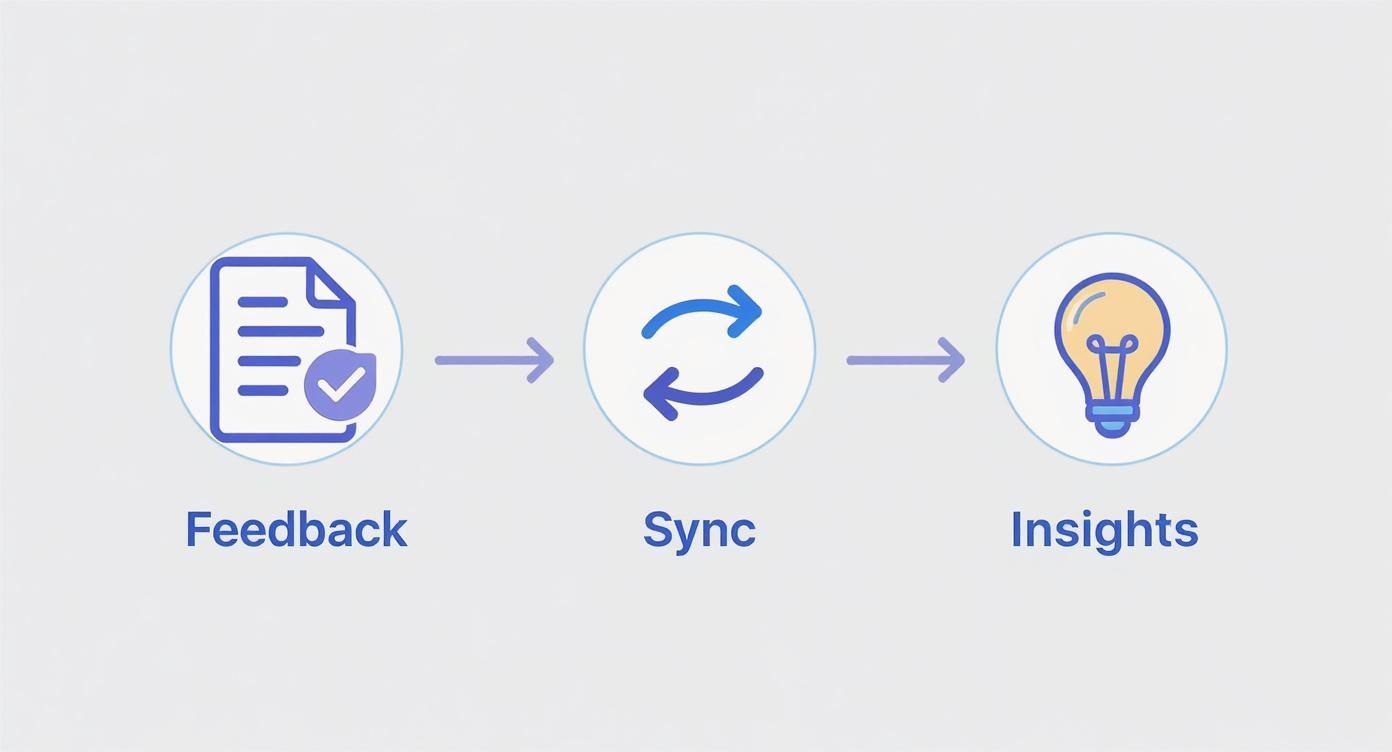
The key takeaway here is that feedback only becomes valuable once it’s synced with your other data and turned into concrete, actionable insights.
From Feedback to Actionable Fixes
Once you start spotting these recurring themes, the next step is to translate them into real-world fixes. This is where you connect the “what” (the feedback) with the “how” (the solution). It’s a simple but incredibly powerful framework that can systematically chip away at your return rates and send customer satisfaction through the roof.
Let’s walk through a few real-world scenarios you might run into:
- The Vague Product Description: You notice multiple comments saying a sweater “looked different” in person. Your action? Get hyper-specific with your product description. Instead of “soft-knit fabric,” try something like “a lightweight, breathable merino wool blend with a slightly textured, heathered finish.”
- The Sizing Surprise: Feedback consistently mentions a pair of jeans is “tighter in the thighs than expected.” Your action? This is a perfect moment to combine feedback with sizing analytics. Update your sizing chart with specific thigh measurements and add a note to the product page suggesting customers who are between sizes should size up for a more relaxed fit.
- The Color Conundrum: Customers are saying the “sky blue” top they ordered looks more like a muted gray in real life. Your action? Time to reshoot. Retake your product photos in bright, natural lighting, or use a tool to generate new, more accurate images that truly reflect the garment’s true color.
Think of every piece of feedback as a conversation with a customer who cares enough to help you get better. Your job is to listen intently and then prove you were paying attention by making a change.
From Feedback to Action: A Simple Framework
This table provides a practical guide to transforming raw customer comments into measurable business improvements that reduce returns and boost conversions.
| Feedback Theme | Potential Business Impact | Actionable Step | Success Metric |
|---|---|---|---|
| “The sizing for the ‘Poppy’ dress runs small” | High return rate for a specific product, customer frustration | Update the product page with a “Runs Small – Size Up!” note. Adjust the sizing chart with specific measurements. | 20% reduction in returns for the “Poppy” dress within 60 days |
| “Color of the ‘Ocean’ tee is not accurate” | Lower conversion, negative reviews | Reshoot product photos in natural light and update all listings. Generate new, color-accurate images. | Increase in add-to-cart rate for the “Ocean” tee |
| “Virtual try-on was great, but I was unsure” | Cart abandonment, lost sales potential | Add a small pop-up or tooltip within the VTO experience explaining how to best interpret the fit map. | 10% decrease in cart abandonment for VTO users |
| “Material felt cheaper than I expected” | Brand perception damage, high returns | Rewrite product description to better manage expectations (e.g., “lightweight synthetic blend” vs. “luxurious silk-like feel”). | Drop in negative reviews mentioning material quality |
This framework isn’t just about putting out fires; it’s about proactively building a better product and a more trustworthy brand, one piece of feedback at a time.
The Power of Closing the Loop
Now for the final step—the one most brands completely forget. It’s also the most important for building fierce, long-term loyalty. After you’ve made a change based on feedback, you must tell your customers about it. This is called “closing the loop.”
It’s your way of proving that their voice actually matters.
When you do this, you aren’t just fixing a problem; you’re building an unbreakable bond of trust. Customers who feel heard are far more likely to stick around, forgive a future mistake, and rave about you to their friends.
This has a direct impact on future sales, too. In fact, research shows that products featuring just five reviews are 270% more likely to be purchased compared to products with zero reviews. By showing you act on feedback, you encourage more of it, creating a powerful, self-sustaining cycle of social proof.
Closing the loop doesn’t have to be a huge production.
- Send a targeted email: Reach out to the specific customers who flagged the issue. A simple, “Hey, remember when you said our sizing was off on the A-line skirt? You were right. We fixed it—thanks to you!” is pure gold.
- Make a social media announcement: Post an Instagram Story or a quick update saying, “You asked, we listened! Our new and improved sizing chart is now live.”
- Update the product page: Add a small but visible note like, “Updated Fit: Based on your feedback, we’ve adjusted the fit to be true-to-size.”
By using customer insights to refine everything from your product descriptions to the accuracy of your virtual try-on technology, you create a better experience for everyone. You’re not just selling clothes anymore; you’re co-creating a brand with the people who matter most—your customers.
Your Top Questions About Customer Feedback, Answered
Jumping into customer feedback can feel like you’re about to open Pandora’s box. It’s totally normal to have questions and maybe even a little hesitation. You’re not alone.
Most Shopify store owners I chat with have the same few worries before they start. So, let’s clear the air and tackle those common questions head-on. My goal is to help you see feedback not as a chore, but as your new secret weapon.
“How Often Should I Ask for Feedback?”
This is the big one, isn’t it? The simple answer is this: only ask when you genuinely need to know something specific and important. Fight the urge to constantly poll your customers just for the sake of it.
Instead of thinking about a rigid schedule, think about key moments in the customer journey. These are the points where their opinions are the freshest and most valuable.
- Transactional Touchpoints: Pop up a quick question right after a meaningful action, like completing a purchase or, even better, using a virtual try-on.
- Relational Check-ins: Once or twice a year, send a slightly broader survey to your email list to get a pulse on your overall brand perception.
The golden rule is to respect their time. A single, perfectly timed question is a thousand times more powerful than a dozen random ones.
“What If I Get Negative Feedback?”
First things first, take a breath. Negative feedback isn’t an attack—it’s a gift. Seriously. It’s free consulting from someone who cares enough about your brand to point out what’s not working.
How you respond to criticism truly defines your brand. Don’t get defensive. Don’t sweep it under the rug. Lean into it as a chance to prove you’re actually listening.
A customer whose problem you solve can become fiercely more loyal than one who never had an issue in the first place. The goal isn’t to dodge complaints; it’s to get incredible at resolving them.
When a tough comment comes in, use it as fuel for improvement. Then, go one step further and “close the loop”—reach back out to that customer and let them know what you did with their feedback. That simple act can turn a critic into your most passionate advocate.
“How Many Questions Should My Form Have?”
Way fewer than you think. When it comes to feedback forms, brevity is your best friend. Every single question you add is another reason for someone to get frustrated and abandon the form.
For most of those “in-the-moment” surveys, stick to one to three questions, maximum. Start with a quick multiple-choice or a rating scale, and then add a single, optional open-ended question like, “Is there anything else you’d like to share?”
You’ll be blown away by the depth of insight you can get from just one or two well-worded questions. Remember, the goal isn’t to collect mountains of data; it’s to gather rich, actionable insights.
“Is This Really Worth the Effort?”
Absolutely, one hundred percent. Investing in a solid customer feedback loop isn’t just a “nice-to-have” anymore. It’s becoming a non-negotiable for brands that want to thrive. In fact, by 2025, 74% of organizations plan to increase their spending on customer experience, and a huge slice of that pie is dedicated to better feedback systems. You can read more about these expanding customer service initiatives.
Starting this today puts you way ahead of the game. You’re building a foundation of listening, learning, and adapting that will pay off for years—through fewer returns, higher conversion rates, and a loyal community of customers who feel seen and heard.
Ready to turn that shopper confidence into conversions? With Icona, you can give your customers a realistic virtual try-on that finally answers their biggest question: “How will this actually look on me?” Start cutting down on returns and boosting your sales today. Get started for free on tryicona.com.