
We’ve all done it. Landed on a store, seen something we liked, and then… clicked away. Maybe the shipping cost was a surprise, or the product photos left us guessing. It’s that tiny moment of friction, that flicker of doubt, that stops a sale cold.
If you’re a Shopify merchant staring at your analytics, you know this story all too well. The traffic is there, but the sales aren’t keeping up. You don’t have a traffic problem; you have a conversion puzzle. And in 2025, solving it is about creating a shopping experience so smooth and confident, clicking “buy” feels like the most natural next step.
Your Store Has Traffic but Not Enough Sales—Here’s Why
It’s a frustratingly common story. You see the visitor numbers climbing, but the sales just aren’t there. This isn’t about slapping on a few generic “best practices.” It’s about getting into the head of the modern shopper—someone whose attention is gold and whose trust must be earned with every single click.
Uncovering Conversion Friction
The number one reason your traffic isn’t converting is something called conversion friction. Think of it as a series of invisible speed bumps scattered throughout your store. Each one creates a moment of hesitation that can kill a sale before it even gets to the cart.
This diagram paints a perfect picture of how friction stands between your hard-earned traffic and your revenue goals.
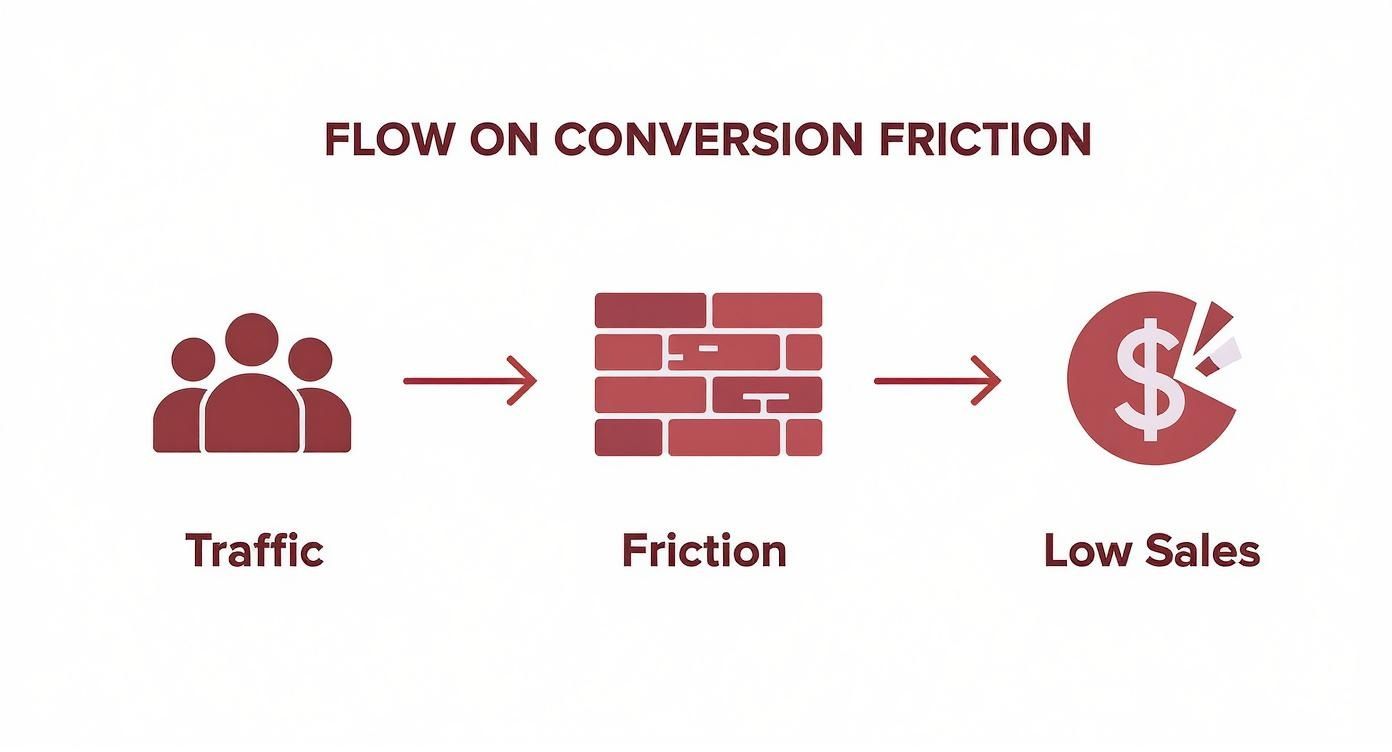
As you can see, friction is a direct roadblock on the path from visitor to customer. Every piece of friction you can smooth over makes that journey easier and more enjoyable.
First things first, you need to know where you stand. In 2025, the global average ecommerce conversion rate hovers between 2% and 4%. It’s a solid benchmark, but it’s not the whole story. Beauty and wellness brands can see rates as high as 6.8%, while fashion stores might average between 1.5% and 2.5%. Knowing your industry’s average gives you a realistic target to aim for and surpass.
This guide will help you see your store differently—not as a digital catalog, but as a carefully guided experience designed to build confidence from start to finish. We’ll focus on the areas that deliver the biggest wins:
- Product Page Experience: Are your pages just spitting out specs, or are they telling a story that makes someone need your product?
- Checkout and Funnel Flow: How many frustrating clicks are you putting between “I want it” and “Thank you for your order”?
- Trust and Social Proof: Are you giving shoppers overwhelming proof that buying from you is a safe and smart decision?
- Personalization and Messaging: Is your communication tailored and helpful, or does it feel like a generic megaphone blast?
By systematically tackling these core areas, you can begin to tear down the walls that are holding your sales back. For a deeper dive, our complete guide on e-commerce optimization strategies has you covered.
Let’s get started and turn those browsers into buyers.
Transforming Product Pages into Conversion Engines
Your product page is your star salesperson. It works 24/7 and has the power to be your biggest asset. But is it just listing facts, or is it telling a compelling story that makes a customer feel like they need your product?
Let’s turn those passive listings into active conversion machines.
Forget about just uploading a photo and a price. To truly increase ecommerce conversion rates, your product page has to close the “imagination gap.” This is the mental hurdle a shopper has to jump over to picture your product in their life. Your job is to make that jump as small and effortless as possible.
From Bland Descriptions to Benefit-Driven Stories
Let’s be honest: most product descriptions are boring. They list features like “100% organic cotton” or “stainless steel hardware.” While true, these details don’t connect with a customer’s real desires. A feature is what something is; a benefit is what it does for them.
Instead of just stating facts, translate them into emotional outcomes. It’s a simple but powerful shift.
- Feature: 100% organic cotton.
- Benefit: “Breathe easier in clothes that are incredibly soft on your skin—and kinder to the planet.”
- Feature: Stainless steel hardware.
- Benefit: “Built to last through countless adventures, so you can trust it won’t let you down.”
See the difference? This small change in language moves the focus from the product to the customer’s experience. You’re no longer selling an item; you’re selling a feeling.
“Your product page is where a customer’s logical brain and emotional heart meet. If you can satisfy both—with clear details and a compelling story—the sale becomes the natural next step.”
Visuals That Build Unshakeable Confidence
Words are powerful, but visuals close the deal. In a world where customers can’t touch your products, your imagery has to do all the heavy lifting. High-quality, zoomable photos are the absolute baseline. To stand out in 2025, you need to go further.
Think about weaving these into your visual strategy:
- Lifestyle Shots: Show your product in a real-world context. A dress on a mannequin is one thing; that same dress at a sunny brunch tells a story. Brands like Anthropologie do this beautifully.
- Scale References: For products like furniture or bags, showing them next to a common object or on a person helps customers instantly understand their true size.
- Short Videos: A 15-second clip showing the flow of a fabric or the clasp on a necklace can answer dozens of unasked questions in an instant.
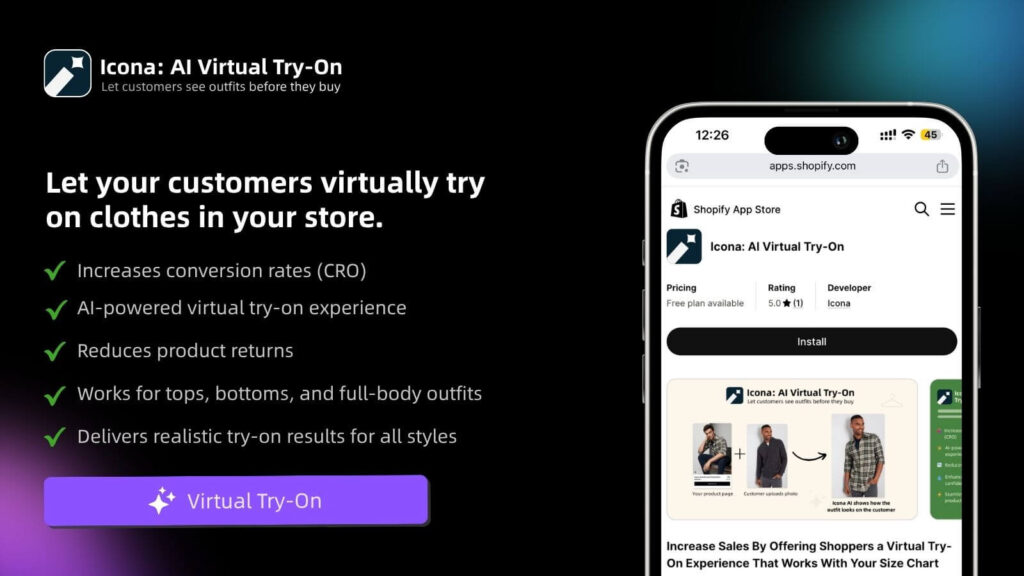
But the real game-changer is technology that lets shoppers place the product directly into their own lives. This is where tools like Icona’s virtual try-on become essential.
Here’s a look at how seamless this experience can be, right on your product page.
By adding a simple “Try It On” button, you invite shoppers to move from passive browsing to active engagement. This single feature demolishes purchase anxiety by answering the biggest question they have: “Will this actually look good on me?”
The Confidence Boost of Virtual Try-On
Virtual try-on technology is more than just a cool feature; it’s a powerful conversion tool. It bridges that final, crucial gap between online browsing and in-store confidence. When a customer can upload a photo and see your dress, necklace, or sunglasses on their own body, their uncertainty melts away.
This isn’t just about visuals; it’s about psychology. It builds an immediate sense of ownership. They’re no longer just looking at an item in a catalog; they’re seeing a future version of themselves. This deepens their emotional investment and makes clicking “Add to Cart” feel like a confident, informed decision. For a deeper look into creating this kind of experience, our guide on Shopify product page customization offers a ton of actionable ideas.
Let’s break down the key elements of a high-performing product page and why they’re so critical.
Product Page Elements That Drive Conversions
| Element | Why It Matters | Actionable Tip for 2025 |
|---|---|---|
| High-Quality Visuals | These are your digital “hands.” They let customers inspect quality and detail when they can’t physically touch the product. Poor visuals scream low quality. | Use a mix of studio shots, lifestyle photos, and 15-30 second product videos. Show every angle and feature. |
| Benefit-Driven Copy | Shoppers buy outcomes, not features. Your copy needs to connect product specs to the customer’s life, desires, or problems. | For every feature you list, ask “so what?” and write down the answer. That answer is the benefit. Lead with it. |
| Virtual Try-On (VTO) | This technology directly answers the #1 purchase hesitation: “How will this look on me?” It builds immense confidence and reduces returns. | Integrate a tool like Icona to offer a seamless VTO experience. Promote it as a key benefit of shopping with you. |
| Social Proof (Reviews) | 93% of consumers say online reviews influence their purchase decisions. Reviews build trust and validate a shopper’s choice. | Feature a mix of star ratings, written reviews, and user-generated photos directly on the product page. Don’t hide them. |
| Clear Call-to-Action (CTA) | The “Add to Cart” button should be impossible to miss. Its color, size, and placement guide the customer’s next step without them having to think. | Make your primary CTA button a contrasting color that stands out from your site’s color scheme. Test a sticky CTA on mobile. |
| Urgency/Scarcity Cues | Gentle nudges like “Only 3 left in stock” or “Low Stock” can encourage decisive action and combat cart abandonment. | Use these cues honestly. A simple, text-based low-stock indicator is often more effective than a flashy, countdown timer. |
Ultimately, by combining benefit-driven storytelling with immersive visuals and confidence-building technology, you create a product page that does more than just present information. It builds trust, sparks desire, and inspires action.
Sealing the Leaks in Your Sales Funnel
An abandoned cart isn’t just a lost sale; it’s a story about a customer who was almost yours. They liked your product enough to add it to their cart, but something in that final stretch gave them pause. This is where you can make some of the biggest and fastest gains to increase ecommerce conversion rates.

Think of your sales funnel like a pipeline. A leak anywhere—a confusing checkout field, a surprise shipping cost—causes you to lose sales. Plugging these holes is about making the path from cart to confirmation so smooth that clicking “Complete Purchase” feels like the only natural next step.
From Cart to Checkout: A Masterclass in Flow
The moment a customer adds an item to their cart, a delicate journey begins. Your job is to make this transition seamless. Don’t immediately redirect them to a full checkout page; that’s like asking for a commitment way too soon.
A much better approach is using a slide-out cart or a mini-cart drawer. This confirms their action without yanking them out of their shopping flow. It gives them the control to keep browsing or proceed to checkout when they are ready.
Inside the cart itself, clarity is everything. Reinforce their great decision with clear details:
- The Essentials: A crisp thumbnail, product name, size, and color.
- The Numbers: Show the item price, any discounts, and a clear subtotal.
- The Next Steps: An unmissable “Checkout” button alongside a “Continue Shopping” option.
This is also a golden opportunity for a smart upsell. Ditch random suggestions and offer products that genuinely complement what they’re already buying. Think of a protective case for a new phone or a conditioning treatment for a new hair color.
The Psychology of Trust at Checkout
Once a shopper hits the checkout page, their mindset shifts. They’re no longer just browsing; they’re actively evaluating risk. Is this site secure? Can I trust them with my credit card? Am I getting a fair deal?
Your checkout design needs to answer these questions before they’re even consciously asked.
The final moments before a purchase are the most fragile. Every single element on your checkout page should be designed to build confidence and remove doubt, not create it.
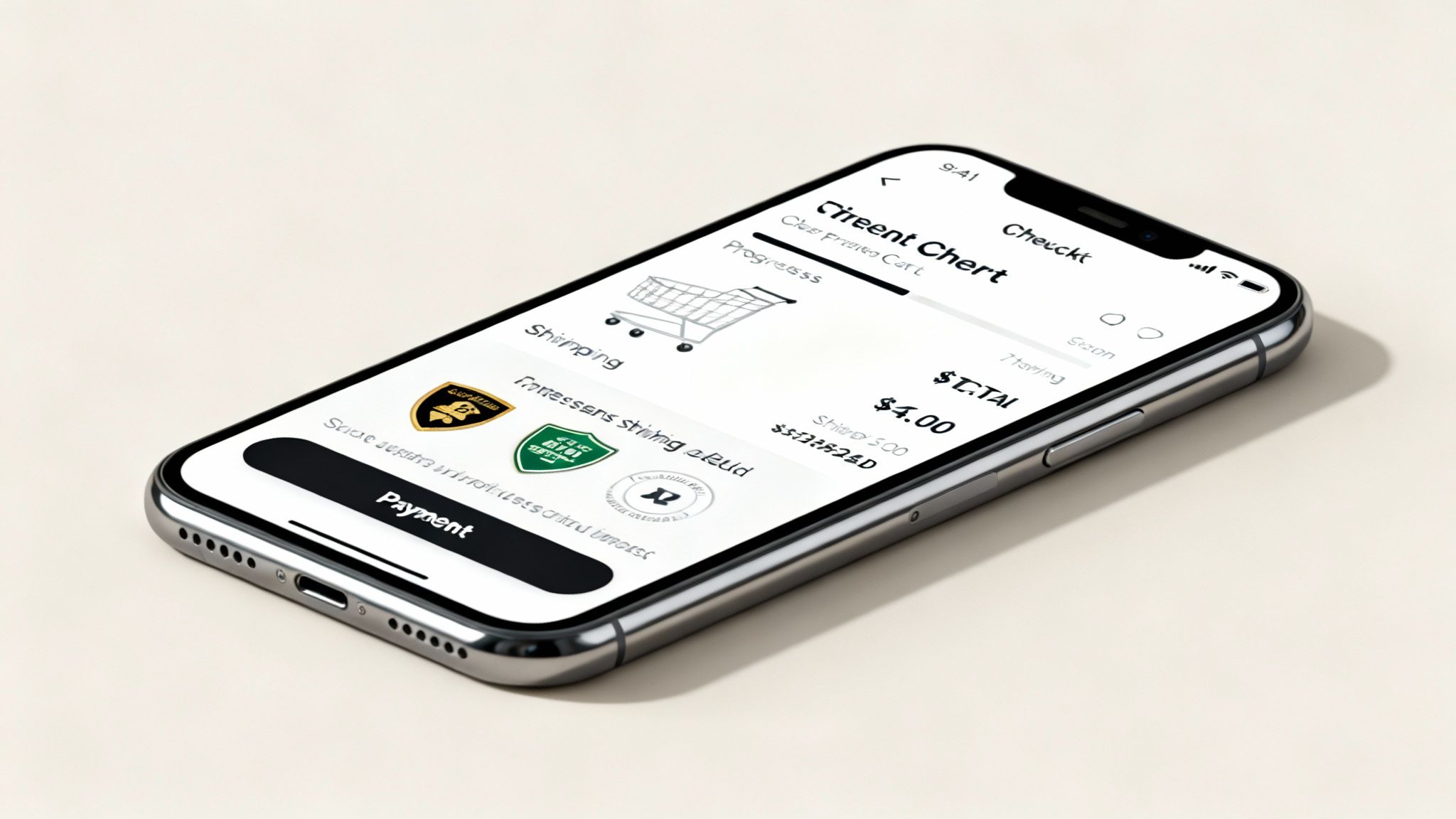
This is where trust signals become non-negotiable. Prominently display security badges like SSL certificates (that little padlock icon) and familiar payment logos like Visa, Mastercard, and PayPal. These are visual shortcuts that scream, “your information is safe here.”
Transparency is another huge trust-builder. The number one reason for cart abandonment is unexpected costs. Don’t ambush your customers with shipping fees at the very last second. Show an estimated shipping cost or a calculator right in the cart so there are no surprises.
Ruthlessly Eliminating Friction
Every extra field, every unnecessary click, and every moment of confusion is friction. And friction is the enemy of conversion. Your job is to sand it all down until the process is perfectly smooth.
Here’s a quick “checkout audit” you can run on your own Shopify store:
- Offer Guest Checkout: Forcing someone to create an account is a massive roadblock. In fact, 24% of shoppers will ditch their cart if you make them. Always have a prominent guest checkout option.
- Embrace Express Payments: Make it easy for them to give you money! Integrate options like Apple Pay, Google Pay, and Shop Pay. These one-click wonders bypass manual address and credit card entry, which is a lifesaver on mobile.
- Simplify Your Forms: Only ask for what you absolutely need to fulfill the order. Use auto-fill wherever possible and label every field clearly. If a shopper has to stop and think, you risk losing them.
Even with a flawless funnel, some people will still leave. That’s where powerful abandoned cart email strategies come into play. A well-timed, helpful email can be the gentle nudge they need to come back and finish.
Building Unshakable Trust Before the Buy Button
In the endless digital aisle of online shopping, trust is the single most valuable currency you have. It’s the silent handshake that happens before anyone even thinks about entering their credit card details. If a shopper feels a hint of uncertainty, they’re gone.
So, how do you build that confidence? It’s not about one magic badge. It’s about weaving trust signals into the fabric of your website, making your store feel like a safe, reliable, and human place to shop.
Go Beyond Star Ratings with Authentic Social Proof
Let’s be honest: star ratings are table stakes now. To truly stand out, you need to show proof from real people in ways that feel genuine. This isn’t just about showing off; it’s about validating a potential customer’s choice before they even make it.
Think of it as building layers of reassurance:
- User-Generated Photos: A dress looks great on a model, sure, but it’s infinitely more relatable on a real customer. Brands like Gymshark build entire communities around this idea.
- Detailed Video Testimonials: A short, heartfelt video from a happy customer is pure gold. It feels raw, believable, and is far more powerful than any marketing copy you could write.
- Press Mentions & Features: If you’ve been featured in a blog or magazine, showcase those logos! This “as seen in” section lets you borrow authority and tells new visitors that you’re a legitimate, respected brand.
By showcasing these different kinds of social proof, you’re not just saying “our product is great.” You’re letting an entire community of happy customers say it for you.
Turn Your About Us Page into a Story
Most ‘About Us’ pages are a corporate snooze-fest—and a massive missed opportunity. People don’t connect with faceless companies; they connect with other people, their missions, and their stories.
Your ‘About Us’ page should be the heart of your brand. Share your origin story. Why did you start this business? What problem are you passionate about solving? Introduce your team with real photos. This transparency builds an emotional bridge and shows there are passionate people behind the products.
“Trust isn’t built on a perfect, polished corporate image. It’s built on authenticity, transparency, and the willingness to show the real humans behind the brand.”
A compelling brand story gives customers something to believe in, not just something to buy. This is especially true in crowded markets like the United States, which is projected to surpass $1.17 trillion in ecommerce sales in 2025. With an average conversion rate of just 2.58%, building a memorable, trustworthy brand is how you capture your share. You can learn more about the latest ecommerce benchmarks for 2025 to see where you stand.
Embrace Radical Transparency
Nothing destroys trust faster than a nasty surprise. Unexpected shipping costs, a confusing return policy, or hard-to-find support are instant red flags.
The antidote is radical transparency. Be upfront and crystal clear about the things that matter most to customers after the purchase:
- Shipping Policy: Don’t make people wait until the final checkout step to see shipping costs. Clearly state your rates and delivery times on a dedicated page or a simple banner.
- Hassle-Free Returns: Your return policy should be easy to find and even easier to understand. Frame it with confidence-building language like, “Love it or send it back, no questions asked.”
- Accessible Support: Make it incredibly easy for customers to contact you. A visible email address, a chat widget, or a phone number proves you stand behind your products, ready to help.
When you operate with this level of honesty, you remove the final barriers of doubt. You’re not just selling a product; you’re making a promise of a great experience.
Using Smart Messaging to Guide Every Visitor
We’ve all been there. A popup explodes on the screen, our mouse instinctively flies to the “X,” and then a split-second later, we think—wait, that might have been useful. It’s a classic online annoyance, but one that’s getting a major rewrite in 2025. Smart messaging today isn’t about interrupting people; it’s about guiding them.
When done right, popups, emails, and even chatbots stop being irritating. They become intelligent, personal, and genuinely helpful guides. This is about mastering messaging that feels less like a marketing blast and more like a real conversation.

The goal is simple: use these tools to answer questions before they’re asked, overcome objections in real-time, and make every visitor feel seen. When you pull that off, you don’t have to push for a sale—you just naturally lead people to it.
The New Era of Exit-Intent Popups
Popups used to be annoying. But today? They’re personal, smart, and actually helpful. Instead of a generic “10% Off!” that feels like a bribe, today’s popups are context-aware. They use behavioral triggers to offer something of real value at the precise moment of hesitation.
Imagine these scenarios on your Shopify store:
- A shopper has spent five minutes comparing three different dresses. As they move to leave, a popup appears: “Can’t decide? Take our 30-second style quiz to find your perfect fit.”
- A first-time visitor is about to bounce from your skincare site. Instead of a discount, they see: “New here? Download our free guide to building your perfect skincare routine.”
- Someone is about to abandon a cart with a high-value item. The popup offers a link to a live chat: “Have a question before you buy? We’re here to help.”
This shift from interruption to assistance is everything. You’re not trying to stop them from leaving; you’re giving them a compelling reason to stay and feel more confident.
Emails That Feel Like One-to-One Conversations
Email marketing is still a powerhouse for one big reason: it’s personal. And yet, so many brands treat their email list like a faceless crowd. To truly increase ecommerce conversion rates, your email campaigns need to feel like they were written for an audience of one.
Your inbox is a sacred space. If a customer invites you in, respect that by sending them messages that are genuinely valuable and relevant to them—not just to your sales targets.
This all starts with smart segmentation. Group your audience based on their actual behavior. A first-time buyer needs a completely different welcome series than a loyal customer who has purchased five times. DTC brands like Bombas are masters at this, sending content that feels tailored to your journey with them.
The numbers don’t lie. Email marketing remains one of the most effective channels, boasting an average conversion rate of around 10.3% in 2025. This rate crushes the general ecommerce average of 2% to 4%, showing just how powerful targeted communication is.
Turning Automation into Authentic Connection
Creating this level of personalization might sound like a ton of work, but it’s more accessible than you think. Here’s how you can start today:
- Welcome Series That Build Relationships: Don’t lead with a sale. Your first few emails should tell your brand story and offer genuinely helpful content. Build a connection first; the sales will follow.
- Abandoned Cart Flows That Solve Problems: Go beyond “You left this behind!” If someone abandoned a dress, your email could include a size guide or link to customer photos. Be helpful.
- Proactive Customer Support with Chatbots: Modern chatbots are incredible tools for instant engagement. They can answer common questions about shipping, guide users to the right product, or offer personalized recommendations. To see what’s out there, you can explore the best chatbots for ecommerce and find one that fits your store.
By combining intelligent automation with a human-first approach, your messaging becomes an invaluable part of the customer journey. You’re not just selling products; you’re building a brand that listens and helps—and that’s a brand people will come back to again and again.
Your Ecommerce Conversion Questions Answered
Jumping into the world of conversion optimization always sparks a ton of questions. I get it. To help you out, here are some quick, no-fluff answers to the things Shopify merchants ask me all the time.
What Is a Good Ecommerce Conversion Rate in 2025?
This is the big one, isn’t it? Everyone wants that magic number. But the honest answer is, “it depends.” While you’ll see global averages floating around the 2-4% mark, a “good” rate is all about your specific niche.
For example, a beauty brand might see conversion rates as high as 6.8%, while a merchant selling high-ticket custom furniture would be thrilled with 1%. They’re both successful.
Instead of getting hung up on a universal benchmark, the best goal is to beat your own numbers. Focus on consistent, month-over-month growth. That’s a far more powerful indicator of success.
The best conversion rate is one that’s better than last month’s. Focus on your own momentum, not just industry averages. Your store, your rules.
What Is the Single Biggest Factor That Hurts Conversions?
If I had to pick one silent killer of sales, it’s decision friction. It’s that moment of doubt, that flash of confusion, that whisper of uncertainty a shopper feels right before they’re about to click “Buy Now.”
This friction isn’t caused by one big thing, but a dozen little ones that add up:
- Surprise Costs: Nothing kills a sale faster than an unexpected shipping fee popping up at the last second.
- Lack of Trust: A product page with no reviews or a checkout process that just feels a bit off.
- Unanswered Questions: A product description that doesn’t say what a shirt is made of or how it’s supposed to fit.
Your job is to make the journey from browsing to buying as smooth, clear, and trustworthy as possible. Every piece of friction you sand down directly boosts your bottom line.
How Long Should I Run an A/B Test for Reliable Results?
The answer here isn’t about time; it’s about traffic. The goal isn’t just to run a test for a week or two, but to reach statistical significance—that’s the point where you can trust the results aren’t just a fluke.
As a solid rule of thumb, you want at least 100–200 conversions for each version you’re testing. For a store with tons of visitors, you might get that in a few days. For a smaller, growing shop, it could take a month or more. It’s always better to let a test run a little longer than to end it early with data you can’t really count on.
A pro tip: always run your tests in full seven-day cycles. This smooths out any weirdness from weekday vs. weekend shopping habits and gives you a much truer picture of performance.
Can AI Tools Like Virtual Try-On Really Increase Conversions?
Yes, absolutely. And it’s not just a cool tech gimmick; it’s a direct solution to one of the oldest problems in ecommerce. AI tools like virtual try-on tackle the biggest question shoppers have: “But will this actually look good on me?”
When you close that “imagination gap,” you’re not just showing someone a product—you’re helping them see it in their life. That builds an incredible amount of confidence right when they need it most.
That confidence translates directly into higher conversion rates. And as a huge bonus, it almost always leads to lower return rates, because customers already know exactly what to expect. That’s why we built Icona—to give every Shopify store an easy way to offer this experience, melt away purchase anxiety, and build trust that converts.
Ready to turn shopper hesitation into confidence? With Icona, you can add a powerful virtual try-on experience to your Shopify store in minutes, helping you increase conversions and reduce returns.
Start your free trial of Icona today
Ever found the perfect shirt online, added it to your cart, then just… closed the tab? We’ve all been there. A tiny flicker of doubt creeps in—”Will this actually look good on me?”—and the sale is lost forever. That moment of hesitation is the silent killer of conversions for apparel brands.
For years, we’ve tried to patch this problem with size charts and generous return policies. But let’s be honest, those are just bandages. What if we could solve the root cause? What if we could give shoppers the one thing they truly crave: total, unshakable confidence?
In 2025, that’s not just a dream—it’s the new reality. A new wave of AI is transforming the cold, one-size-fits-all product page into a warm, personal styling session. This guide isn’t about chasing trends; it’s about a fundamental shift in how we build trust and how to increase online sales by making online shopping feel more human.
Your Product Page Is a Conversation, Not a Catalog
Think of your product page as the final conversation before a customer commits. For too long, it’s been a monologue. We talk at shoppers with specs and photos, but we don’t talk with them. It’s time to rewrite that script.
The goal isn’t just to display a product. It’s to build unshakable confidence. You want to transform that page from a simple description into a dynamic experience that makes the shopper feel seen, understood, and absolutely certain about their choice. When you pull that off, you’re not just selling clothes; you’re selling a feeling of security.
This is how you increase your sales in a way that feels genuinely helpful, not pushy. You’re guiding your customer from doubt to trust, which is the most natural path to a sale.
This simple visual breaks down that journey from a shopper’s uncertainty to a confident purchase.

It’s clear that closing that gap between doubt and trust is where the magic happens—and where the sale is won.
Go Beyond the Standard Photo Gallery
High-quality photos are the bare minimum. They’re table stakes. But for 2025, they don’t solve the biggest hurdle in online apparel shopping—that nagging “how will it fit me?” question. A stunning photo on a size 4 model doesn’t tell a 5’9″ shopper much about how that dress will look on her. This is where you can build a massive competitive advantage.
The real breakthrough happens when you let the customer see themselves in the picture.
A virtual fitting room isn’t some far-off concept anymore; it’s a practical and incredibly powerful tool for any Shopify store. By integrating a solution like TryIcona, you add a simple button right on your product page that lets shoppers upload a photo and see the garment on their own body.
This is so much more than a gimmick. It’s a direct answer to their biggest unspoken question: “But will it look good on me?”
When you remove that one piece of uncertainty, you’re not just tweaking a product page—you’re fundamentally changing the psychology of the purchase. Doubt evaporates, replaced by confidence and genuine excitement.
Weave a Story Around Every Product
Your product descriptions are another area begging for a makeover. So often, they’re just a dry list of materials. Instead, think of each description as a mini-story waiting to be told.
Where is this piece meant to be worn? What feeling does it evoke? Is it the perfect flowy dress for a warm summer evening, or a structured blazer that commands respect? Use sensory language that helps the shopper imagine the feel of the fabric and the way it moves.
Here’s a quick framework for bringing your descriptions to life:
- Set the Scene: Start with an image. “Picture yourself walking along the beach at sunset in this…”
- Describe the Feeling: Tap into emotion. “…lightweight linen that feels cool and soft against your skin.”
- Explain the Fit: Talk about how it drapes. “…a relaxed silhouette that offers an effortless, flowing elegance.”
- Highlight the Details: Point out what makes it special. “…finished with mother-of-pearl buttons for a subtle touch of luxury.”
This approach forges an emotional connection, making the product more than just an object—it becomes part of an experience they can’t wait to have.
Show, Don’t Just Tell, With Social Proof
Seeing your product on a real person who isn’t a professional model is unbelievably powerful. It provides a relatable, authentic context that a studio photoshoot just can’t capture. Sprinkling user-generated content (UGC) throughout your product pages can give your credibility a massive boost.
Get your customers involved! Encourage them to share photos by offering a small discount on their next purchase or by featuring them on your brand’s social media. There are great tools that can automatically pull in Instagram photos with a specific hashtag and display them in a beautiful gallery right on your product page.
This social proof acts as a powerful, collective testimonial, showing potential buyers that people just like them are already loving your products.
Ensure Every Shopper Feels Represented
One of the biggest missed opportunities for apparel brands is failing to show products on a diverse range of body types. When a shopper browses your site and doesn’t see anyone who looks like them, it sends an unintentional but clear message: “This product isn’t for you.”
Of course, hiring models to showcase every single product variant—across different sizes and colors—is often financially out of reach for growing brands. This is where AI-generated model imagery becomes an absolute game-changer.
Tools like Icona Studio let you generate hyper-realistic model images for your entire catalog at a tiny fraction of the cost of a traditional photoshoot. You can showcase a single dress on a dozen different models, representing a true spectrum of your actual customer base.
This isn’t just about being inclusive; it’s smart business. When customers see themselves reflected in your brand, they feel an immediate connection and are far more likely to buy. For more ideas on transforming your product displays, check out our deep dive on Shopify product page customization.
Your product page is your digital storefront. Making it a place of confidence, inspiration, and true representation is the key to unlocking real, sustainable growth.
How to Increase Online Sales by Attracting Shoppers Who Are Ready to Buy
Pouring money into ads without first plugging the leaks in your store is like trying to fill a bucket with holes. You can get thousands of clicks, but if they aren’t the right clicks, your budget just evaporates. The secret isn’t just getting more traffic—it’s attracting shoppers who show up with a mission to buy.
These are the people who have already done their homework. They know what they’re looking for and are just searching for the one brand that gives them the confidence to finally hit “Add to Cart.” Your job is to be that brand.
To pull this off, you need a smart strategy that marries the quick wins from paid ads with the long-term, compounding power of organic growth.
Speak Their Language on Social Media
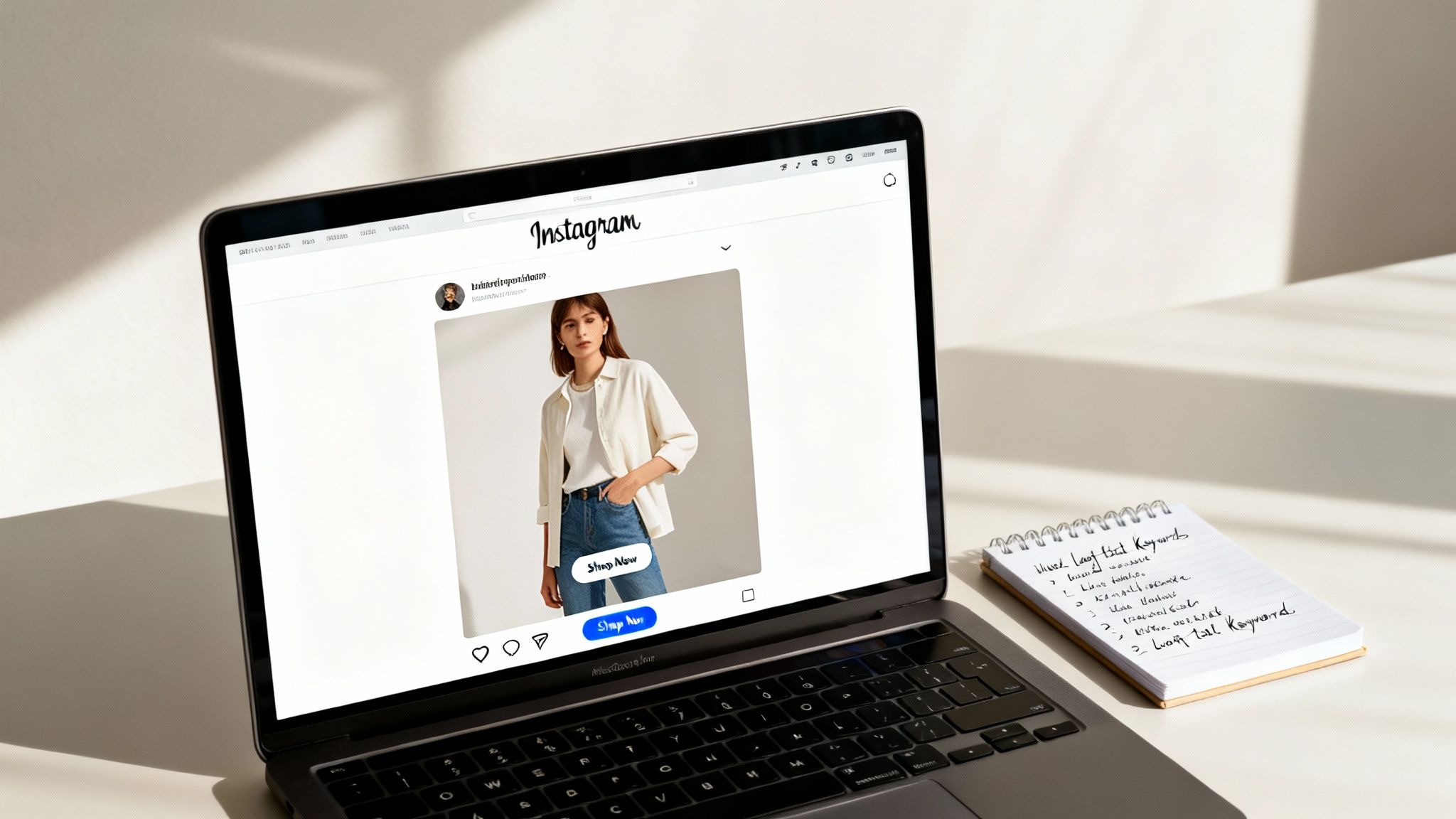
For apparel brands, Instagram and TikTok aren’t just marketing channels; they’re your digital storefronts. But let’s be real, nobody scrolls through their feed hoping to see a sales pitch. They’re looking for inspiration, entertainment, and connection.
So, stop thinking like a brand and start acting like a trusted friend dishing out style advice.
Instead of another sterile product shot, why not post a quick Reel showing three different ways to style one of your dresses? Find micro-influencers who genuinely vibe with your brand and have them do an authentic try-on haul. Use Instagram Stories to ask your audience which new colorway they’d rather see.
This approach accomplishes two huge things:
- It builds a community: You’re starting a conversation, not just broadcasting a message.
- It pre-qualifies your traffic: When someone clicks over from a styling video they loved, they land on your site already inspired and excited.
Master the Art of Search Intent
While social media is great for discovery, search engines are where you capture shoppers who are actively hunting for what you sell. Mastering SEO is one of the most powerful things you can do because it brings you customers who are already halfway to the checkout.
Forget about broad, hyper-competitive keywords like “women’s dresses.” The real gold is in long-tail keywords—those specific, multi-word phrases that reveal exactly what a shopper is thinking.
Just look at the difference in intent:
- Broad keyword: “jeans” (Is the user just browsing? Looking for pictures? Researching styles?)
- Long-tail keyword: “best petite-friendly wide-leg jeans for summer” (This person knows exactly what they want and is probably ready to buy it today.)
Your blog content should be built entirely around answering these specific questions. Write articles like “The Ultimate Guide to Finding Linen Sundresses for Humid Weather” or “5 Ways to Style Wide-Leg Jeans for a Petite Frame.” Each post becomes a tiny magnet, pulling in super-qualified traffic for months and years to come.
Winning at SEO these days isn’t about gaming the system. It’s about being the most helpful, authoritative answer to a customer’s very specific question.
Blend Paid and Organic for Maximum Impact
Think of it this way: your organic efforts build a rock-solid foundation, while paid ads give you a targeted, immediate boost. An improved PPC campaign setup for increased traffic and sales can be a game-changer, especially when it targets users with clear buying signals.
Use your paid social ads to retarget visitors who have already seen your organic content. For example, if someone read your blog post on linen dresses, you can serve them an ad showcasing your brand-new linen collection. This synergy is incredibly powerful because it builds familiarity and reinforces your value.
Build an Email List That Feels Like a VIP Club
Finally, your email list is your single most valuable asset. It’s the one channel you actually own, completely immune to algorithm whims. But getting that email address is harder than ever. A tired “Join our newsletter” popup just doesn’t cut it.
You need to make your email list feel like an exclusive community.
Offer something genuinely valuable in exchange for their inbox access. Instead of just a 10% discount, promise early access to new collections, a downloadable seasonal style guide, or entry into a members-only giveaway. You’re not just asking them to subscribe; you’re inviting them to become an insider.
When you get this right, every email you send is a welcome arrival, not an interruption, driving your most loyal customers back to your store, excited to see what’s new.
Turn First-Time Buyers Into Lifelong Brand Advocates
It’s so easy to pour all our energy into landing that first sale. But the moment a customer clicks “buy” isn’t the finish line. It’s the starting gun for the most important race you’ll run—the race for their loyalty.
Real, lasting growth isn’t built on one-off transactions. It’s built on the second, third, and tenth purchase from a customer who has fallen in love with your brand.
The post-purchase experience is your single greatest opportunity to turn a curious buyer into a true fan. This is where you graduate from a simple transaction to a genuine connection. It’s your chance to deliver a moment of pure delight they’ll be thinking about long after the package lands on their doorstep.
Redesign Your Post-Purchase Communication
Think about the usual stream of emails a customer gets. “Order Confirmed.” “Your Order Has Shipped.” It’s functional, but it’s also cold and totally forgettable. This is prime real estate to inject your brand’s personality and show your customers you actually care.
So, let’s flip the script. Your post-purchase emails should build anticipation, not just relay logistics.
- The “Thank You” Email: Don’t just send a receipt. Share a heartfelt message from the founder. Maybe include a quick styling tip for the item they just bought. It’s a small touch that transforms a sterile confirmation into a warm welcome.
- The “Shipped” Notification: This is your chance to really build the excitement. Instead of only a tracking number, why not embed a link to a curated Spotify playlist that captures your brand’s vibe?
- The Follow-Up: A week after the item arrives, send a friendly check-in. But don’t just beg for a review. Genuinely ask them how they’re enjoying their new piece. This shows you care about their experience, not just their data.
The moments right after a sale are when a customer is most emotionally invested in you. Don’t let that precious window be filled with generic, automated messages. Make it personal. Make it memorable.
Turn Returns into a Retention Superpower
For most apparel brands, returns feel like a painful cost of doing business. But what if we saw them differently? A smooth, stress-free return process can actually make a customer more loyal. When you make it easy, you’re telling them you trust them.
Of course, the real goal is to stop returns before they even happen. This is where getting the pre-purchase experience right has a massive impact on your post-purchase world. When you use tools like a virtual try-on, you give shoppers the confidence they need to pick the perfect size from the get-go.
This has an incredible ripple effect. Did you know that up to 40% of all online clothing returns are simply because of fit issues? When you drastically cut that number down, you’re not just saving money on shipping. You’re freeing up your team’s time and energy.
Instead of processing returns, your team can focus on creating “wow” moments that build loyalty—writing personalized thank-you notes, engaging with customers on social media, or building out a killer VIP program. By solving the fit problem upfront, you’re not just improving conversions; you’re funding a richer, long-term customer experience.
Build a Community, Not Just a Customer List
The final piece of the loyalty puzzle is creating a true sense of belonging. People want to buy from brands they feel connected to. Your job is to build a space where your customers feel like insiders, not just shoppers.
This is where your brand’s unique personality can really shine.
Maybe you create a private Facebook group for your most dedicated fans. Give them early access to new collections, ask for their honest feedback on upcoming designs, and feature their photos on your main social channels.
Think about a brand like Glossier. They built an empire by making their customers feel like they were part of an exclusive club, co-creating the brand right alongside them. This is how you build a loyal base of advocates who don’t just wear your clothes, they live your brand.
When you invest in this post-purchase journey, you stop chasing every new lead and start cultivating a thriving ecosystem of repeat buyers. That’s not just good business—it’s how iconic brands are born.
Use Customer Behavior Data to Make Smarter Decisions
Gut feelings are great for starting a business, but data is what builds an empire. For a long time, “analytics” felt like a chore—a messy dashboard of charts that never quite connected to real-world growth. But what if we started looking at data not as a report card, but as a treasure map leading directly to what our customers truly want?
The real magic happens when you uncover the “why” behind every click, every moment of hesitation, and every final purchase. This is how you build an intelligent growth engine. It’s about creating a powerful feedback loop where customer behavior continuously sharpens your products and fine-tunes your marketing.
Pinpoint the Metrics That Truly Matter
It’s easy to get lost in a sea of numbers. To make smart decisions, you have to cut through the noise and focus on the signals that have a real impact on your bottom line. Forget vanity metrics and zero in on the data that tells you the story of your business’s health.
I’ve seen so many brands obsess over traffic numbers but ignore what that traffic actually does. Let’s focus on what actually moves the needle.
- Conversion Rate by Traffic Source: This shows you which channels are bringing in shoppers who are genuinely ready to buy. If your Instagram traffic converts at 4% while your Google Ads traffic is stuck at 1%, you know exactly where to double down.
- Customer Lifetime Value (CLV): This is the holy grail. It’s the total amount a customer is expected to spend with you over their entire relationship with your brand. A high CLV is proof that you’re building a loyal community.
- Average Order Value (AOV): How much do people typically spend in one go? Even small increases here, often sparked by smart upselling or bundling, can have a massive impact on your revenue.
- Product Return Rate: For any apparel store, this is a critical health metric. A high return rate almost always points directly to problems with fit, confusing product descriptions, or inaccurate photography.
Your analytics dashboard isn’t just for looking back at what happened. It’s for looking forward and predicting what your customers will want next.
To make this even clearer, let’s break down the most important metrics and how to act on them.
Key Metrics for Boosting Online Sales
A solid grasp of your key metrics is the foundation of smart, scalable growth. Here’s a quick-glance table to help you focus on what’s important and what to do about it.
| Metric | What It Measures | Actionable Tip to Improve |
|---|---|---|
| Conversion Rate | The percentage of visitors who make a purchase. | Enhance product pages with high-quality images, virtual try-on, and clear calls-to-action. |
| Average Order Value (AOV) | The average amount spent per order. | Implement “complete the look” suggestions or offer a small discount on bundled items. |
| Customer Lifetime Value (CLV) | The total revenue a single customer generates over time. | Create a loyalty program that rewards repeat purchases and engages customers between orders. |
| Product Return Rate | The percentage of sold items that are returned. | Use a virtual try-on tool like TryIcona to drastically reduce fit-related returns and improve sizing guides. |
| Cart Abandonment Rate | The percentage of shoppers who add items to their cart but don’t complete the purchase. | Simplify your checkout process to a single page and offer guest checkout options. |
By consistently monitoring these five areas, you’ll always have a clear picture of your store’s health and know exactly where to direct your energy for the biggest impact.
Explore the New Frontier of Behavioral Data
Beyond these standard metrics, amazing new tools are giving us a much deeper look into shopper behavior before the sale even happens. This is where we shift from being reactive to truly proactive.
Think about the incredible insights hiding within a virtual try-on experience. With a tool like TryIcona, you’re not just offering a cool feature; you’re collecting invaluable data. Its analytics dashboard can reveal which styles are most “tried on,” even if they aren’t your bestsellers yet. This is a powerful leading indicator of future trends.
Imagine this: you discover a specific jacket is being virtually tried on 500 times a week but has a strangely low conversion rate. That’s not a failed product—it’s a massive signal. Digging a little deeper, you might find that shoppers consistently hesitate after seeing the sleeve length. This isn’t just a customer service issue; it’s pure gold for your product development team.
This new layer of data helps you answer business-critical questions:
- Which of our new designs are really catching our audience’s eye?
- Are there common fit issues we need to fix in our next collection?
- Do certain colors get way more virtual try-ons, suggesting a new marketing angle?
This is the future of data-driven fashion. It’s about using technology to finally understand the unspoken needs of your customers. By closing the loop between what shoppers do and how you design your next product, you create a brand that feels like it’s always one step ahead.
Your Top Questions About Growing Online Sales, Answered
If you have questions about growing your store, you’re on the right track. It means you’re looking past today and thinking strategically about what it takes to win tomorrow. Let’s dive into some of the most common questions I hear from Shopify apparel store owners.
Think of this as a quick, candid chat—no fluff, just straight talk.
How can I get more sales on my Shopify store, fast?
When you need a quick sales injection, the smartest play isn’t always more traffic. It’s about getting more from the traffic you already have. You need to focus intensely on your conversion rate.
Here are a few things you can do this week:
- Create real urgency. Don’t just say “sale.” Launch a flash sale with a very clear deadline. Adding a countdown timer to your product pages works wonders.
- Show off your social proof. Pull up your best-selling product pages and make sure the photo reviews from happy customers are front and center.
- Go after abandoned carts. Your cart abandonment email flow should be working hard for you. A simple, friendly reminder—maybe with a small “complete your order” discount—is often all it takes.
These are short-term boosts, not a long-term strategy, but they are incredibly effective for a quick win.
What’s the single most important thing for increasing online sales?
If I had to pick just one thing for success in 2025, it’s customer confidence. End of story.
Every single part of your store experience needs to answer one silent question from your customer: “Can I trust this brand and will this product actually work for me?” When a shopper trusts your brand, believes the item will fit them perfectly, and feels secure in their decision, the sale feels almost inevitable.
Every single thing you do—from your product descriptions to your return policy—is either building or eroding that confidence. It’s the bedrock of every sale you make.
How exactly does virtual try-on lead to more sales?
This is a great question because it gets right to the heart of turning tech into revenue. Virtual try-on directly demolishes the #1 reason people don’t buy clothes online: fit uncertainty. It’s that nagging doubt that kills millions of sales right at the finish line.
When you let someone see how a dress will actually look on their specific body, you erase that doubt in an instant. This creates massive purchase confidence. Shoppers become far more certain about their choice, which translates directly into higher conversion rates. The formula is simple but powerful: more confidence = more sales.
Even better, it protects the sales you’ve already made. When customers get the right fit the first time, your return rates drop significantly. This doesn’t just save you money; it creates happier customers who come back to buy again.
For a deeper dive into this and other tactics, check out this fantastic guide on proven strategies to increase online sales.
Ready to turn shopper doubt into confidence and sales? TryIcona adds a virtual fitting room to your Shopify store in minutes, letting customers see themselves in your clothes. Start converting more visitors and reducing returns today. Get started for free on tryicona.com.
We’ve all been there. You finally pull the trigger on a new pair of sneakers, only to be haunted by ads for the exact same pair for the next two weeks. A generic recommendation of product isn’t just a missed opportunity; it’s an experience that can actively erode the trust you’ve built with your customers. It feels like the brand isn’t listening.
In a world overflowing with choices, your customers are looking for a guide, not just a catalog. They want you to understand their style, anticipate their needs, and show them things they’ll genuinely love. When you get this right, it’s magic. It’s the difference between a one-time sale and a lifelong fan. This shift from generic algorithms to truly helpful guidance is the single biggest opportunity for Shopify stores in 2025. It’s about creating those “aha!” moments that make a shopper feel completely seen.

Why Shoppers Crave Trustworthy Guidance
Today’s shoppers are smart and skeptical. Before they click “buy,” they’re looking for signals that tell them they’re making the right choice. Research looking ahead to 2025 shows just how much they rely on validation.
- A staggering 78.1% of shoppers say customer reviews influence their decision to buy.
- 51% head to online marketplaces to research products before committing.
- 45% still rely on recommendations from friends or family—the original trusted source.
What’s fascinating is how quickly generative AI is becoming a go-to resource. Already, 43% of consumers consider tools like ChatGPT a reliable place for product research. The message is clear: customers crave confident, well-informed guidance, whether it’s from a peer review, a best friend, or a smart algorithm.
This is why your on-site strategy is so critical. By fine-tuning your store’s recommendations, you position your brand as that trusted expert. It’s not about overwhelming them with more options; it’s about presenting the right options at the perfect moment. Because when you get it right, powerful ecommerce personalization tools don’t just sell products—they build relationships.
The best recommendations don’t feel like an algorithm at all. They feel like a thoughtful suggestion from someone who truly gets your style.
When you get this right, you stop wasting your customer’s time and start earning their loyalty for the long haul.
Let’s Move Beyond ‘Customers Also Bought’
Let’s be honest: the old “Customers Also Bought” widget just doesn’t cut it anymore. It’s time to graduate from generic, often irrelevant suggestions. An effective recommendation strategy is built on a genuine understanding of your shopper, feeling less like a machine and more like a trusted friend who just gets their style.
The goal here isn’t just to boost AOV. It’s to create a seamless experience that guides people toward products they’ll not only love but also keep. This isn’t about slapping a widget on a page; it’s about thoughtfully weaving recommendations into the entire customer journey.
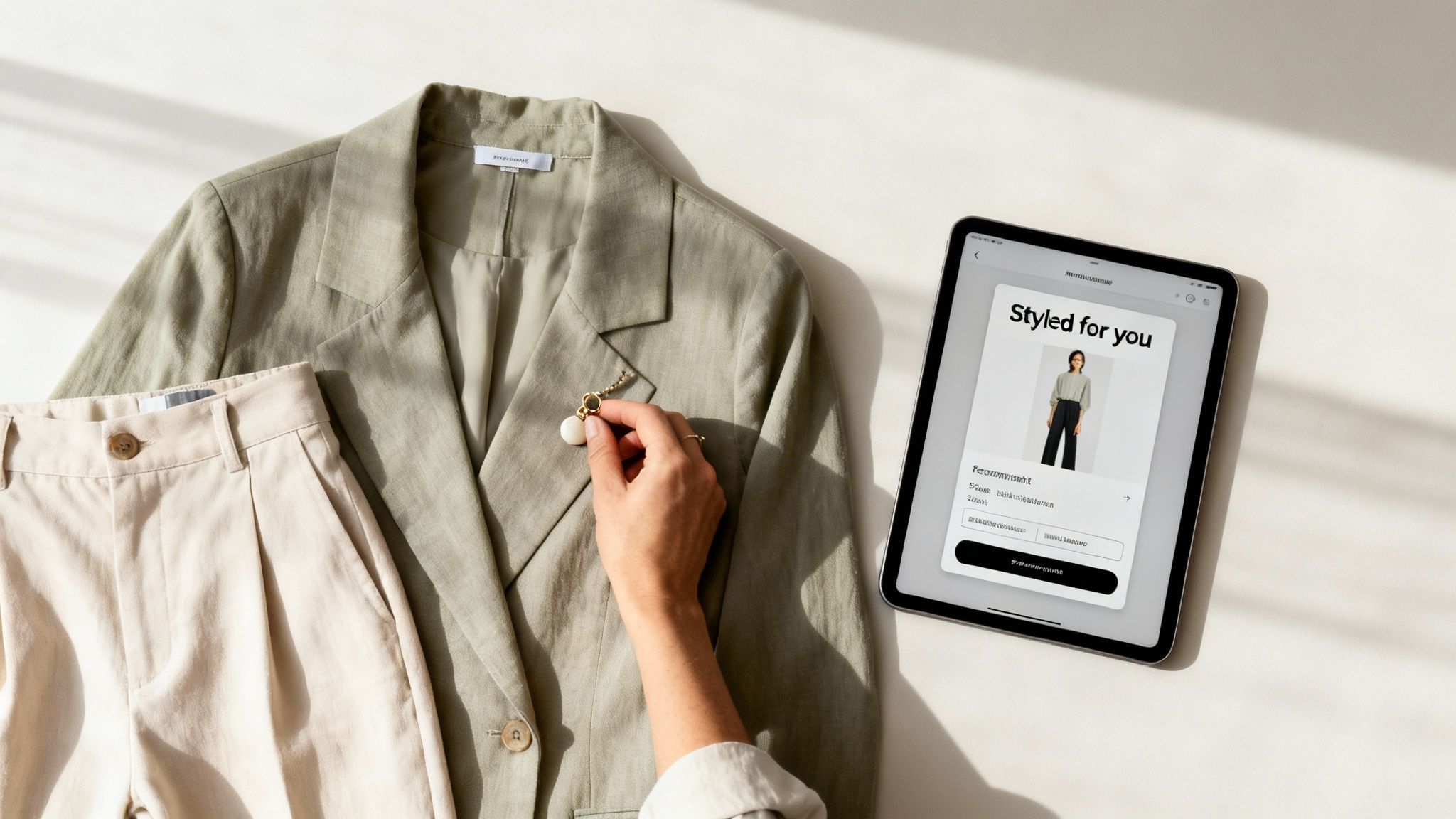
Weaving Recommendations into the Customer Journey
A powerful recommendation of product strategy isn’t about carpet-bombing your site with suggestions. It’s about surgical precision—serving up the right kind of recommendation at exactly the right moment.
Think about the different stages of the shopping experience:
- Homepage: This is your digital storefront window. Capture attention instantly with “New Arrivals” or “Trending Now.” It’s your first chance to establish your brand’s voice and show off what’s exciting.
- Product Pages: Here’s where context is king. Instead of a vague “You Might Also Like,” try something more inspiring like “Complete the Look” or “Pairs Perfectly With.” This helps shoppers visualize the entire outfit, not just a single item.
- In the Cart: This is the perfect spot for a gentle nudge. A simple “Don’t Forget These” suggestion for a matching belt or the right cleaning kit can feel genuinely helpful and significantly increase the average order value.
- Post-Purchase: The conversation doesn’t end at checkout. A follow-up email a week later with the subject line “Styled With Your New Jacket” feels personal and continues to build the relationship.
Understanding how to guide customers through each phase is a game-changer. For a deeper dive, our guide on the eCommerce marketing funnel is a great resource for mapping out these interactions.
Let’s look at how this new way of thinking stacks up against older methods.
Modern vs. Traditional Recommendation Tactics
The table below contrasts outdated methods with modern, personalized strategies that build trust and drive conversions.
| Tactic | Traditional Approach (Low-Impact) | Modern Approach (High-Impact) |
|---|---|---|
| Product Page | Generic “Customers Also Bought” based on popular items. | “Complete the Look” with curated, complementary products. |
| Homepage | Displaying “Best Sellers” to everyone. | Personalized “Trending for You” based on browsing history. |
| Shopping Cart | Last-minute, unrelated impulse-buy suggestions. | Smart suggestions for accessories or care items related to cart contents. |
| Post-Purchase | Sending a generic “Shop Our New Arrivals” email. | A personalized follow-up email with styling tips for their recent purchase. |
| Core Data | Relies solely on past sales data. | Blends purchase history, browsing behavior, and fit feedback. |
As you can see, the shift is from a one-size-fits-all sales push to a one-on-one styling session.
The Data That Actually Fuels Good Recommendations
To make these personal moments happen, you need the right fuel. And that means looking beyond what someone bought last month.
A smart recommendation engine listens to what customers do, not just what they buy. It pays attention to clicks, views, and even what they ignore.
So, where do you start? Focus on gathering these crucial inputs:
- Purchase History: This is your foundation. What have they bought from you in the past?
- Browsing Behavior: What are they clicking on? Which collections do they keep coming back to? This is the digital equivalent of window shopping.
- Style Preferences: If you offer a style quiz or let customers save their preferences, that data is pure gold for refining recommendations.
- Fit & Return Feedback: Don’t overlook this. When a customer returns an item because it was “too small,” that’s an invaluable piece of information. You now know not to recommend that same cut or size again.
By blending these different data streams, you can build a rich, nuanced profile for each customer. This allows you to make recommendations that feel less like a guess and more like a genuinely insightful suggestion from someone who knows their style.
Closing the Confidence Gap with Visual AI
Let’s be honest about the biggest hurdle in online fashion. It’s not just about helping shoppers find a style they love; it’s about quieting that nagging voice of uncertainty in their head.
“Will this actually fit me?”
“How will this fabric really drape on my body, not a professional model’s?”
A simple text-based recommendation, no matter how smart the algorithm, can’t answer those deeply personal questions. It can point a customer to the perfect dress, but it can’t close the critical gap between seeing something online and believing it will work for them. This is where visual AI completely changes the game.
From Suggestion to Experience
Picture this: a shopper lands on a dress your system recommended. Instead of just scrolling through standard product photos, they can instantly see it on a hyper-realistic AI model that mirrors their specific body type. Or even better, they can virtually “try it on” themselves using nothing more than a photo.
This isn’t some far-off concept; it’s happening on Shopify stores right now.
When you weave visual AI into your recommendation strategy, you’re doing more than just showing a product. You are turning a passive suggestion into an interactive, confidence-building experience. It tackles the customer’s number one doubt—fit—head-on, before it has a chance to cause cart abandonment or a costly return.
The Power of “Seeing is Believing”
Think about the difference. Traditional recommendations suggest what a customer might like. Visual AI shows them exactly how they will look and feel. That shift is everything.
- It Answers the Fit Question Instantly: No more poring over confusing size charts. Visual try-on gives immediate, personalized feedback.
- It Creates an Emotional Connection: Seeing a garment on a body they relate to (or their own!) helps a shopper envision wearing it in their own life. It pulls the product out of the sterile world of a product page and into their reality.
- It Builds Unshakeable Trust: Offering this transparency shows you care about their happiness, not just the sale. You’re empowering them to make a confident choice, and that’s the bedrock of real customer loyalty.
This approach is so effective because it gets to the root cause of nearly 40% of all fashion returns: poor fit. Instead of just tweaking the suggestion algorithm, you’re solving the real-world problem that stops customers from clicking “buy.”
Visual commerce stops being about selling a product and starts being about selling confidence. When you solve for confidence, conversions naturally follow.
Making It Real on Your Store
The great news is that tools like TryIcona are built to make this incredibly accessible for Shopify merchants. You don’t need a massive development team to bring this to life.
The whole idea is to embed this technology right where the buying decision happens—on your product detail pages. By simply adding a virtual try-on button next to your “Add to Cart” button, you give customers a direct path to resolving their biggest uncertainty at the most crucial moment.
To see how this works in practice, you can explore the ins and outs of virtual try-on technology and see how it integrates seamlessly into the shopping journey.
By arming your recommendations with visual proof, you’re not just improving an algorithm. You’re fundamentally upgrading how customers engage with your brand, making them feel seen, understood, and truly confident in every single purchase.
Putting Your Smart Recommendation Engine to Work on Shopify
A brilliant strategy is one thing, but execution is everything. Let’s get into the playbook for bringing an intelligent recommendation system to life on your Shopify store. This is where we move from ideas on a whiteboard to a living engine that guides customers and grows your business.
First, a quick audit. Before you add a new app, take an honest look at what you’re already doing. Where are you currently showing recommendations? Are they just the generic widgets that came with your theme? You can’t measure progress if you don’t know your starting line.
Pinpointing Your High-Impact Moments
Not all recommendation placements are created equal. The key is to be surgical, placing the right suggestions exactly where they’ll make the biggest impact. It’s less about blasting customers with options and more about perfect timing.
Let’s break down the most crucial touchpoints:
- On the Product Page: This is your prime real estate. A customer is already showing clear interest, so your job is to build on that momentum. Instead of a random grid of products, think “Complete the Look.” If they’re eyeing a linen shirt, show them the perfect trousers and sandals. A brand that nails this is Taylor Stitch; they create a cohesive story around every single item.
- Inside the Cart Drawer: The moment an item hits the cart, purchase intent is sky-high. This is the perfect spot for a gentle, helpful upsell—not a hard sell. Think small, complementary items. If they’ve added a dress, why not suggest the matching earrings or a special garment care kit? It feels less like a sales pitch and more like a thoughtful tip from a friend.
- Post-Purchase Emails: The conversation doesn’t end when the order is confirmed. A follow-up email a week later showing them new ways to style their purchase with other items from your store is an incredibly powerful way to bring them back. It builds loyalty and shows you care about their experience beyond the sale.
The world of e-commerce is only getting more crowded. Projections show it hitting a staggering $7.5 trillion in 2025, with the AI-powered tools behind this growth becoming a $16 billion market. It’s crystal clear that getting personalization right is no longer just a nice-to-have. Discover more insights into the future of digital commerce and see what’s coming.
Your goal is to make every recommendation feel like a natural next step in a conversation, not an interruption. Guide, don’t just sell.
This is all about turning a shopper’s initial doubt into a confident purchase, and visuals are your secret weapon.
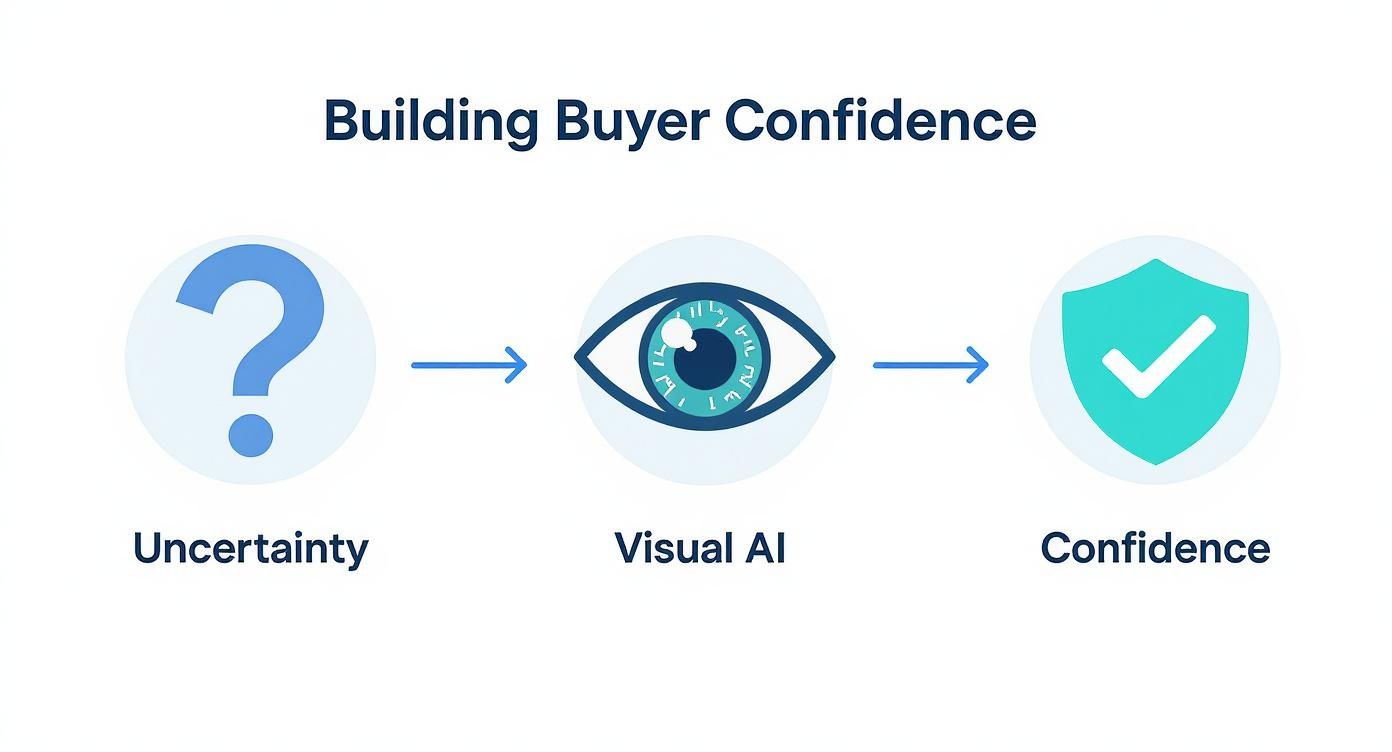
This simple flow shows how visual AI can act as the bridge between “I’m not sure” and a confident “yes,” directly answering the fit and style questions that so often stop a sale in its tracks.
Choosing the Right Tools for the Job
Once you’ve mapped out your strategy, it’s time to find the right tech to make it happen. The Shopify App Store is a treasure trove, but you need a tool that aligns with your specific goals, not just the one with the most reviews.
For instance, if fit-related returns are your biggest headache, a tool like TryIcona can be a game-changer. By integrating virtual try-on directly into your recommendations, you’re not just suggesting a product; you’re offering visual proof that it will look great. This tackles the confidence gap head-on.
When you’re vetting an app, here’s what to look for:
- Deep Segmentation: Can you create different rules for different customer groups, like first-time visitors versus loyal VIPs?
- Strategic Placements: Does it give you granular control over where and how the recommendation widgets appear on your site?
- Performance Focus: Is it built for speed? The last thing you want is a powerful app that slows down your site and kills conversions.
With the right strategy and tools, you can build a system that doesn’t just boost sales, but elevates the entire shopping experience. You’ll make your customers feel seen, understood, and confident—and that’s how you earn a customer for life.
Measuring the Metrics That Actually Matter
Alright, you’ve put in the work and your smart recommendation strategy is live. But how do you know if it’s actually working? It’s easy to get distracted by clicks, but the real story is in the numbers that impact your bottom line and make customers happy.
To get a true read on performance, you have to look past the surface-level stuff. We need to track the metrics that spell out real growth, profitability, and the kind of loyalty that keeps people coming back.
Beyond Clicks and Impressions
An effective recommendation engine does more than just grab attention—it inspires action. There’s a reason the global recommendation engine market is projected to hit a staggering USD 7.34 billion in 2025. Smart brands know its value runs deeper than engagement. For a glimpse into what’s next, these insights on the future of AI recommendation engines are worth a read.
Here’s what you should be laser-focused on:
- Conversion Rate from Recommendations: Isolate the conversion rate specifically for shoppers who click on your recommendation widgets. This is direct proof of how well your suggestions are turning browsers into buyers.
- Recommendation-Influenced Revenue: This is a big one. Track the total revenue from any shopping session where a customer interacts with a recommended product. It shows you the direct financial footprint of your entire strategy.
The Metrics That Reveal True Value
Driving sales is fantastic, but the best recommendation strategies also boost your profitability and keep customers satisfied long-term. This is where the real magic happens.
A great recommendation doesn’t just sell another item; it sells the right item. This simple shift is the key to reducing returns and building lasting customer relationships.
To see that deeper impact, keep a close eye on these two critical areas:
- Lift in Average Order Value (AOV): Are your “Complete the Look” carousels getting people to add more to their cart? A rising AOV is a crystal-clear sign your cross-selling and upselling ideas are hitting the mark.
- Reduction in Return Rate: This is the ultimate test. When you give shoppers better guidance—especially with visual AI that helps them see the fit—they buy with more confidence. A falling return rate translates directly to happier customers and healthier profit margins.
To really grasp the long-term impact, it’s essential to measure performance indicators like Customer Lifetime Value. You can learn more about how to calculate Customer Lifetime Value (LTV) and see why it’s often a more telling metric than AOV alone.
The best way to start is with simple A/B tests. Pit different algorithms against each other, try out new widget placements, and experiment with visual styles to find out what your audience loves. This isn’t a one-and-done setup; it’s a constant process of refining. With a data-backed approach, you can ensure every recommendation of product gets smarter and more powerful over time.
Answering Your Top Questions About Product Recommendations
Jumping into a new strategy always brings up a few questions. I’ve heard them all from Shopify merchants, and they usually circle back to data, site speed, and how to actually use these tools in the real world. Let’s clear those up.
How Much Data Do I Really Need to Get Started?
Honestly, you can start sooner than you think. While more data fuels better personalization, you can get the ball rolling with just a few hundred orders. That’s enough to power simple but effective recommendations, like a “Best Sellers” carousel.
When you’re ready for the advanced stuff—like a “Recommended for You” section that feels like it’s reading your customer’s mind—you’ll want to have at least 1,000 orders and consistent traffic. The key is to start simple and let the system get smarter as your store grows. Don’t wait for perfect data; start with what you have today.
Will Recommendation Widgets Tank My Site Speed?
This is a huge—and totally valid—concern. Site speed is everything in e-commerce. The good news is that modern, well-built recommendation apps are designed with performance in mind. They typically use asynchronous loading, which means they load in the background, separate from your main page content. Your customer sees the important stuff first, without any delay.
My advice? When you’re picking a tool, make sure speed is a top feature. And it never hurts to run a quick speed test before and after you install a new app, just to see the impact for yourself.
The right recommendation tool should feel invisible to your site’s performance but incredibly visible to your customers’ experience.
Can I Use Recommendations to Clear Out Slow-Moving Stock?
Absolutely! This is one of my favorite, and most overlooked, ways to use a recommendation of product system. It’s a brilliant strategy for moving older or overstocked items without having to slash prices.
Think about it: you can set up a rule that showcases these items alongside your best-sellers or new arrivals. For instance, create a “Styled With” widget that pairs a popular new top with a skirt that’s been sitting around for a while. This puts the less-seen item in the spotlight, giving it a relevant context and a much better chance of being discovered. To see how other brands pull this off, you can find some great inspiration from these various product recommendation examples.
Ready to turn recommendations into your store’s superpower? With Icona, you can add AI-powered virtual try-on to your Shopify store in minutes, giving shoppers the confidence to click “buy.” Start reducing returns and delighting customers today. Explore Icona and start your free plan.
Remember when every pop-up was an instant close? We’ve all been there, reflexively hunting for the tiny ‘X’. But what was once the internet’s most annoying guest has quietly become one of the smartest tools for Shopify merchants. Today, they’re personal, timely, and actually helpful.
So what changed? In a word: intelligence. The pop-up didn’t just get a facelift; it got a new brain. It’s time to rethink what a small box on a screen can do for your store.
The Unexpected Comeback Of The Pop-Up Notification
Let’s be honest. For years, the term “pop-up” was basically a curse word. It felt like a digital door-to-door salesperson who wouldn’t take no for an answer, shoving a loud, irrelevant offer in your face.
They were clumsy, intrusive, and completely out of touch with what you were actually trying to do. But somewhere along the line, something shifted. The best pop-ups today feel less like an ad and more like a helpful store associate who appears at the perfect moment. This isn’t just about better design; it’s a complete rethinking of what a pop up notification can be.
From Annoying To Astute
So, what fueled this comeback? A mix of smarter tech and a much deeper understanding of the customer journey. Modern pop-ups aren’t one-size-fits-all interruptions anymore. They’re driven by context, timing, and real value.
Smart Targeting: Instead of shouting at everyone who walks through your digital door, they whisper to the right person at the right time. Pop-ups now appear based on specific behavior—whether it’s a visitor’s first time on your site, they’re a loyal returning customer, or they’re about to click away forever.
True Personalization: They’ve moved beyond generic messages. A great pop-up can greet a customer by name, mention the exact items in their cart, or offer a deal tailored to what they’ve been browsing. It feels human, not robotic.
Value-Driven Offers: The modern pop-up doesn’t just ask for an email. It earns it by offering something compelling in return—a killer discount, first dibs on a new collection, or an exclusive invite to a unique experience.
This comeback story is all about turning a potential frustration into a meaningful connection. It’s proof that a small box, when used with thought and care, can become a powerful way to build relationships and grow your brand.
Your Modern Pop-Up Playbook
The pop-up notification has come a long way. It’s no longer a single, annoying tool but a sophisticated kit, with different instruments perfectly suited for specific moments in the customer journey. The secret isn’t just using them; it’s knowing which one to use and when. That’s how you make them feel helpful, not intrusive.
Let’s break down the essential types every Shopify merchant needs to understand. Think of each one as having a unique personality and purpose, like the specialist staff in a high-end boutique.
This is the journey we want to take our pop-ups on—from an irritation to a genuinely helpful part of the shopping experience.
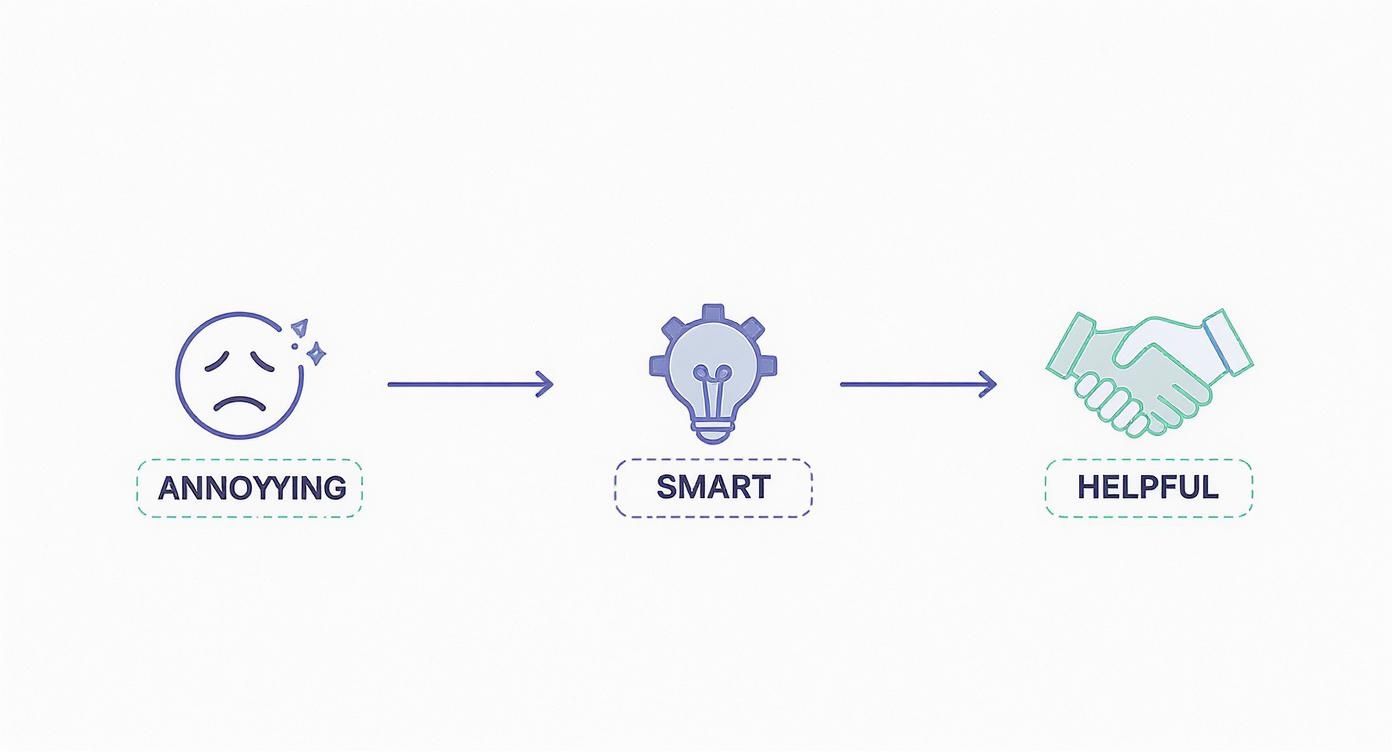
The goal is to move past disruptive tactics and embrace smart, value-driven interactions that actually build relationships with your customers.
The Main Players On Your Stage
Here are the most common pop-up types you’ll encounter and how to think about them for your store.
Modal Pop-Ups (The Welcome Mat)
This is the classic pop-up you know best. It appears right in the center of the screen, dimming the background to demand focus. It’s your store’s welcome mat. When a new visitor arrives, a well-timed modal is the perfect way to present a compelling, can’t-miss offer, like a first-time shopper discount.
But its biggest strength is also its biggest risk. Because it demands immediate attention, the offer has to be undeniably valuable. If it feels irrelevant or premature, it just becomes an irritating roadblock.
Slide-Ins (The Subtle Nudge)
A slide-in is a far more polite interruption. Instead of taking over the whole screen, it gracefully appears from the side or bottom corner. Think of it as a helpful store associate who subtly points out a special promotion while you’re browsing a specific aisle.
This format is fantastic for contextual offers. You can use it to highlight free shipping once a customer adds something to their cart or suggest a related blog post as they read an article. It guides without commanding.
Gamified Pop-Ups (The Fun Surprise)
Who doesn’t love a game? Gamified pop-ups, like a “spin-to-win” wheel, inject a dose of fun and excitement into the shopping experience. They transform the boring act of signing up for a newsletter into an interactive, rewarding moment.
The psychological trigger here is incredibly powerful. The chance to “win” a better discount than the standard offer feels exciting and personal, making customers far more willing to engage and hand over their email.
This tactic creates a positive first impression and can seriously boost your email sign-up rates compared to a plain old static form. It’s a small moment of delight that makes your brand stick.
Choosing Your Pop Up Notification Type
Deciding which pop-up to use depends entirely on your goal and your customer’s context. This table breaks down the key players to help you make a strategic choice for your Shopify store.
| Pop Up Type | Best Use Case | Pros | Cons |
|---|---|---|---|
| Modal | Capturing emails from new visitors with a strong welcome offer (e.g., 15% off). | High visibility, impossible to ignore, great for critical calls-to-action. | Can be highly disruptive and lead to high bounce rates if the offer isn’t valuable. |
| Slide-In | Providing contextual help, promoting related content, or announcing free shipping thresholds. | Less intrusive, feels more helpful, can be triggered by specific user actions. | Lower visibility means it can sometimes be missed by less engaged shoppers. |
| Gamified | Growing your email or SMS list in a fun and memorable way. | High engagement rates, creates a positive brand interaction, feels less transactional. | May not fit every brand’s aesthetic; can feel gimmicky if not designed well. |
Ultimately, the best approach is to test different types and see what resonates with your audience. Start with the one that best matches the specific action you want users to take.
A Quick Note On Push Notifications
Another key player in this world is the push notification opt-in. This is a browser-level request asking for permission to send updates directly to a user’s device, even when they aren’t on your site. While incredibly powerful for re-engagement, getting that initial “yes” is tougher than ever.
The landscape for push permissions has changed dramatically due to new privacy policies. For example, Android’s historically high opt-in rate dropped from 85% to 67% after recent updates, bringing it much closer to iOS’s 56%. This has settled the global average to around 61%. You can read the full research about these push notification trends to see just how much things have shifted.
Choosing the right format for your message is the first crucial step. It’s what turns your pop-up from an unwelcome interruption into the start of a welcome conversation.
Why Smart Pop-Ups Are Your Unfair Advantage
So, we’ve seen what a modern pop-up looks like. But why should you, a busy Shopify merchant, invest your precious time getting them right? The answer is simple. When done well, they’re less of an interruption and more of a conversation starter—a conversation that directly grows your business.
At their core, smart pop-ups are masters of timing. They meet customers in crucial moments with the perfect message, turning hesitation into action and browsers into buyers. It’s not about shouting louder; it’s about whispering the right thing at the right time.
Build Relationships, Not Just Lists
The most obvious benefit is growing your audience. A well-crafted pop-up is still the single most effective way to build your email and SMS lists, which are communication channels you own completely. But it’s so much deeper than just that. You’re not just collecting contacts; you’re starting a relationship.
By offering genuine value—a discount, exclusive content, or early access—you earn their trust from the very first interaction. This simple exchange transforms a passive visitor into an engaged member of your brand community.
A great pop-up makes a customer feel understood. It anticipates their needs and offers a solution before they even think to ask, building a foundation of trust that pays off long after the initial sale.
Drive Revenue in Critical Moments
Beyond list building, pop-ups are your secret weapon for boosting revenue at key decision points in the customer journey. Think of them as your best salesperson, always ready with the perfect offer.
- Reduce Cart Abandonment: An exit-intent pop-up that offers free shipping or a small discount just as someone is about to leave can be the exact nudge they need to finish their purchase.
- Increase Average Order Value (AOV): You can use a subtle slide-in to suggest a perfect product pairing or a special bundle offer once a customer has added an item to their cart.
- Guide and Inform: Use a pop-up to introduce first-time visitors to a unique feature, like a virtual try-on tool, turning a simple notification into an engaging, confidence-boosting experience. In a store powered by TryIcona, this kind of interaction feels less like an ad and more like a helpful service.
This targeted approach is absolutely essential as mobile shopping continues to dominate. With so much web traffic now coming from smartphones, your pop-up notification strategy must be sharp, concise, and perfectly timed for smaller screens.
Ultimately, a smart pop-up isn’t just a marketing tactic. It’s one of the best ecommerce personalization tools you have, turning anonymous traffic into loyal customers by making every interaction feel personal and valuable.
Crafting Pop-Ups That Convert Without Annoying Customers
A great pop-up notification is part art, part science. It’s an exercise in empathy—figuring out what your customer needs and delivering it at the exact moment they need it most. Get this wrong, and you’re just another annoying interruption. But get it right? You create a loyal customer for life.
The secret isn’t some complex mystery. It really just comes down to four key pillars that work together to create an experience that feels genuinely helpful, not intrusive. Think of this framework as your blueprint for turning a simple box on a screen into one of your most powerful conversion tools.

Pillar 1: The Timing
When you show a pop-up is just as important as what it says. Interrupting a customer mid-thought is a surefire way to get them to slam that ‘X’ button and maybe even close the tab. The key is to focus on moments of transition or hesitation.
- On Entry: Perfect for welcoming first-time visitors. A friendly offer can make a fantastic first impression, but give them a moment to breathe. Consider a slight delay of 5-10 seconds so they can get a feel for your store before you jump in.
- On Exit-Intent: This is your last chance to make a connection. When a user’s cursor moves toward the back button or the top of the browser, triggering a compelling offer can be incredibly effective at preventing a lost sale. Knowing how to recover these almost-lost sales is a game-changer; you should dig into more strategies for reducing abandoned carts on Shopify.
- On Scroll-Depth: This is a brilliant way to gauge interest. Show your pop-up only after a visitor has scrolled 50% or more down a page. This tells you they’re already engaged and far more likely to be receptive to your message.
Pillar 2: The Targeting
Let’s be honest: one-size-fits-all messages almost always get ignored. The real magic happens when you show the right message to the right person. Thankfully, modern pop-up tools allow you to segment your audience with incredible precision.
Think about crafting different offers for:
- New vs. Returning Visitors: Welcome new shoppers with a “Take 15% off your first order!” message. For your regulars, try something like, “Welcome back! Here’s free shipping on us.”
- Geographic Location: Promote region-specific deals or special shipping offers based on a visitor’s country. It shows you’re paying attention.
- Referral Source: Did they click through from an Instagram ad? Greet them with a pop-up that directly reflects the campaign they just saw. It creates a seamless, personalized journey.
Pillar 3: The Offer
Your pop-up is a value exchange. You’re asking for their attention (or their email), so you need to offer something truly worthwhile in return. A discount is classic and often effective, but don’t be afraid to think bigger.
An irresistible offer goes beyond the price tag. It can be exclusive access, a solution to a problem, or a moment of delight that makes your brand unforgettable.
Consider offers that genuinely help your customers:
- Exclusive Content: A free style guide, an early-access link to a new collection, or a helpful checklist they can actually use.
- An Enhanced Experience: Instead of another discount, invite them to an interactive experience. A pop-up on a dress product page could say, “Not sure about the fit? Try this on virtually with Icona.” This builds confidence and solves a real, tangible pain point for the shopper.
- A Community Invite: Offer exclusive access to a VIP Facebook group or a newsletter with insider tips. Make them feel like part of the club.
Pillar 4: The Copy
Finally, how you ask matters. Ditch the corporate jargon and write like a real person. Your copy should be crystal clear, concise, and perfectly aligned with your brand’s unique personality.
Always focus on the benefit to the customer. Instead of a dry “Sign Up for Our Newsletter,” try something like, “Get 10% Off & Insider Style Tips.” The first is a command; the second is a promise of real value.
By mastering these four pillars, your pop-ups will stop being frustrating interruptions and start becoming welcome, valuable conversations.
Measuring Success And The Art Of The A/B Test
Launching your new pop-up isn’t the finish line—it’s the starting gun. The real growth begins when you stop guessing and start listening to what your customers’ actions are telling you. This isn’t about becoming a data wizard overnight; it’s about staying curious, paying attention, and making small, smart adjustments along the way.
Think of measurement as your feedback loop. It’s the mechanism that tells you what’s hitting the mark, what’s falling flat, and where your golden opportunities are hiding. It’s the difference between hoping you know what your customers want and actually knowing.
Key Metrics Beyond The Click
The conversion rate—the percentage of people who take the action you want—is definitely the star of the show. But it doesn’t tell the whole story. To get the full picture of your pop-up’s performance, you need to look at a few other critical numbers.
- View Rate: What percentage of your total visitors even see the pop-up in the first place? If this number is surprisingly low, your timing or targeting triggers might be off.
- Engagement Rate: Of the people who see the pop-up, how many interact with it—by clicking a button or filling out a form—versus just closing it? This is a direct reflection of how compelling your offer and design truly are.
- Impact on Bounce Rate: Keep a close eye on your page’s bounce rate after you launch a new pop-up. A sudden, sharp spike could be a red flag that your message is too intrusive, annoying visitors before they even have a chance to look around.
The Simple Art Of The A/B Test
“A/B testing” can sound intimidating, but the idea behind it is incredibly simple: you test two versions of something to see which one works better. You have a “Version A” (your control, the original pop-up) and a “Version B” (which has one single change). Then, you show each version to a different slice of your audience and see which one wins.
The golden rule? Only change one thing at a time. Seriously. If you change the headline, the offer, and the button color all at once, you’ll have no clue which change actually moved the needle.
Testing isn’t a one-and-done hunt for the “perfect” pop-up. It’s a cycle of continuous improvement: Launch, measure, learn, and optimize. Every test offers a new piece of the puzzle, a fresh insight into your customers’ minds.
Not sure where to start? Begin with simple tests on high-impact elements:
- The Headline: Pit a question against a bold statement.
- The Offer: See what resonates more: “15% Off” or “Free Shipping.”
- The Button Copy: Does “Get My Discount” pull in more clicks than “Sign Up”?
To get even better at this, diving into broader A/B testing methodologies will give you a stronger foundation. Remember, every test—no matter how small—gets you one step closer to a pop-up that truly connects with your audience and drives real results.
Thinking Beyond The Click To Build Lasting Trust
A great pop-up strategy respects one thing above all else: the customer. The smartest pop-up isn’t designed just for a click—it’s built to create a moment of trust. This means embracing transparency, especially when it comes to privacy.

Your pop-ups should be clear, honest, and fully compliant with regulations like GDPR and CCPA. Tell customers exactly what they’re signing up for and make your privacy policy incredibly easy to find. This isn’t just about ticking a legal box; it’s a powerful way to show you genuinely care about their data.
Accessibility And Respect
Beyond privacy, a trustworthy pop-up is an accessible one. Think about it from their perspective: can a customer easily find the ‘X’ to close it? Does it function flawlessly on all devices, especially mobile?
Forcing someone to hunt for a tiny exit button or trapping them in an inescapable pop-up on their phone is the fastest way to lose a sale and shatter their trust.
The real goal isn’t just to capture an email or prevent an exit. It’s to prove that you’re a brand that values your customer’s experience, even in the smallest interactions.
This is where your pop-up becomes part of a larger conversation with your customer. Each notification is a fresh chance to guide, help, and even delight them, moving them smoothly through your ecommerce marketing funnel.
When you shift your mindset from simply getting a click to building genuine trust, your entire pop-up strategy transforms. It becomes less about interruption and much more about connection—one helpful, respectful message at a time.
Your Top Pop-Up Questions, Answered
Even with the best strategy in place, questions will pop up (pun intended). That’s a great sign—it shows you’re thinking deeply about how to create a genuinely good experience for your customers. Let’s dig into a few of the most common questions we hear from Shopify merchants.
How Many Pop-Ups Are Too Many?
There’s no single right answer here, but a fantastic rule of thumb is always less is more. The goal is to add value, not create a wall of interruptions.
A smart approach is to start with one primary pop-up tied to your most important goal, like growing your email list. You could then add a secondary, much less intrusive pop-up, like a small slide-in banner announcing a free shipping threshold. The golden rule? Never stack pop-ups on top of each other, and for heaven’s sake, don’t interrupt someone when they’re trying to check out.
Do Pop-Ups Actually Hurt Your SEO?
They absolutely can, but only if they’re obnoxious and poorly timed. Google is all about the user experience, especially on mobile. If a visitor clicks through from a search result only to have their screen immediately blocked by a giant, hard-to-close pop-up, Google will notice—and you might see a penalty.
The secret to keeping Google happy is simple: make your pop-ups easy to close. On mobile, ensure they don’t dominate the whole screen. Even better, trigger them based on user behavior—like when they’ve scrolled down the page or are about to leave—instead of ambushing them the moment they arrive. A pop-up that’s genuinely helpful and respectful of the user’s journey won’t hurt your SEO at all.
What’s a Good Conversion Rate for a Pop-Up?
Across the board, you’ll see an average conversion rate of around 3-4%, but that number is just a starting point. It can swing dramatically based on your industry, your audience, and—most importantly—how compelling your offer is.
Don’t get hung up on hitting a specific number. A “good” conversion rate is one that’s better than it was last month because you’re constantly testing and learning what resonates with your customers.
We’ve seen brands with razor-sharp targeting and killer copy hit conversion rates of 10% or even higher. Use the average as your initial benchmark, but then shift your entire focus to beating your own numbers through smart A/B testing.
Ready to make your pop-ups an experience, not an interruption? With Icona, you can invite shoppers to a virtual try-on straight from a pop-up, giving them the confidence to click “add to cart.” See exactly how Icona works and transform your pop-up strategy.
We’ve all been there. You click on a product that looks perfect, your credit card practically leaping out of your wallet, and then… you’re met with a blank screen and a spinning wheel of doom. One second passes. Two. Three. And just like that, you’ve clicked away.
That brief wait isn’t just a minor annoyance for your customers; it’s a dealbreaker. A slow loading web page is the silent killer of sales, tarnishing your brand before a visitor even sees how incredible your products are. In 2025, that first impression happens in milliseconds, not seconds.
The Three-Second Test Your Store Is Probably Failing
In the world of eCommerce, three seconds is an eternity. It’s the unspoken deadline your Shopify store has to prove it’s worth a customer’s time. We pour so much passion into beautiful design and clever marketing, but if the page doesn’t snap to life instantly, none of it matters. This isn’t about chasing a perfect score on a techy speed test; it’s about respecting your customer’s time and meeting their fundamental expectation of a modern online store.
Think of it like walking into a physical shop. If the door was stuck or the lights took ten seconds to flicker on, you’d turn around and leave, right? Your website is no different. A sluggish site creates friction and plants a seed of doubt from the very first click.
Why Speed Is Your Silent Salesperson
Every millisecond counts, and the data paints a brutally honest picture of what’s at stake. A delay of just one second can have a cascading, negative impact on your store’s performance. For Shopify merchants, this isn’t just a technical problem—it hits your bottom line, hard.
- Conversion Rates Plummet: There’s a direct link between page speed and sales. I’ve seen stores boost conversions simply by shaving off a few hundred milliseconds. Faster pages just convert better. Period.
- Trust Evaporates: A snappy, seamless experience feels professional. It builds trust and tells customers you’re reliable. A slow site does the complete opposite, making you look amateur.
- Bounce Rates Soar: Think of a high bounce rate as a customer walking in, taking one look around, and immediately leaving. Over 53% of mobile visitors will abandon a page if it takes longer than three seconds to load.
In 2025, speed isn’t a feature—it’s the foundation of a great customer experience. It’s the invisible engine that powers every click, every purchase, and every loyal fan you create.
The best part? This is a problem you have complete control over. Once you understand what’s causing the slowdown and take a few targeted steps, you can transform a frustrating user experience into a serious competitive advantage. Let’s start by digging in and finding out what’s really going on under the hood.
Become a Speed Detective: How to Find Your Bottlenecks
Before you can fix anything, you have to know what’s broken. Right now, your slow-loading pages are leaving a trail of clues, and it’s our job to follow them. This isn’t about getting lost in technical jargon; it’s about using a couple of brilliant tools to get a clear picture of what’s really holding your store back.
Think of this as a doctor’s visit for your website. You wouldn’t start a treatment without a proper diagnosis, and the same principle applies here. Making random changes is just shooting in the dark. Instead, we’re going to pinpoint the exact issues so we can fix them with confidence.
The reality for your customers is brutally simple. A few seconds of waiting is all it takes to lose their interest—and their business.
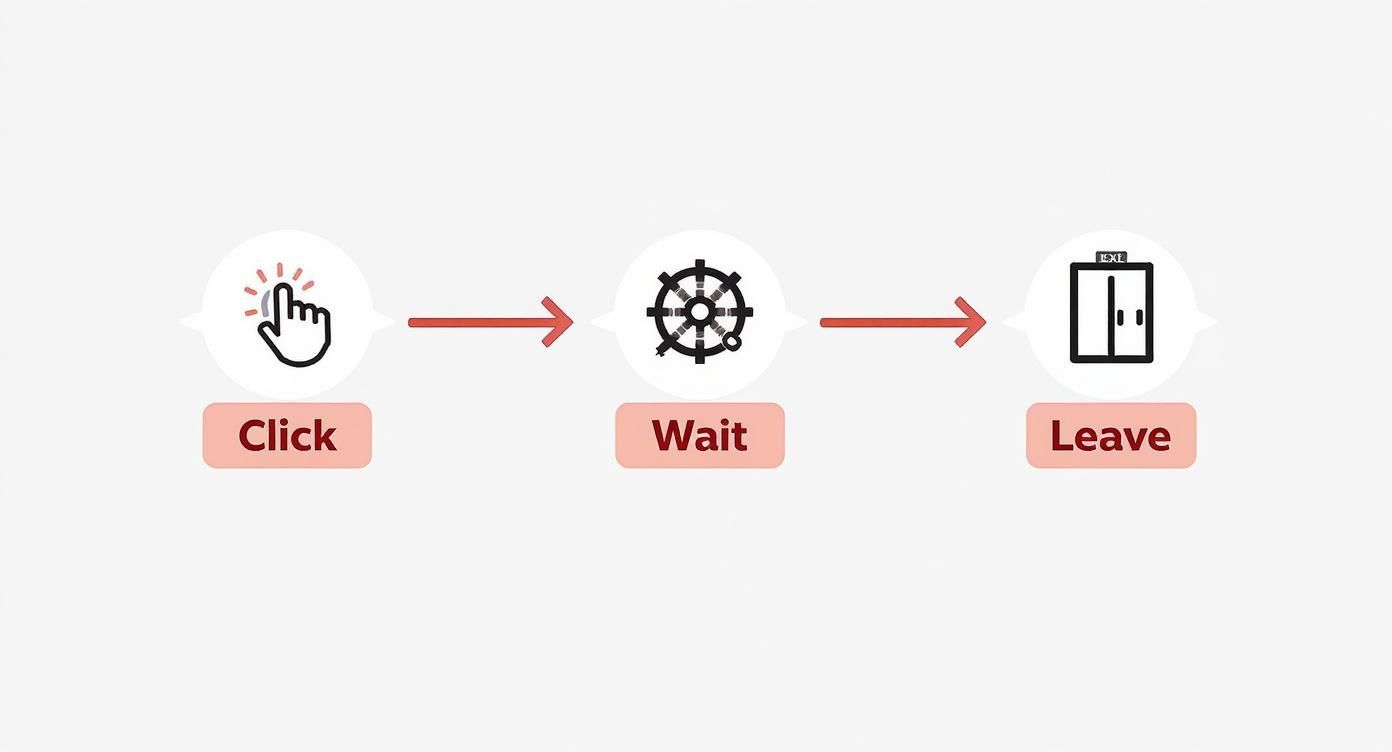
That journey from “Click” to “Wait” to “Leave” can happen in an instant, turning a potential sale into just another bounced visitor.
Your Go-To Diagnostic Tools
So, where do we start? The best tool for the job is free, incredibly powerful, and designed to give you clear, actionable insights. Your first stop should always be Google’s PageSpeed Insights.
Just plug in your store’s URL, and it’ll spit out a detailed performance report for both mobile and desktop. It gives you an overall score, which is nice, but the real gold is in the specific recommendations it provides.
And while it’s tempting to chase a perfect score of 100, don’t get hung up on it. Instead, focus on the real-world metrics that directly impact your customers’ experience.
- Largest Contentful Paint (LCP): How long does it take for the most significant piece of content (usually your hero image or a big block of text) to show up? This is what tells your customer, “Okay, this page is actually loading.”
- Cumulative Layout Shift (CLS): Ever tried to click a button, only to have an ad load and push it down, making you tap the wrong thing? That’s CLS. It’s a measure of visual stability, and a high score is a massive source of frustration.
- Interaction to Next Paint (INP): This new metric measures how quickly your page responds when a user tries to do something—like clicking an “Add to Cart” button or opening the navigation menu. A long delay feels like the site is broken.
These aren’t just abstract numbers; they are direct translations of your customer’s experience. A poor LCP means they’re staring at a white screen. A high CLS makes your store feel glitchy and untrustworthy.
Understanding these metrics is vital because the stakes are sky-high. In 2025, while the goal is a load time under 2 seconds, the average mobile site still takes a sluggish 8.6 seconds to load. With nearly half of all shoppers expecting a site to load in two seconds or less, that massive gap contributes to an estimated $2.6 billion in lost sales annually. You can read more about how load times impact ecommerce revenue on Hostinger.
By using these diagnostic tools, you stop guessing and start making informed decisions that bring those lost opportunities back to your store.
The Top 5 Speed Killers on Shopify Stores
After running these tests on hundreds of stores, I’ve seen the same culprits show up time and time again. This table is your cheat sheet to the most common issues, helping you zero in on what likely needs your attention first.
| The Culprit | Why It Slows You Down | Quick Fix Action |
|---|---|---|
| Huge, Unoptimized Images | Large image files are the #1 cause of slow pages. They take forever to download, especially on mobile connections. | Compress images before uploading, use modern formats like WebP, and ensure they are sized correctly for their containers. |
| Too Many Third-Party Apps | Each app adds its own code (JavaScript & CSS) that has to be loaded, often from different servers, creating multiple points of failure. | Audit your installed apps. If you aren’t using one or its value is low, uninstall it completely. Don’t just disable it. |
| Bloated or Inefficient Theme Code | Some themes are packed with features you don’t use, leading to heavy, complex code that browsers struggle to process quickly. | Choose a well-coded, lightweight theme. If you’re stuck with a slow one, consider a professional code audit or switching themes. |
| Render-Blocking Scripts & Stylesheets | Scripts that must load before the rest of your page is visible create a bottleneck, forcing visitors to wait on a blank screen. | Use the defer or async attributes for non-essential JavaScript. This tells the browser to load them in the background. |
| Lack of Caching & CDN | Without a Content Delivery Network (CDN), every visitor has to fetch data from your origin server, which can be slow depending on their location. | Ensure your theme and hosting are leveraging browser caching and Shopify’s built-in CDN to serve assets from a server close to the user. |
Looking at this list, you can probably already spot a few areas to investigate on your own store. The key isn’t to fix everything at once but to tackle the biggest wins first. More often than not, starting with your images and apps will give you the most significant performance boost.
Unmasking the Common Culprits Behind a Slow Loading Web Page
Alright, you’ve run the tests and have your performance report in hand. Now comes the fun part—playing detective and hunting down the usual suspects. In my experience, when I see a slow loading web page on Shopify, it’s almost always one of these three main culprits causing the drag.
Let’s unmask them together.
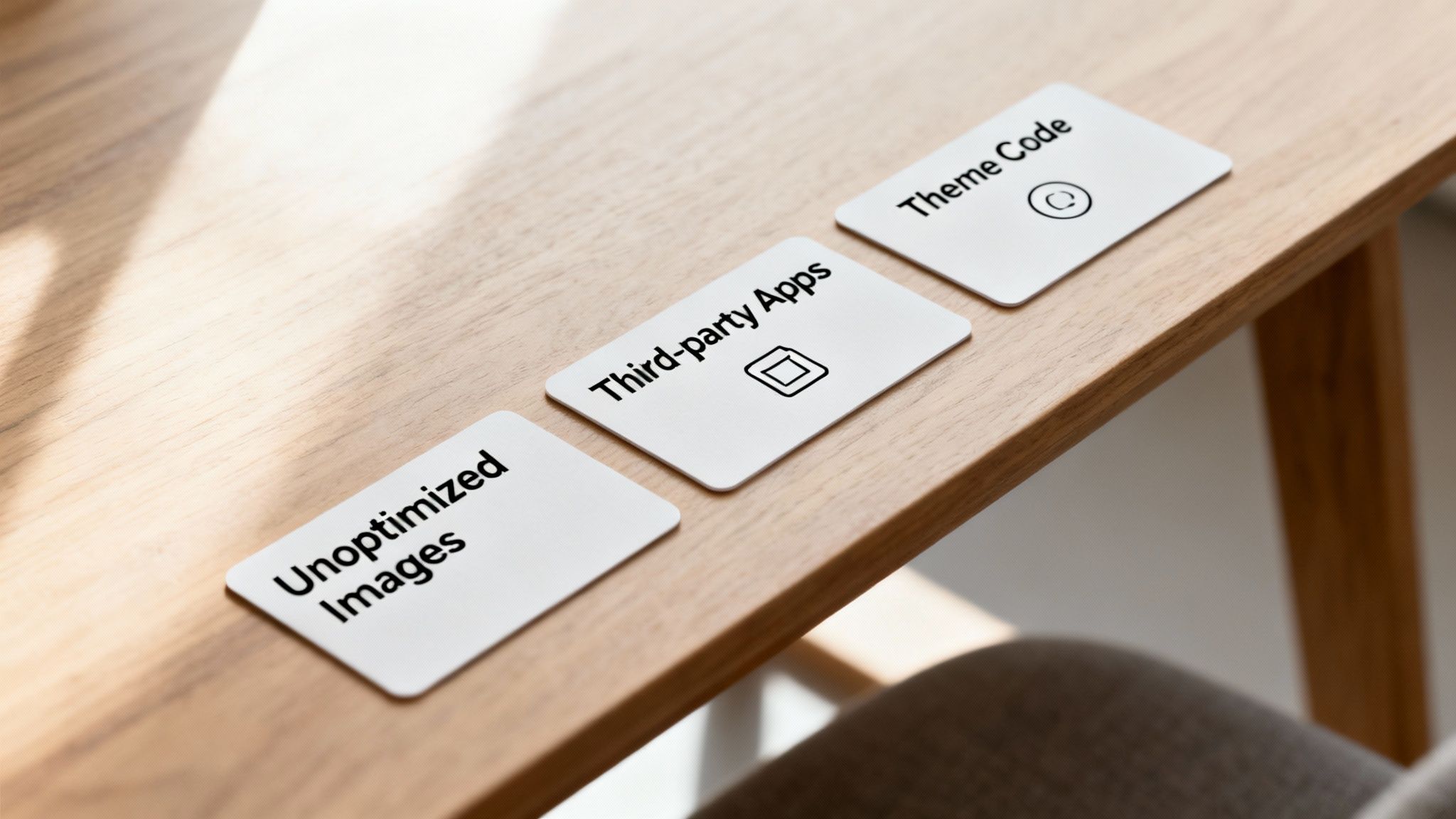
The Number One Offender: Big, Beautiful Images
Your product photography is your lifeline. Those crisp, high-resolution shots are what convince a customer to click “Add to Cart.” But there’s a catch: unoptimized images are the single biggest cause of website slowdowns, bar none.
Every single image is a file that your visitor’s browser has to download. The bigger that file, the longer the wait, especially for someone shopping on their phone with a spotty connection. Think of it like trying to stream a 4K movie on old dial-up internet—it’s just not going to be a good experience.
This doesn’t mean you need to sacrifice quality for speed. The trick is to find that sweet spot with smart compression and modern file formats like WebP, which Shopify can handle automatically. If you’ve already uploaded huge images, you can often improve them with Shopify apps or even use a free online tool to resize or enhance smaller, optimized photos when needed.
Your Overcrowded App Drawer
Third-party apps are one of Shopify’s superpowers. They let you add incredible functionality to your store without writing a single line of code. But each app you install is like adding a new passenger to a car—the more you add, the heavier it gets and the harder the engine has to work.
Every app adds its own scripts and stylesheets that must be loaded. Some are feather-light, but others can be surprisingly heavy, creating a traffic jam of network requests that slow everything down. A pop-up app, a review widget, and a social feed plugin can quickly add precious seconds to your load time.
It’s time for an “app audit.” Go through your installed apps and ask a tough question for each one: “Does the value this app provides truly outweigh the performance cost?” If the answer is no, or if you haven’t used it in months, it’s time to uninstall it.
And remember, just disabling an app isn’t always enough. Some leave behind snippets of code in your theme. For a true clean-up, you have to hit uninstall.
Heavy Themes and Code Clutter
Finally, we need to talk about your theme. Not all Shopify themes are created equal. Some are built for speed—lightweight, clean, and efficient. Others are packed with so many built-in features, sliders, and complex animations that they become bloated and slow, even before you add your first product.
It’s tempting to choose a theme with all the bells and whistles, but often, a simpler, faster foundation is a much better starting point. When diagnosing a slow loading web page, investigating your server’s performance is also essential. Understanding different web server performance characteristics can offer insight into how quickly your theme’s assets are delivered. This technical side directly impacts the user experience.
With an average website in 2025 taking about 1.9 seconds to load its main content on mobile, every single piece of your site’s foundation matters.
By zeroing in on these three areas—images, apps, and theme code—you’re targeting the root causes of most speed issues. You’re taking the first critical steps toward a faster, more profitable store.
Your Game Plan for a Faster Shopify Store
Alright, you’ve done the detective work. You have the data, you know what’s slowing you down, and now it’s time to roll up your sleeves and get to work. This is the fun part—where we stop analyzing and start doing. We’re about to turn those diagnostic reports into real-world speed improvements that your customers will feel instantly.
Forget needing a degree in computer science. The most effective fixes are often the most straightforward. We’re going to focus on the heavy hitters, the changes that give you the biggest performance boost for the least amount of effort. Let’s transform that frustrating slow loading web page into a fast, seamless shopping experience.

Make Your Images Work Smarter, Not Harder
First up, let’s tackle the biggest resource hogs on almost every e-commerce site: the images. It’s a common mistake to make a customer’s browser download every single gorgeous product photo the moment they land on a page. There’s a much smarter way: lazy loading.
Think of it like this: you don’t need to see the pictures at the end of a long blog post until you actually scroll down to them, right? Lazy loading applies that same logic to your store. It only loads images and videos as they are about to appear on the screen. The result? Your initial page load becomes lightning-fast.
The good news is that many modern Shopify themes have this feature baked right in. Dive into your theme customization settings—you’ll often find a toggle for it under a “Performance” or “Media” section. Flipping that one switch can be a total game-changer.
Key Takeaway: Enabling lazy loading is all about prioritizing what the customer sees first. The rest of your beautiful assets load in the background as needed, which can dramatically improve that all-important “time to interactive” score.
Tame Your Third-Party Scripts
Remember those third-party apps we flagged earlier? Their scripts are often the real culprits behind a sluggish site. By default, a browser reads your site’s code from top to bottom. When it hits a script, it stops everything else—rendering the page, loading images—just to download and run that script. These “render-blocking” scripts are a primary cause of that dreaded loading delay.
The fix is to defer any script that isn’t absolutely essential for the initial page view. Adding a defer attribute to a script is like telling the browser, “Hey, go ahead and download this, but don’t run it until the rest of the page is ready.”
This is the perfect approach for elements that don’t need to appear instantly, such as:
- Live chat widgets
- Customer review carousels
- Social media feeds
This might sound overly technical, but many performance-minded apps give you an option to defer their scripts in their settings. If you’re comfortable poking around in your theme’s code, you can also manually add the defer attribute to script tags in your theme.liquid file. If not, this is a quick and high-value task to hand off to a Shopify developer. Moving from diagnosis to action is the most important part, and you can find more quick and effective tips to improve your website’s loading speed to keep the momentum going.
Let Shopify’s Network Do the Heavy Lifting
Here’s something you might not realize: as a Shopify merchant, you already have an incredible speed-boosting tool working for you 24/7. It’s a world-class Content Delivery Network (CDN), powered by the pros at Cloudflare.
A CDN is a massive, global network of servers that stores copies of your site’s assets (images, stylesheets, scripts) in datacenters around the world. So, when a shopper from London visits your store, your product images are served from a server in Europe, not all the way from one in North America.
This seriously cuts down on latency—the physical time it takes for data to travel across the globe. While Shopify handles all of this for you automatically, you can help it work even better. Just make sure all your theme assets are properly uploaded to the “Assets” folder in your theme editor. This guarantees they’re being served through the CDN for the fastest possible delivery to every customer, wherever they are. Smart optimizations can have a huge impact, especially on your most critical pages. To dive deeper into this, take a look at our guide on Shopify product page customization.
From Milliseconds to Money: Why Speed Equals Growth
Let’s move beyond the technical jargon of code and metrics for a moment and talk about what really matters: your bottom line. Getting your store to load faster isn’t just a box to check on a technical to-do list. It’s one of the most powerful growth levers you can pull for your business. The link between a snappy, responsive site and a healthy, growing business is direct, proven, and incredibly powerful.
Think of it this way: every millisecond you trim from your load time is like removing another tiny obstacle between a potential customer and a sale. When a page just works—snapping into view instantly—it communicates professionalism and builds trust. It tells your visitors that you value their time, creating confidence long before they ever add something to their cart.
The True Cost of a Slow-Loading Web Page
The financial drain of a sluggish site can be staggering. Recent research paints a crystal-clear picture: websites that load in 1 second have conversion rates nearly 3 times higher than sites that take 5 seconds to load. Each additional second of delay sends your bounce rate through the roof. For instance, a delay from 1 to 3 seconds increases the probability of a user leaving by 32%. You can explore the full research on website speed and revenue to see the numbers for yourself.
This isn’t just a scary statistic; it’s a massive opportunity. A staggering 53% of mobile users will abandon a page if it takes longer than three seconds to load. Just imagine what it would mean for your business to win back even a small fraction of those visitors.
Tackling a slow loading web page goes way beyond just trying to make Google happy. Yes, a faster site absolutely contributes to better rankings, but the most immediate and tangible reward comes directly from your customers. A better user experience translates directly to higher conversions, more repeat purchases, and a stronger brand reputation. For more ways to boost your store’s visibility, don’t miss our essential SEO tips for Shopify.
Speed as Your Competitive Edge
In a crowded marketplace, the customer’s experience is the ultimate differentiator. I can almost guarantee that many of your competitors are running on slow, clunky websites. By making speed a priority, you create a real, tangible advantage that shoppers can feel with every single click.
Your site’s performance becomes a silent salesperson, working around the clock to make the path to purchase smooth, enjoyable, and effortless. This isn’t about chasing a perfect 100 on some speed test tool. It’s about building a fundamentally better and more respectful relationship with the people who keep your business running. The return on that investment isn’t just measured in milliseconds—it’s measured in real, sustainable growth.
Your Shopify Speed Questions Answered
We’ve dug deep into the world of site speed, from using diagnostic tools to wrangling unruly images and apps. But even after all that, a few questions always seem to surface. Let’s clear them up right now so you can move forward with absolute clarity.
Think of this as the final huddle before the big game. These are the real-world questions we hear all the time from merchants who are serious about making their store lightning-fast.
How Often Should I Check My Store’s Speed?
The best approach is to treat it like a regular health checkup. I usually recommend my clients run a full speed test once a quarter, but always after making any significant change to their store.
What’s a “significant change”? Good question. It’s things like:
- Installing a new app
- Switching themes
- Uploading a big batch of new product photos
Getting into this habit is a game-changer. It lets you spot performance problems the moment they appear, long before they start eating into your sales. You’ll know right away if that cool new feature is actually costing you more than it’s worth.
Can Adding Too Many Products Slow Down My Website?
This is a classic myth, and the short answer is no, not really. The total number of products in your catalog has almost zero impact on the loading speed of any single page. What truly matters is what you try to load on a page at one time.
A collection page trying to display 100 high-resolution, unoptimized images will be a painfully slow loading web page. It doesn’t matter if your store has 100 products or 10,000. The fix is always the same: smart image optimization and lazy loading.
Is It Worth Paying for a Faster Shopify Theme?
It absolutely can be, but you have to understand what you’re buying. A premium, performance-focused theme from a trusted developer gives you an incredible head start. It’s like building your house on a solid concrete foundation instead of on shifting sand.
But here’s the catch: even the fastest theme in the world will crumble under the weight of gigantic images and a dozen resource-hungry apps. A fast theme gets you to the starting line in pole position, but your ongoing optimization habits are what will win you the race.
Will Deleting an App Completely Remove Its Code?
I wish I could say yes, but unfortunately, that’s not always the case. This is one of the most frustrating things Shopify store owners run into. When you uninstall some apps, they leave behind little scraps of code in your theme files. This digital debris builds up over time and can really drag down your performance.
Here’s a pro tip: After you uninstall an app, it’s a great idea to take a peek inside your
theme.liquidfile for any leftover scripts. If you’re not comfortable digging into the code yourself, it’s well worth having a Shopify expert do a quick cleanup for you.
Ready to give your customers an experience so seamless they’ll never think twice about site speed? Icona adds a virtual try-on button to your product pages, boosting confidence and conversions without slowing you down. See how it works at https://apps.shopify.com/icona.
We’ve all been there. You see a piece of clothing online and feel that instant magnetic pull. It’s more than just a jacket; it’s the person you want to be when you wear it. A shot of confidence, a nod to your favorite subculture, a way to tell the world who you are without saying a word.
That feeling? That’s the heart of the culture of fashion. It’s not about runway shows in Paris; it’s the silent language we all speak to tell our stories and find our people. And for your Shopify store, understanding this language isn’t just a nice-to-have—it’s everything.
Fashion Is More Than Just Clothes
Forget what you thought you knew about trends. In 2025, fashion culture is a living, breathing conversation happening on TikTok, in niche Discord servers, and through powerful social movements. Your customers aren’t just buying fabric and thread; they’re buying into an identity, a community, and a set of values. Getting this right is the new standard for success.
Understanding the Scale of Fashion Culture
The fashion industry is a behemoth, a global economic force valued at around $1.84 trillion. It employs roughly 430 million people worldwide—that’s a huge chunk of the global workforce. You can discover more insights about the fashion industry’s vast reach.
What this massive scale means is that tiny cultural shifts create tidal waves of change. A single viral TikTok video or a growing demand for sustainability can completely rewrite what people want to buy, almost overnight.
Your brand isn’t just selling products; it’s an active participant in this cultural conversation. The brands that thrive in 2025 and beyond will be the ones that listen, adapt, and contribute authentically.
Why This Matters for Your Shopify Store
When you get the cultural context, you stop thinking in transactions and start building relationships. It’s your chance to create a brand that feels relevant, necessary, and deeply personal.
Tapping into the culture of fashion unlocks some serious opportunities:
- Connect on a human level: You’re no longer just selling a dress. You’re offering a shot of confidence, a sense of belonging, or a badge that represents personal values.
- Build a loyal tribe: People naturally rally around shared aesthetics and beliefs. Your brand can become the gathering place for a community of like-minded individuals who champion what you do.
- Create a future-proof business: By keeping your finger on the pulse of cultural shifts, you can start anticipating trends and leading the conversation, instead of just reacting to what everyone else is doing.
This guide is your playbook for understanding what the ‘culture of fashion’ really means right now. We’ll break down how to align your brand with the currents that matter most to your audience. Let’s dive in.
The Four Pillars Driving the Culture of Fashion
To really get the culture of fashion, you have to understand the forces shaping it from the inside out. I like to think of it as a four-legged stool—if one leg is wobbly, the whole thing feels unstable. In 2025, those four legs are Identity, Community, Sustainability, and Technology.
These aren’t just industry buzzwords. They’re the real, human drivers behind why your customers click “add to cart.” Nailing how they work together is the first step toward building a brand that feels essential, not just optional.
Pillar 1: Identity and Self-Expression
At its very heart, fashion is a language. Before we ever say a word, our clothes have already introduced us. Today, that introduction is more personal and powerful than ever.
Shoppers, especially younger generations, see their wardrobe as a canvas for who they are. They’re piecing together outfits that broadcast their personality, their values, and even their mood on any given day. This isn’t about blindly following a single, top-down trend anymore; it’s about crafting a unique personal story.
For your Shopify brand, this means your products are more than just items—they’re ingredients for someone’s identity. That vintage-style jacket isn’t just outerwear; it’s a nod to nostalgia. That minimalist dress isn’t just clothing; it’s a quiet statement of confidence.
The takeaway: Your customers aren’t just asking, “What does this look like?” They’re asking, “What does this say about me?”
This chart visualizes how the journey starts with individual identity and blossoms into a powerful form of social connection.
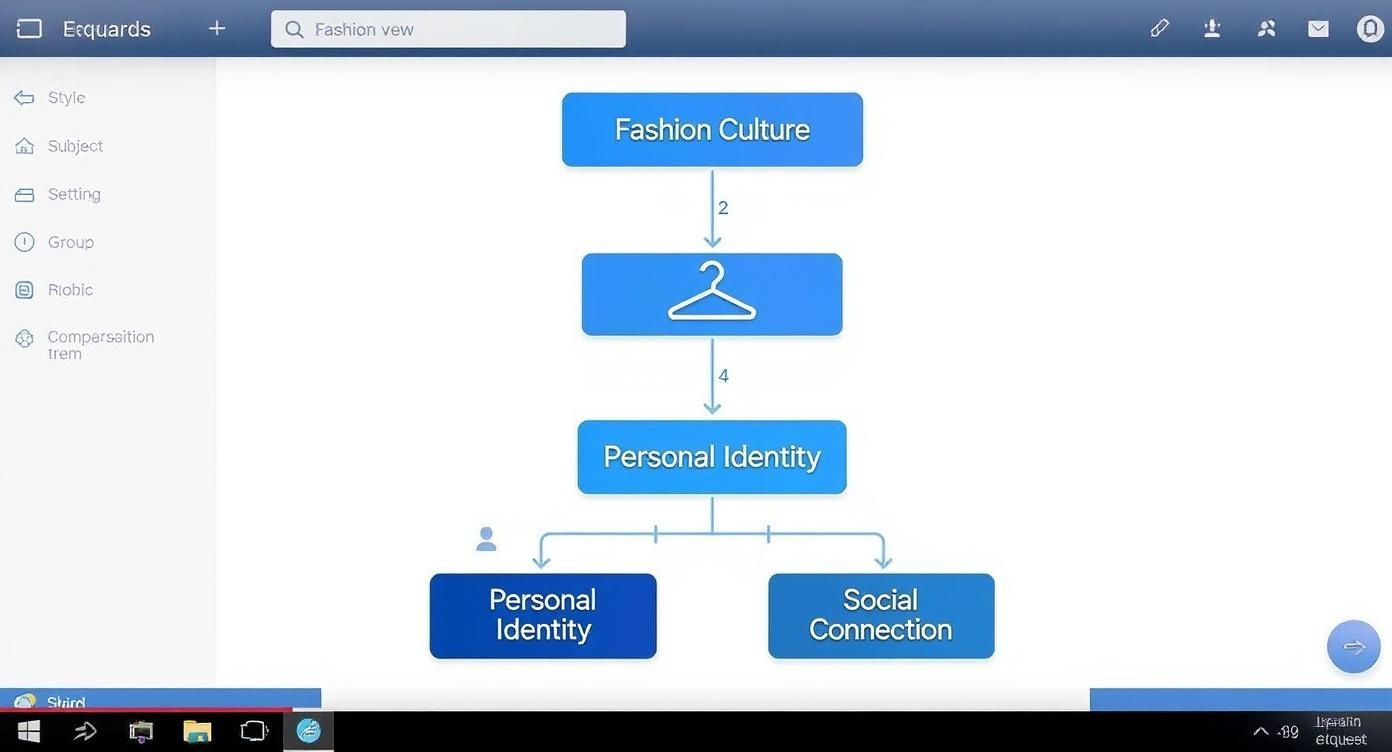
Ultimately, what we choose to wear is a deeply personal act that signals who we are and which groups we feel we belong to.
Pillar 2: Community and Digital Tribes
Fashion has always been tribal, but the internet gave those tribes a global stage. From the dreamy fields of #cottagecore to the rugged trails of #gorpcore, digital communities now spring up around shared styles and deeply held values.
These communities are the new tastemakers. A trend can ignite within a niche TikTok group and hit the mainstream in a matter of weeks, all without the blessing of a traditional fashion editor. People simply trust creators and peers within their digital circles far more than they trust a billboard ad.
Your brand doesn’t just need customers; it needs to find its community. That means you need to:
- Identify your tribe: Who are the people who truly share your brand’s aesthetic and core values? Where do they hang out online?
- Speak their language: Engage with them using the references, humor, and visual styles they already know and love.
- Add value, not just sell: Share content that inspires, educates, or entertains. Position your brand as a core member of the group, not an outsider looking in.
Pillar 3: Sustainability and Conscious Choices
What was once a niche concern is now a non-negotiable for millions of shoppers. They’re asking tough, important questions about where their clothes come from, what they’re made of, and who made them.
A simple “eco-friendly” tag just doesn’t cut it anymore. Today’s consumers are smart, savvy, and quick to call out “greenwashing.” They want to put their money behind brands that are genuinely committed to ethical practices, from sourcing raw materials to reducing post-consumer waste. Just look at brands like Patagonia, which have built empires by making their principles their best marketing tool.
This shift is a massive opportunity to build real trust. Being honest about your sustainability journey—even the imperfect parts—can create a much deeper, more loyal connection with your audience than any discount code ever could.
Pillar 4: Technology and New Experiences
Finally, technology is the engine supercharging the other three pillars. It’s how we discover new identities, connect with our communities, and learn about a brand’s sustainable practices.
Tech isn’t just about having a slick website anymore. It’s about creating better, more human-centric shopping experiences. AI-powered tools can offer personalized recommendations that feel like advice from a trusted friend. And virtual try-on solutions, like our own TryIcona, give shoppers the confidence to explore new styles from their living rooms, finally bridging the gap between online browsing and real-world satisfaction.
Technology allows you to meet your customers where they are, offering them experiences that feel seamless, personal, and genuinely engaging.
Here’s a quick look at how these four pillars come together to influence both shoppers and the brands that serve them.
The Four Pillars of Modern Fashion Culture
A summary of the key cultural drivers shaping consumer behavior and brand strategy in the fashion industry.
| Pillar | What It Means for Consumers | What It Means for Shopify Brands |
|---|---|---|
| Identity & Self-Expression | “My clothes are a reflection of who I am and what I believe in.” | Frame products as tools for personal storytelling, not just garments. |
| Community & Digital Tribes | “I connect with people who share my style and values online.” | Find your niche community and become an authentic, valuable member. |
| Sustainability & Conscious Choices | “I want to know the story behind my clothes and feel good about my purchase.” | Build trust through transparent, ethical practices and honest communication. |
| Technology & New Experiences | “I expect a seamless, personalized, and engaging shopping journey.” | Use tech like VTO and AI to enhance confidence and create memorable experiences. |
In short, each pillar builds on the others. A brand that understands this interconnectedness is one that’s built to last.
How Digital Subcultures Redefined Style
Remember when a handful of glossy magazines decided what was ‘in’? Those days feel like ancient history now. The internet didn’t just change the rules of fashion—it lit the entire rulebook on fire.
Social media, in particular, caused a seismic shift that completely rewired the culture of fashion. Platforms like TikTok and Instagram have become the new runways, where trends bubble up from viral moments and niche aesthetics, not from top-down seasonal collections. This is a massive decentralization of power.
Suddenly, individual creators and tiny online communities can have just as much sway as the legacy fashion houses. For your brand, this is both a daunting challenge and a massive opportunity. It’s your invitation to stop broadcasting and start being part of the conversation.
The Rise of the Niche Aesthetic
In the past, style tribes were defined by geography—think of the punks in London or the Harajuku scene in Tokyo. Today, they’re defined by hashtags. These digital subcultures, or “aesthetics,” are communities built around a shared visual language and a common set of values.
These online tribes form in the blink of an eye and have a huge impact on how people shop. A customer who identifies with the #cottagecore aesthetic isn’t just buying a floral dress; they’re buying into a fantasy of a rustic, peaceful life. Someone into #gorpcore isn’t just picking up a technical jacket; they’re signaling a love for the outdoors and utilitarian style.
Understanding these digital movements is everything. It’s how you find your people.
The Big Insight: Your ideal customer isn’t just a demographic. They’re part of a digital tribe with its own language, heroes, and visual codes. Your job is to learn that language and speak it fluently.
From Trend Cycles to Trend Ecosystems
That old, predictable fashion cycle—spring/summer, fall/winter—is a relic. We now live in a constant, churning trend ecosystem that’s fueled by the internet. A forgotten style from the early 2000s can resurface on TikTok and become a global phenomenon in a week.
This new pace can feel chaotic, but it also creates room for more diverse and interesting styles to thrive all at once. It’s not about one single look being “in,” but dozens of micro-trends coexisting.
This dynamic is supercharged by the sheer scale of online retail. By 2025, online fashion sales are projected to hit a staggering $1.2 trillion globally, with e-commerce expected to make up nearly half of all fashion retail sales worldwide. As more and more shopping moves online, the influence of these digital subcultures will only get stronger. You can explore more data on the future of fashion e-commerce here.
How to Engage Without Being Cringey
So, how do you tap into these communities without looking like you’re just trying to cash in? It all comes down to authenticity and respect.
Listen First, Post Later: Before you even think about creating content, immerse yourself in the communities you want to reach. What creators do they follow? What inside jokes are they sharing? What do they truly value? This is your real market research
Collaborate with Micro-Influencers: Forget the mega-celebrities for a moment. Partner with creators who are genuine, respected members of a niche community. Their endorsement feels like a recommendation from a trusted friend, not a clunky sponsored ad.
Use Technology to Build Confidence: One of the biggest hurdles in online fashion is the fact that you can’t try things on. This is where tech can actually build a human connection. By adding tools that let customers see how an item might fit their unique body, you empower them to experiment with new looks confidently. Understanding how virtual try-on technology bridges this gap is a game-changer for brands looking to connect with a digitally-native audience.
Tuning into digital subcultures isn’t about chasing every fleeting trend. It’s about understanding the deeper cultural currents your customers are swimming in. Find your tribe, add real value, and you’ll build a brand that feels less like a store and more like home.
Turning Sustainability Into Your Superpower

Let’s be honest: sustainability isn’t just a nice-to-have anymore. It’s a core expectation woven deep into the fabric of fashion culture. Today’s shoppers, especially the savvy Gen Z and Millennial crowd, are looking right past the vague promises. They want the real story.
A generic ‘eco-friendly’ tag slapped on your product page isn’t going to fly in 2025. People are digging deeper. They’re asking the hard questions: Where did this fabric really come from? Who made this garment? What happens to it when I’m done with it?
This isn’t about achieving perfection overnight. It’s about being honest, intentional, and real. It’s your opportunity to weave sustainability into your brand’s DNA so authentically that it becomes your greatest strength.
Beyond Buzzwords to Real Action
This shift in thinking isn’t just a fleeting trend—it’s a massive market movement. The global sustainable fashion market is projected to skyrocket from an estimated $12.46 billion in 2025 to $53.37 billion by 2032. That explosive growth is proof that customers are voting with their wallets for brands that genuinely care about their impact.
This is an incredible moment to build a brand that people don’t just buy from, but fiercely believe in. So, how do you get there?
Here are three powerful ways to build your sustainability strategy:
Radical Transparency: This means pulling back the curtain on your supply chain and sharing the whole story, warts and all. Talk about the factory you partner with. Show behind-the-scenes videos of your materials being sourced. If you’re working to improve an area, be upfront about it! Brands like Allbirds built a cult following by being obsessively transparent about the carbon footprint of every single shoe.
Mindful Materials: The materials you choose are a direct reflection of your values. Start exploring alternatives to conventional fabrics. This could mean sourcing organic cotton, using recycled polyester, or even experimenting with innovative materials like Tencel or Piñatex (pineapple leather). You don’t have to change everything at once; start small with a capsule collection and tell the story behind your choice.
Embracing Circularity: The old “take-make-waste” model is on its way out. The future is circular, and it’s all about extending the life of your products. Think about offering a repair program, like Patagonia famously does. You could also launch a resale or take-back program, giving your garments a second life and building a lasting relationship with your customers.
The goal isn’t to claim you’ve “solved” sustainability. It’s to show you’re on a journey and invite your customers to join you. Honesty, even about your imperfections, builds far more trust than empty greenwashing ever will.
Communicating Your Commitment
How you talk about your sustainability efforts is just as important as the work itself. Ditch the corporate jargon and speak from the heart.
Your product pages are the perfect stage. Instead of just listing specs, tell a compelling story.
- Instead of: “Made from recycled materials.”
- Try: “This jacket started its life as 15 plastic bottles, saved from our oceans and woven into a fabric that’s as durable as it is beautiful.”
See the difference? That kind of narrative transforms a simple product feature into a powerful statement your customers can feel proud to wear.
Technology can also be a powerful ally. While sustainability focuses on the physical world, smart tech can help reduce waste in the digital one. Returns, for instance, are a massive source of carbon emissions and landfill waste. By offering a virtual fitting room, you give customers the power to see how a garment will actually look on their body, helping them nail the right size the first time. This not only boosts their confidence but directly cuts down on wasteful returns.
As shoppers become more eco-conscious, making these principles part of your brand is no longer a choice. For more inspiration, check out guides on embracing sustainability in ecommerce that offer practical strategies for brands of all sizes. By turning your commitment into a core part of your story, you build a brand that doesn’t just sell clothes—it stands for something that truly matters.
Using Tech to Create a Human Connection
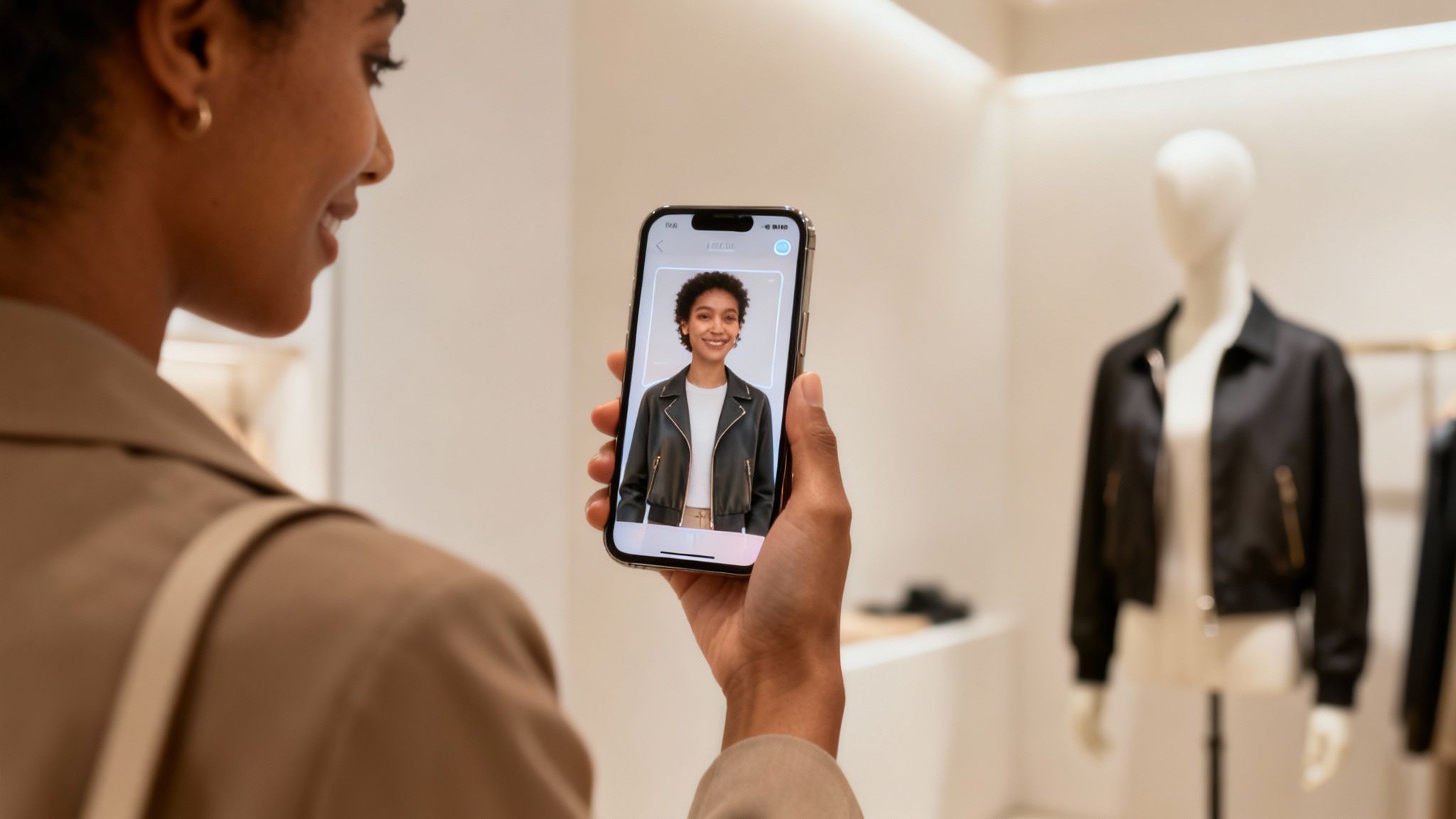
In the modern culture of fashion, it’s easy to think of technology as cold and robotic. We immediately picture algorithms and data points, not the warmth and intuition of a fantastic shopping experience. But what if we flipped that script entirely?
What if technology wasn’t a barrier, but a bridge to a more human, more empathetic connection with your customers?
That’s precisely where the magic is happening in 2025. The smartest brands aren’t just using tech to be more efficient; they’re using it to listen, to understand, and to build genuine trust. It’s the tool that can connect your brand’s unique story directly to your customer’s personal identity, making online shopping feel less like a transaction and more like a conversation.
AI as Your Personal Stylist
Imagine an online store that actually gets your customer. A store that doesn’t just push what’s popular, but recommends pieces that genuinely resonate with their personal style, their past purchases, and even their future aspirations. This is the promise of AI-powered personalization, and it’s an absolute game-changer.
Instead of a generic, one-size-fits-all homepage, AI can curate a unique storefront for every single visitor. It can act like a trusted personal stylist, suggesting a floral dress to the shopper who loves #cottagecore or a sleek technical jacket to the one who’s been deep-diving #gorpcore trends. That deep level of personalization makes people feel seen and understood, which is the bedrock of real loyalty.
This is so much more than just tracking sales data. It’s about using that data to understand the cultural currents your audience is swimming in, which helps you make smarter, more empathetic decisions for your brand.
Building Confidence with Virtual Try-On
One of the biggest emotional hurdles in online fashion is that nagging, universal question: “But will it actually look good on me?” That single moment of doubt kills countless sales and leads to a mountain of frustrating, wasteful returns.
This is where technology can offer a profoundly human solution. Virtual try-on (VTO) technology does more than just display a product; it gives customers the power to experiment with total confidence. It closes that intimidating gap between seeing a piece on a model and truly imagining it in their own life.
When a customer can see how a new silhouette or a bold color looks on their own body, you’re not just selling them a piece of clothing—you’re giving them permission to explore their identity without risk.
A tool like TryIcona, for instance, is designed to create that exact moment of certainty. By placing a simple try-on button on your product pages, you can transform a moment of hesitation into an experience of confident discovery. This isn’t just about cutting down on return rates (though it absolutely does that). It’s about fostering a deeper, more trusting relationship by giving your customers the power to make choices that make them feel amazing.
Using Tech to Foster Empathy
Ultimately, the goal is to make your technology feel invisible, leaving only the human connection behind. Every tool you bring into your ecosystem should serve one core purpose: to make your customer’s journey easier, more personal, and more inspiring.
Here are a few ways to start thinking about tech with an empathy-first mindset:
Listen to Data with Heart: Look beyond the raw numbers. What are your analytics really telling you about your customers’ desires and pain points? Use those insights to improve your product descriptions, your sizing guides, and your entire shopping experience.
Make It Effortless: The best tech integrations are the ones customers don’t even have to think about. Whether it’s a buttery-smooth checkout or a one-click virtual try-on, your mission should be to remove friction and add delight.
Personalize Beyond Products: Use what you know to create more relevant content and stories. If a customer consistently buys from your sustainable line, send them a behind-the-scenes look at your sourcing process. There are so many incredible ecommerce personalization tools out there that can help you tailor every single touchpoint.
Technology isn’t the opposite of human connection—it’s one of the most powerful ways to create it at scale. By wielding it with empathy, you can build a brand that feels less like a website and more like a trusted friend.
From Cultural Insight to Brand Action
We’ve journeyed through the new world of fashion culture—from the raw power of identity and community to the massive waves of change brought by tech and sustainability. Now, it’s time to shift gears. It’s time to stop just watching and start doing.
This isn’t about frantically chasing every micro-trend that flickers across your TikTok feed. It’s about building a brand that truly understands the cultural conversation, speaks authentically, and connects with the people you’re here to serve.
If you remember one thing, let it be this: your brand is an active participant in culture, not just a passive seller of goods. Every product you list, every email you send, every post you share—it all adds to the conversation. So, the real question is, are you shaping that conversation with purpose?
Your First Steps Toward Cultural Fluency
Making this leap can feel huge, but the first steps are simpler than you think. It all starts with a mental shift: from broadcasting at people to listening to them.
Begin by immersing yourself in the digital spaces where your customers actually live. Spend time there to observe and learn, not just to sell. And be radically transparent. Share your brand’s values and your journey, even the parts that aren’t perfectly polished yet.
To make sure these cultural insights actually drive growth, you need to be seen. Understanding and implementing winning SEO strategies for fashion brands is how you get your message in front of the right people.
Finally, think of technology as a bridge, not a barrier. Use it to create shopping experiences that feel more personal, more confident, and more human. Whether it’s through smart personalization or virtual try-on, technology should always serve the connection, not the other way around.
Your Challenge: Pick one of the cultural pillars we’ve covered—Identity, Community, Sustainability, or Technology. Now, find one meaningful, tangible way you can strengthen that pillar within your brand this quarter.
That’s it. One small, intentional step. That’s how you build a brand people don’t just buy from, but truly believe in.
Your Questions, Answered
Let’s be real—trying to wrap your head around the massive, ever-changing world of fashion culture can feel overwhelming. So, let’s break down some of the most common questions we hear from Shopify merchants who are ready to connect their brand to these powerful ideas.
What Exactly Is the “Culture of Fashion,” and Why Should I Care?
Think of the culture of fashion as the unspoken language of clothing. It’s the collection of shared beliefs, styles, and habits that tell us what an outfit means. It’s the story behind why someone picks a vintage band tee over a crisp button-down—it’s all about crafting an identity and finding your people.
Why does this matter for your store? Because customers today aren’t just buying a product; they’re buying into a feeling, a community, a story. When you tap into the cultural waves your audience is already riding, you stop just selling clothes. You start building a tribe and creating marketing that resonates on a much deeper, more human level.
How Can My Small Brand Possibly Keep Up with All These Trends?
Here’s the secret: don’t even try. Chasing every single micro-trend is a recipe for burnout and a brand that feels inauthentic.
Instead, focus on “social listening” within your specific niche. Get really good at observing the spaces where your ideal customers hang out online, like TikTok and Instagram. What aesthetics are they building? Which creators do they trust? What conversations are they passionate about? The goal isn’t just to mimic a popular look, but to truly understand the values behind it. It’s always better to genuinely resonate with one subculture that aligns with your brand’s soul than to chase them all.
I Want to Be More Sustainable. What Are the First Practical Steps?
You don’t need to reinvent your entire supply chain overnight. The key is to start with small, honest steps that you can share with your customers.
- Start with Transparency: The first, most powerful step is simply being open. Use your product pages to share where your materials are sourced. Honesty builds a foundation of trust that is priceless.
- Rethink Your Packaging: Can you switch to recycled or compostable mailers? This is a relatively easy win that shows your customers you care about the entire journey of their purchase.
- Champion Quality: Frame your brand around creating high-quality, durable pieces that are made to be loved for years, not just a season. This mindset shifts the focus toward mindful consumption.
- Launch a Pilot Collection: Try introducing a small, focused collection made with materials like organic cotton or recycled polyester. This lets you experiment and, more importantly, bring your customers along on your learning journey.
Remember, being open about your sustainability progress—even when it’s imperfect—is far more powerful than pretending to have all the answers. It shows you’re in it for the right reasons.
Ready to close that gap between seeing and believing? TryIcona adds a simple virtual try-on button to your product pages, letting shoppers see how your clothes fit their body. It’s that boost of confidence they need to finally hit “add to cart.”
Explore how Icona can bring a human touch to your store
We’ve all been there. You’re scrolling through an online store, a product catches your eye, but the photos just… fall flat. Blurry, poorly lit, or plain uninspired. Suddenly, that must-have item feels like a risky purchase. In the hyper-competitive world of eCommerce, a picture isn’t just worth a thousand words; it’s worth a sale. For you, as a Shopify merchant, great photography isn’t a luxury—it’s the bedrock of trust and desire.
So what do you do if you don’t have a Hollywood-sized budget? What if ‘professional photoshoot’ sounds more intimidating than inspiring? The good news is, you don’t need it. The gap between amateur and amazing is smaller than you think, and it’s not about expensive gear; it’s about technique. This guide is packed with powerful tricks for photography that will transform your product images from simple snapshots into conversion-driving assets. To truly make your product photos speak volumes and effectively engage customers, consider exploring comprehensive visual merchandising guidelines. We’ll blend timeless composition rules with modern workflows to help you create visuals that not only look incredible but also build the confidence your customers need to click ‘add to cart’.
1. Rule of Thirds: The Simple Grid for Pro-Level Shots
Forget the idea that professional-looking photos require complex setups. One of the most powerful tricks for photography is also one of the simplest: the rule of thirds. It’s your secret weapon against the flat, static, and uninspired product shots that fail to stop a customer’s scroll.
Imagine a simple 3×3 grid overlaid on your image, like a tic-tac-toe board. Instead of placing your subject dead center, you position its most important elements along these lines or where they intersect. This small tweak instantly creates a more dynamic, balanced, and visually engaging image. It subconsciously guides the viewer’s eye, making your products feel more intentional and professionally presented.

Why it works for your store
This technique creates a sense of movement and narrative. By placing a garment’s key feature, like an intricate collar on a blouse, on an intersection point, you’re telling your customer exactly where to look. Aligning a model’s gaze with the top horizontal line adds a layer of human connection, making the photo feel more relatable and less like a stock image.
How to do it today
- Enable Your Grid: Virtually every smartphone and digital camera has a grid overlay option in its settings. Turn it on. This lets you compose your shots with the rule of thirds in real-time.
- Shoot Apparel Intentionally: For a shirt or jacket, place the model’s silhouette along one of the vertical third lines. This creates an elegant, elongated look that feels more like a fashion editorial than a simple product photo.
- Crop in Post-Production: Didn’t get it perfect in-camera? No big deal. Use the crop tool in your favorite editing app to reframe your image and apply the rule of thirds after the fact. It’s a quick fix that makes a massive difference.
2. Golden Hour Photography: Magical Light That’s 100% Free
What if the best lighting for your apparel shots wasn’t found in expensive studio kits, but was available for free every single day? Welcome to the magic of golden hour, one of the most revered tricks for photography. It’s that brief, precious period just after sunrise and before sunset when the sun casts a soft, warm, and utterly enchanting light that makes everything look better.
This isn’t just about a pretty sunset; it’s about leveraging directional, diffused light that minimizes harsh shadows and renders skin tones beautifully. The low angle of the sun creates long, dramatic shadows and a warm, golden hue that infuses your photos with a professional, high-end feel. It’s the secret sauce that transforms a simple outdoor shoot into an atmospheric, captivating scene that stops scrollers in their tracks.

Why it works for your store
For apparel brands, golden hour adds an instant layer of luxury and emotion. The warm tones can make fabrics like cashmere or linen look incredibly inviting, while the soft light flatters every model, reducing the need for heavy retouching. This natural, romantic aesthetic is perfect for your lookbooks and social media, creating a lifestyle narrative that helps customers envision themselves wearing your pieces.
How to do it today
- Time It Perfectly: Use an app like PhotoPills or just Google “golden hour [your city]” to find the exact sunrise and sunset times. Arrive at your spot at least 20 minutes early to set up—the best light is fleeting.
- Create a Backlight Effect: Position your model so the sun is behind them. This creates a stunning “rim light” or halo effect around their hair and the silhouette of the garment, making them pop from the background.
- Shoot in RAW: If your camera allows, shoot in RAW format. This captures way more data, giving you more flexibility to perfect those warm tones during editing without losing quality.
3. Leading Lines: The Visual Pathway to “Add to Cart”
Great photography doesn’t just show a product; it guides the customer’s eye directly to it. Leading lines are one of the most effective tricks for photography because they act as visual pathways, drawing attention precisely where you want it. This technique uses natural or man-made lines within your scene—like a path, a railing, or even the seam of a garment—to create a powerful sense of depth and direction.
This compositional tool transforms a simple product shot into a compelling visual journey. Instead of passively viewing an item, the customer is actively led through the image, with their focus landing intentionally on your product. It’s a subtle but powerful method for making your apparel feel like the destination.

Why it works for your store
For apparel, this technique builds a narrative. The lines of a city crosswalk can lead to a model’s stylish new boots, while the railing of a staircase can guide the eye up toward an elegant blouse. This creates a more dynamic, lifestyle-oriented photo that helps customers envision themselves wearing your products in the real world. It makes the shot feel deliberate and professional.
How to do it today
- Scout Your Locations: Before a shoot, look for natural lines in your environment. Staircases, fences, roads, and architectural details are all powerful tools. Position your model or product at the end of these lines.
- Use Props Creatively: Don’t see any lines? Create them. A strategically placed scarf, a row of books, or even the shadow from a window can serve as a leading line to highlight a product’s best feature.
- Emphasize with Angles: Experiment with your camera position. Shooting from a low angle can make lines appear more dramatic and converge more quickly, strengthening their guiding effect and adding a high-fashion feel.
4. Depth of Field: Creating That Dreamy, Professional Look
One of the most impactful tricks for photography is mastering depth of field to create that professional, high-end look where your product is sharp and the background is beautifully blurred. This technique instantly elevates an image from a simple snapshot to a polished photograph, drawing the viewer’s eye exactly where you want it.
Controlling depth of field means you’re choosing what part of the image is in sharp focus. A “shallow” depth of field creates a soft, out-of-focus background, making your subject pop with stunning clarity. This effect adds a three-dimensional quality to your photos, isolates your apparel from distracting surroundings, and gives your product shots a luxurious, editorial feel that customers associate with premium brands.
Why it works for your store
This technique is a storyteller’s dream for apparel. A shallow depth of field can highlight the intricate knit of a sweater or a unique button on a jacket. It directs the customer’s focus, creating a visual hierarchy that screams “look at this detail.” This is essential for conveying quality without saying a word. To truly make your subject pop, explore advanced techniques to blur backgrounds like a pro in photos and video.
How to do it today
- Use a Wide Aperture: Set your camera to Aperture Priority mode (A or Av) and choose the lowest f-number available (like f/1.8 or f/2.8). This opens up the lens, creating that beautiful blur. Investing in good cameras for product photography with wide-aperture lenses is key.
- Increase the Distance: Physically move your model or mannequin further away from the background. The greater this distance, the more pronounced the blur will be.
- Leverage Portrait Mode: Don’t have a DSLR? Most modern smartphones have a “Portrait Mode” that digitally simulates a shallow depth of field. It’s a fantastic, one-tap solution for achieving this pro look on the fly.
5. Framing: Adding Depth and Focus to Your Shots
Let’s move beyond the flat, one-dimensional product photo. A powerful compositional trick is using a frame within your frame. This technique involves using elements already in your scene—like a doorway, an archway, or even tree branches—to create a secondary frame around your subject. It’s a storytelling device that adds layers, depth, and a sophisticated sense of focus.
This is one of the most effective tricks for photography because it naturally directs the viewer’s eye. By creating a visual border within the image itself, you eliminate distractions and build a stronger connection between the customer and your product. The frame adds context and transforms a simple photo into a curated, intentional scene that feels both artistic and professional.
Why it works for your store
For your brand, framing a model in a doorway can evoke a specific lifestyle or mood, making the garment more aspirational. An accessory placed on a table and shot through the foreground of a plant adds a touch of organic elegance. This gives your products a sense of place, making them more memorable than those shot against a plain white background.
How to do it today
- Scout Your Location: Before shooting, look for natural frames. A window, an archway, a gap between two buildings, or even the branches of a tree can serve as a powerful compositional element.
- Create a Foreground: Place your model or product so the framing element is in the foreground. This creates an immediate sense of depth and draws the eye inward toward the main subject—your apparel.
- Use Props as Frames: You don’t always need architecture. Experiment with props like mirrors, open books, or even the shape of a high-quality photography background cloth to create unique and compelling frames.
6. Backlighting: Adding Drama and Dimension
Want to elevate your shots from flat product listings to dramatic, high-fashion statements? Backlighting is the trick that separates amateur from artist. This technique involves placing your main light source behind your subject, creating a brilliant halo effect, or “rim light,” that outlines their form and separates them from the background.
This isn’t just about looking cool; it’s a powerful tool for adding depth and sophistication. The glowing outline immediately draws the eye, highlighting the texture of a fabric or the silhouette of a garment. It’s one of the most effective photography tricks for making your subject pop, turning a simple photo into a memorable image.
Why it works for your store
For apparel, backlighting is a game-changer. It accentuates the shape and cut of clothing, making the silhouette the hero. This is especially effective for highlighting delicate fabrics like silk or garments with interesting textures, as the light catches the fine details. It creates a high-end, editorial feel that can significantly boost the perceived value of your products.
How to do it today
- Go for Gold: Use the golden hour for natural, warm backlighting. Position your model so the sun is behind them to create a beautiful, ethereal glow.
- Add a Fill Light: To avoid your subject becoming just a dark silhouette, use a reflector or a secondary, less powerful flash from the front. This will gently illuminate their face and the front of the garment while keeping that dramatic rim light.
- Experiment with AI: Recreating this effect consistently can be tough. Advanced tools like those used for AI product photography can help you generate stunning, perfectly backlit scenes without complex setups.
7. HDR: Mastering Tricky Lighting Like a Pro
Ever tried to photograph a white blouse against a bright window, only to get a silhouette or a completely blown-out background? High Dynamic Range (HDR) photography is the advanced trick that solves this exact problem, ensuring every part of your image—from the darkest shadows to the brightest highlights—is perfectly detailed.
The technique involves taking multiple pictures of the same scene at different exposure levels: one too dark, one just right, and one too bright. These images are then merged into a single HDR photo, creating a final shot with an incredible range of color and detail that a single exposure could never capture. It’s how you get professional, evenly lit product photos even in challenging light.
Why it works for your store
For apparel, this means the delicate texture of a dark wool sweater and the subtle sheen of a silk scarf can coexist perfectly in one shot. It eliminates the tough choice between exposing for the product or the background, giving you a polished image that looks like it came from a major brand’s catalog. This technique is a game-changer for lookbooks featuring complex indoor and outdoor scenes.
How to do it today
- Use a Tripod and Auto-Bracketing: Stability is key. Place your camera on a tripod and find the “Auto Exposure Bracketing” (AEB) setting. This tells your camera to automatically capture the sequence of shots.
- Merge in Editing Software: Import your bracketed photos into a program like Adobe Lightroom or Photoshop. Use the “Photo Merge > HDR” function to automatically combine them into one high-detail file.
- Keep it Natural: The goal is realism, not an over-processed, dramatic effect. When editing your final HDR image, adjust the settings subtly to create a balanced, true-to-life photo that showcases your product beautifully.
8. Forced Perspective: Bending Reality to Stop the Scroll
Ready to move beyond standard, flat product shots? Let’s play with perception itself. Forced perspective is a powerful photography trick that manipulates scale and depth to create dramatic, memorable images. It can make a simple garment look larger-than-life or place your products in imaginative, surreal settings that are impossible to ignore.
Forced perspective creates illusions by strategically placing subjects at different distances from the camera. Think of a model appearing to hold a tiny version of your handbag in her palm, or a shoe looking as big as a car. It’s a technique that instantly injects energy and a high-fashion, playful feel into your visuals, making your brand stand out.
Why it works for your store
This technique is storytelling gold. It stops scrollers in their tracks and makes them look twice. Using a low angle with a wide-angle lens to shoot a model wearing boots makes them appear dominant and empowering. For accessories, you can create whimsical scenes where a ring becomes a giant sculpture, making your product unforgettable and highly shareable on social media.
How to do it today
- Go Wide: Use a wide-angle lens (around 14-35mm) and get close to your subject to create dramatic perspective distortion. This is perfect for emphasizing a specific feature, like the sole of a shoe.
- Play with Distance: For forced perspective, place your product very close to the lens and your model or background elements much farther away. Look through your camera to align them perfectly and create your illusion.
- Shoot from Below: A low camera angle, often called a “worm’s-eye view,” naturally enhances distortion. This makes models look taller and products more heroic—a classic trick for lookbooks.
9. Silhouettes: Creating Drama by Embracing the Dark
Sometimes, the most powerful statement a photo can make is by what it doesn’t show. Silhouette photography is a dramatic technique that turns your subject into a dark, crisp outline against a bright, beautiful background. It’s one of the most artistic tricks for photography, transforming a simple garment into a piece of high-contrast art.
This method intentionally underexposes your subject, forcing the viewer’s eye to focus entirely on its shape and form. By backlighting your product, you create an image filled with mystery, emotion, and elegance. The lack of detail draws attention to the iconic outline, making it instantly memorable.
Why it works for your store
For apparel, a silhouette can highlight the unique cut of a jacket or the flowing shape of a dress in a way no standard photo can. It’s an incredibly effective tool for ad campaigns and social media content that needs to stop the scroll. This technique sells a mood and a story, not just a product, making your brand feel more aspirational and art-driven.
How to do it today
- Meter for the Background: Set your camera to meter the brightest part of your scene, like the sky at sunset. This tells the camera to darken everything else, creating the silhouette effect automatically.
- Position for Clarity: Place your model or garment against an uncluttered, bright background like an open sky or a large window. Ensure the outline is distinct and recognizable.
- Embrace the Golden Hour: Shoot during sunrise or sunset when the low-angle sun provides the perfect natural backlight. This not only creates a stunning silhouette but also bathes your background in warm, compelling colors.
10. Motion Blur: Capturing Life, Not Just Images
Static product shots can feel lifeless. To truly captivate your audience, you need to convey emotion and energy. One of the most artistic tricks for photography is embracing intentional motion blur. Instead of freezing every moment, this technique uses movement to tell a story, making your products feel dynamic and alive.
Imagine a flowing scarf or the graceful swing of a jacket captured not as a still object, but as a fluid line of color. By using a slower shutter speed, you can transform a simple action into a visual narrative. This method captures the essence of how apparel moves with the body, adding a high-fashion quality that standard, crisp images often lack.
Why it works for your store
For apparel, motion blur showcases a fabric’s drape and flow in a way no static photo can. It suggests a lifestyle and an experience, not just a product. A slight, elegant blur as a model walks or turns can make a dress feel ethereal and luxurious, while a sharp pan following a running shoe conveys speed and performance. It’s about selling the feeling of wearing your product.
How to do it today
- Stabilize Your Camera: Mount your camera on a tripod. This is crucial. You want the background sharp while your subject’s movement creates the blur.
- Adjust Your Shutter Speed: Switch your camera to Shutter Priority mode (‘S’ or ‘Tv’). Start with a speed around 1/15th of a second and experiment. A slower speed creates more blur.
- Direct the Movement: Ask your model to perform a specific, repeatable action, like walking, spinning, or tossing their hair. This controlled movement gives you the best chance to capture the perfect, artful blur.
Top 10 Photography Tricks Comparison
| Technique | 🔄 Complexity | ⚡ Resource Requirements | ⭐ Expected Outcomes | 💡 Ideal Use Cases | 📊 Key Advantages |
|---|---|---|---|---|---|
| Rule of Thirds | Low 🔄 — easy to apply | Low ⚡ — no gear needed | ⭐⭐⭐⭐ — more balanced, dynamic images | Landscapes, portraits, street | Fast to learn; built-in grid overlays |
| Golden Hour Photography | Low 🔄 — timing-dependent | Low ⚡ — time + planning | ⭐⭐⭐⭐⭐ — flattering, warm mood and soft light | Portraits, weddings, landscapes | Natural flattering light; minimal artificial fill |
| Leading Lines | Medium 🔄 — requires composition planning | Low ⚡ — scene-dependent | ⭐⭐⭐⭐ — strong depth and directional focus | Architecture, landscapes, street | Guides viewer eye; enhances depth and narrative |
| Depth of Field Control | Medium 🔄 — requires aperture/focus control | Moderate ⚡ — fast lenses beneficial | ⭐⭐⭐⭐⭐ — precise subject isolation, professional look | Portraits, macro, product | Strong subject separation; creates bokeh and focus control |
| Framing Within Frame | Medium 🔄 — scouting and positioning | Low ⚡ — uses scene elements | ⭐⭐⭐⭐ — layered compositions and added context | Travel, interiors, documentary | Adds depth and storytelling; natural emphasis |
| Backlighting and Rim Lighting | Medium-High 🔄 — precise positioning/exposure | Moderate ⚡ — reflectors/flash helpful | ⭐⭐⭐⭐ — dramatic separation and dimensionality | Portrait, fashion, wedding | Creates halo/rim effects; separates subject from background |
| Exposure Bracketing & HDR | High 🔄 — multiple shots + post-processing | High ⚡ — tripod + HDR software/time | ⭐⭐⭐⭐ — wide tonal range, detail in extremes | Real estate, landscape, architecture | Recovers highlights/shadows; accurate detail in high-contrast scenes |
| Perspective Distortion & Forced Perspective | Medium-High 🔄 — careful positioning | Low ⚡ — usually no special gear | ⭐⭐⭐ — creative, attention-grabbing effects | Travel, creative portraits, social content | Creates optical illusions and dramatic scale shifts |
| Silhouette Photography | Low-Medium 🔄 — exposure control needed | Low ⚡ — relies on backlight | ⭐⭐⭐⭐ — strong, memorable shapes and mood | Sunset scenes, portraits, fine art | Emphasizes outline and drama; minimalistic impact |
| Motion & Blur Techniques | Medium-High 🔄 — shutter control and technique | Moderate ⚡ — tripod, ND filters often needed | ⭐⭐⭐⭐ — conveys motion, energy, and time | Sports panning, waterfalls, light trails | Adds movement and narrative; produces dynamic visuals |
From ‘Tricks’ to Trust: Turning Your New Skills into Sales
You’ve just explored a deep arsenal of tricks for photography, moving far beyond simple point-and-shoot methods. From mastering the dramatic shadows of the Golden Hour to using leading lines that guide a customer’s eye directly to your product’s best features, these techniques are your new creative toolkit. We’ve deconstructed concepts like depth of field, framing, and backlighting, transforming them from abstract ideas into concrete strategies you can implement tomorrow. Think of each technique not just as a way to take a better picture, but as a way to tell a better story about your brand.
The journey from a curious browser to a loyal customer is paved with moments of connection and confidence. Mastering these tricks for photography is the foundational step. A beautifully executed silhouette shot can evoke a feeling of elegance, while a dynamic motion blur photo can communicate energy and freedom. These aren’t just aesthetic choices; they are powerful tools for building brand perception and communicating value before a customer even reads your product description. Your photography becomes the visual handshake—the first promise of quality you make to your audience.
The Real Goal: Building Customer Confidence
Ultimately, every technique, from controlling exposure to playing with perspective, serves one primary purpose in eCommerce: to build unwavering trust. You are asking a customer to make a purchase without ever physically touching the garment. Your images must do the heavy lifting, bridging that gap between the digital and the tangible. They must answer unspoken questions about fabric texture, garment drape, and true-to-life color. When your photos are sharp, professional, and emotionally resonant, they signal that you are a brand that cares deeply about quality and transparency.
Your newfound skills in composition and lighting will attract shoppers, but the ultimate conversion hinges on eliminating their final doubt: “Will this actually look good on me?” This is where brilliant photography meets intelligent technology. By pairing your stunning new visuals with a virtual try-on experience, you close that final gap in the customer journey. You’ve used artistry to capture their attention; now you can use technology like Icona to give them the personalized confidence they need to click “add to cart.” You’re not just selling clothes; you’re selling the feeling of wearing them.
We’ve all done it. You’re scrolling through a city, looking for a place to eat, and you see two cafes side-by-side. One is empty. The other has a line stretching out the door. Which one do you assume is better?
You don’t need to see a menu or an ad. The crowd tells you everything.
That’s the magic of marketing social proof. It’s a deep-seated human shortcut that whispers, “Hey, if everyone else is choosing this, it must be the right move.” For your Shopify store, this isn’t just a nice-to-have; it’s the invisible hand guiding a hesitant shopper to click “buy.”
Why Social Proof Is Your Unofficial Sales Team
Think about that moment of online shopping doubt. The cart is full, your finger is hovering over the “Complete Purchase” button, but a voice in your head asks, “Is this actually going to work for me? What if it looks cheap in person?”
What pushes you over the edge? It’s rarely another pop-up ad. It’s the user-submitted photo gallery showing the product in a real home. It’s the wall of five-star reviews from people who had the exact same problem you’re trying to solve. In 2025, shoppers are savvier and more skeptical than ever. Your beautiful branding is the hook, but it’s the unfiltered voice of a real customer that seals the deal.
Social proof shifts the narrative from, “Our brand claims this product is great,” to, “People just like you are confirming this product is great.” That subtle change is powerful enough to dissolve purchase anxiety and build the kind of trust advertising can’t buy.
This guide isn’t just about adding star ratings to your store. It’s about building a genuine, self-sustaining system of trust—one that turns curious visitors into customers, and customers into your most passionate advocates.
It’s time to let your biggest fans do the talking.
The Six Flavors of Social Proof Every Store Needs
Think of social proof not as a single ingredient, but as a spice rack for your marketing. Different customers respond to different flavors of trust. To really win them over, you need to understand the six core types of social proof and how to sprinkle them across your store.
Each one taps into a unique psychological trigger, working together to build a powerful, layered sense of confidence that guides shoppers from “just browsing” to “happily buying.”
Let’s break down these essential pillars.
| The Six Pillars of Social Proof for eCommerce |
| — | — | — |
| Pillar of Social Proof | Primary Goal | Shopify Example |
| Customer Reviews | Answer the “Will it work for me?” question directly. | A 5-star rating with detailed comments on a product page. |
| User-Generated Content (UGC) | Show the product in real life, on real people. | Displaying customer photos from Instagram on your homepage. |
| Expert & Influencer Endorsements | Borrow credibility from a trusted authority figure. | A quote from a well-known blogger in your niche. |
| Wisdom of the Crowd | Create FOMO and safety in numbers. | “Bestseller” badges or “20 people bought this today” notifications. |
| Certifications & Badges | Provide instant visual shortcuts for trust and security. | “SSL Secure” badges in the checkout or “As Seen In Forbes” logos. |
| Social Media Signals | Demonstrate an active, thriving brand community. | Showing your Instagram follower count or recent positive comments. |
By mastering these six pillars, you’re not just selling a product; you’re building a community and a reputation that sells for you.
Pillar 1: Customer Reviews
This is the absolute foundation. A customer review is a raw, unfiltered story from someone who already took the leap of faith. It directly answers a shopper’s biggest hesitation: “Is this product actually as good as they say it is?”
Good reviews are golden, but don’t fear the occasional critical one. Responding publicly shows you’re a transparent, caring brand, which can build even more trust than a perfect 5-star record.
Pillar 2: User-Generated Content (UGC)
If a review tells the story, UGC shows it. We’re talking about real photos of a customer rocking your jacket, or an unboxing video they posted on TikTok. This is where your product comes to life.
UGC closes the gap between a polished product photo and the reality of how it fits into a customer’s world. It’s the ultimate proof that your product doesn’t just look great on a model—it looks great on them.
This is how trust spreads. One happy customer’s experience can create a powerful ripple effect that convinces countless others.
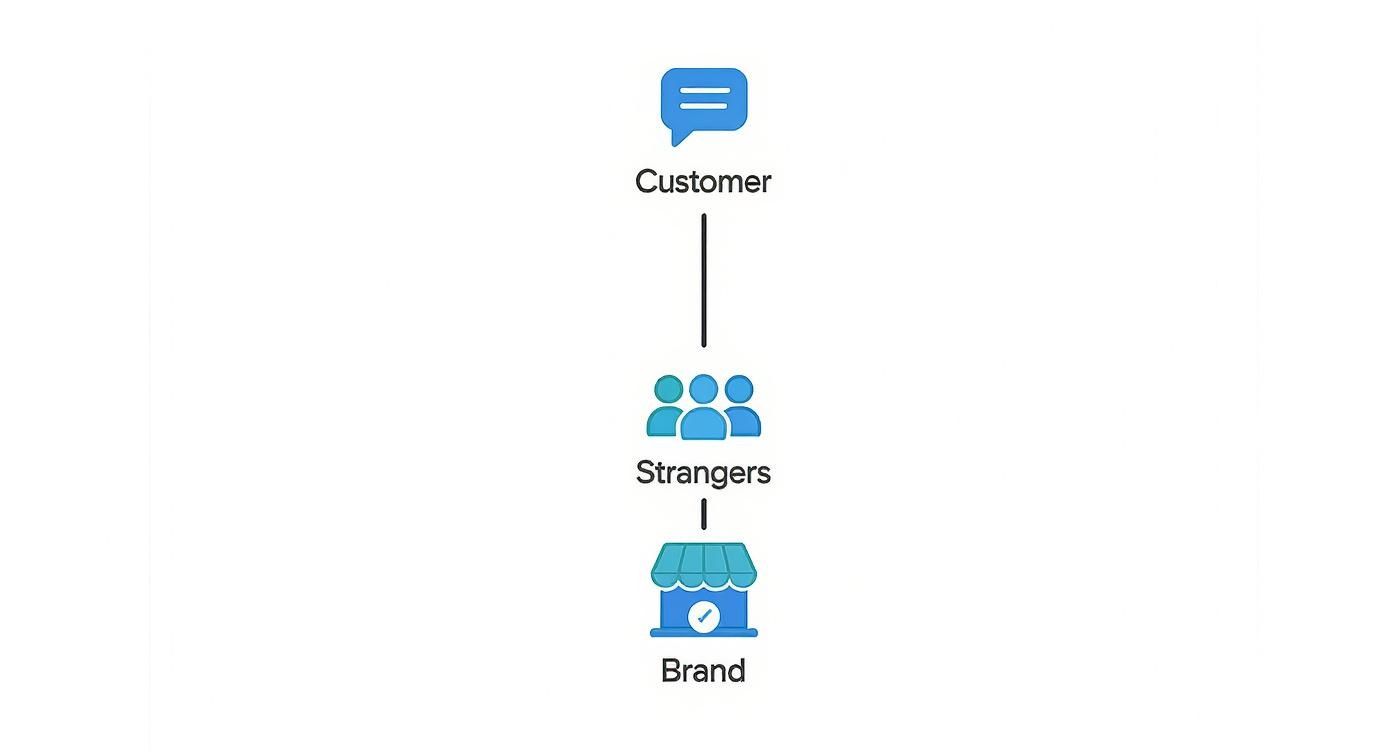
The magic here is that a stranger’s authentic experience often carries more weight than any ad you could ever run.
Pillar 3: Expert and Influencer Endorsements
When a respected voice in your niche—a popular blogger, a trusted influencer, or a major media outlet—gives your product a nod, their credibility instantly becomes your credibility.
An endorsement from a trusted source is a powerful shortcut. It tells shoppers that someone with high standards has already done the research and given their stamp of approval. And you don’t always need a celebrity. A micro-influencer with 5,000 highly engaged followers who truly love your niche can drive more sales than a mega-star with a passive audience.
Pillar 4: Wisdom of the Crowd
This one is all about the power of numbers. It’s built on a simple human instinct: if lots of people are doing something, it must be a good idea. You see this everywhere on successful Shopify stores:
- “Bestseller” badges calling out the most popular products.
- “15 people have this in their cart right now” pop-ups.
- Proudly displaying the total number of happy customers you’ve served.
These little nudges create a powerful sense of FOMO (fear of missing out) and reassure shoppers they’re making a popular—and therefore safe—choice. Knowing how to sprinkle these elements throughout your site is a core part of effective Shopify product page customization.
Pillar 5: Certifications and Badges
Think of these as visual shortcuts to trust. Official seals, industry awards, and security badges instantly communicate professionalism and safety.
Things like “As Seen In” logos from major publications, awards you’ve won, or secure payment icons from Norton or Shopify Payments ease shopper anxiety about quality and data security without you having to write a single word.
Pillar 6: Social Media Signals
Your social media presence is a living, breathing testament to your brand’s relevance. Your follower count, the likes on your posts, and the comments from your community all tell a story.
When a potential customer discovers your brand and sees thousands of people following you and eagerly engaging with your content, it validates you. It says, “This is a place people want to be.” It makes them want to join the club, too.
Why Customer Reviews Are Your Greatest Sales Asset
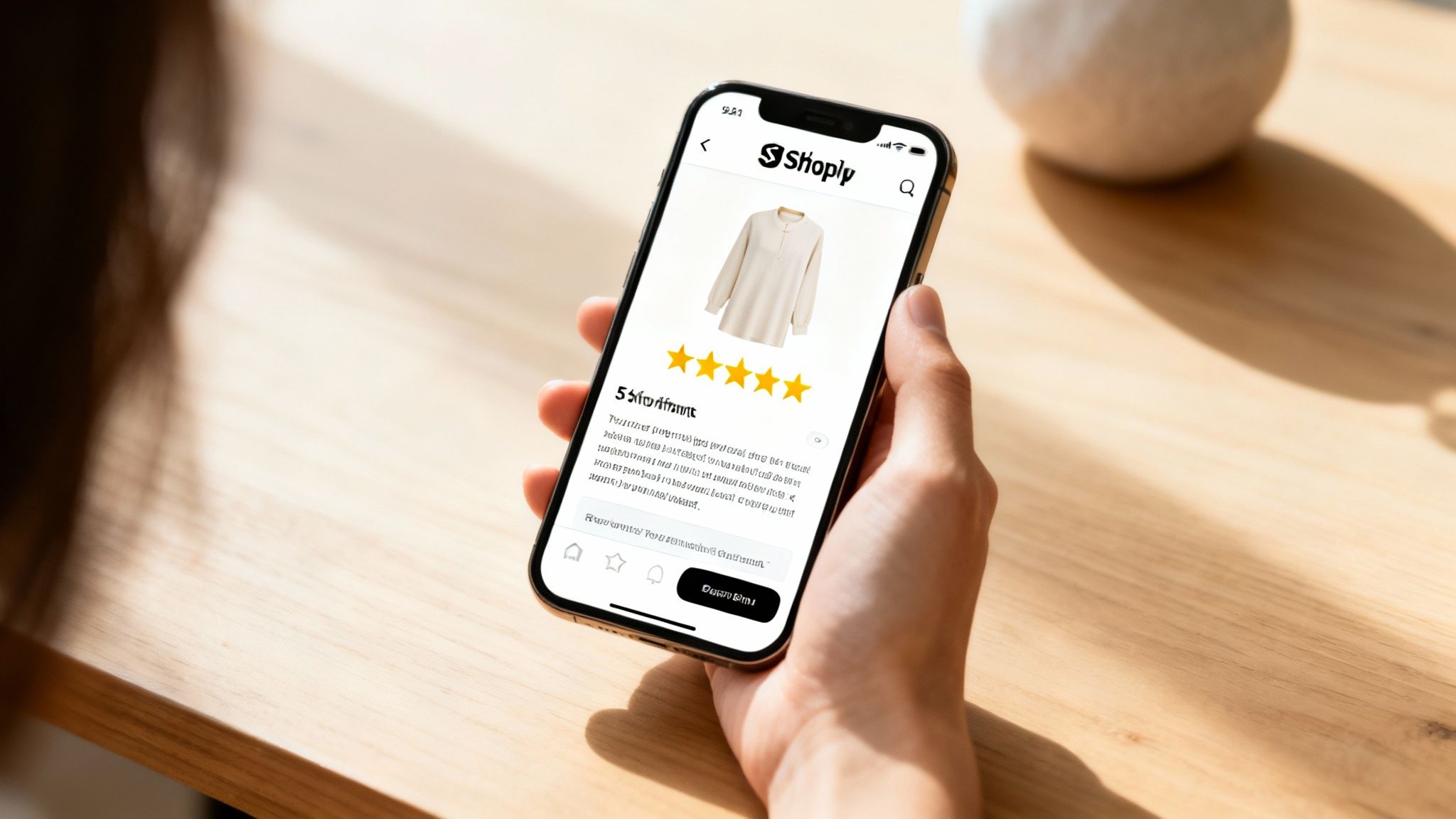
If your marketing social proof strategy has one essential cornerstone, this is it: customer reviews. Think of them as the digital equivalent of a friend leaning in to whisper, “Seriously, you have to try this.”
In a world filled with glossy ads, reviews cut through the noise with unfiltered reality. They’re raw, personal, and answer the one question every shopper has: “But will this actually work for me?”
The numbers don’t lie. Research shows that 93% of consumers say online reviews influence what they buy. Even more telling? A staggering 91% of shoppers aged 18-34 trust them as much as a recommendation from a friend. For Shopify stores, this trust translates directly into sales—displaying reviews can increase conversion rates by as much as 270%.
This is about far more than just chasing five-star ratings. It’s about building a living, breathing library of customer experiences that does the selling for you.
Turning Feedback into Fuel
So, how do you get more of these incredible reviews without sounding needy? The secret is to weave the request into the natural flow of the customer’s journey. You’re not begging for feedback; you’re inviting them to share their story.
Here’s how to do it:
- Automate a Gentle Nudge: Set up a simple email to go out a week or two after the product arrives. Keep the tone friendly, personal, and low-pressure.
- Make It Effortless: The link in your email should take them directly to the review form for the product they bought. The fewer clicks, the better.
- Offer a Small Thank You: A small discount on a future purchase isn’t a bribe. It’s a genuine gesture of appreciation for their time and insight.
The goal isn’t just to collect a review—it’s to show your customers you’re still listening long after they’ve checked out. That’s how you build the kind of loyalty that turns one-time buyers into lifelong fans.
Showcase Your Stories Everywhere
Once you start collecting these powerful stories, don’t hide them. Your reviews deserve to be a star feature across your entire store.
Think about weaving them into key areas like:
- Your Homepage: Feature a rotating carousel of your best, most compelling reviews.
- Product Pages: Place star ratings right under the product title where no one can miss them.
- Marketing Emails: Sprinkle in authentic quotes from happy customers to build confidence.
Going a step further, a well-planned user-generated content (UGC) strategy can take this to the next level, turning satisfied customers into your most powerful brand advocates. While reviews are text-based, UGC provides the visual proof that truly brings those stories to life.
Building Authentic Connections with Influencers

Let’s be honest, the term “influencer marketing” can make us cringe. It often brings to mind celebrities holding products they’ve clearly never touched. But that old, transactional approach is dead. In 2025, the game is all about building real, authentic connections.
This is incredible news for Shopify merchants. You don’t need a Hollywood-sized budget to create powerful marketing social proof. All you need is to find the right people—creators whose audiences hang on their every word—and build a genuine partnership.
Think of it as borrowed trust. When a creator your target customer already admires vouches for your product, their credibility becomes your credibility. It’s the modern-day version of a friend’s glowing recommendation, just delivered to thousands of people at once.
From Big Names to Niche Voices
Here’s a secret: the most powerful partnerships are often with creators you might have overlooked. A mega-influencer might offer massive reach, but a micro-influencer with a smaller, hyper-engaged community has something far more potent: genuine influence.
Consider the difference:
- The Old Way: Paying for a single, sterile photo from a celebrity with millions of disengaged followers that just screams “ad.”
- The New Way: Collaborating with a creator who has 5,000 die-hard fans who trust their recommendations implicitly because they are a true authority in your niche.
That second scenario is where the real connection happens. A creator who is genuinely excited about your product won’t just create an ad; they’ll create a story. Their endorsement feels earned and personal, which is why it hits home with their audience and builds unshakable trust for your brand.
The right influencer doesn’t just put your product in front of people; they give their audience a reason to care.
Structuring a True Partnership
A great collaboration feels less like a contract and more like a conversation. The goal is to create a relationship where the creator is a valued partner, not just a paid spokesperson.
Here’s a simple way to get started:
- Lead with Value, Not an Ask: Don’t just slide into their DMs with a pitch. Engage with their content first. Show them you genuinely appreciate what they do.
- Make Your Pitch Personal: When you do reach out, explain why you think your product is a perfect match for their specific audience. Make it clear you’ve done your homework.
- Give Creative Freedom: You’re the expert on your product, but they are the expert on their audience. Trust them to know what will connect.
The creator economy is a massive force for a reason. The influencer marketing market ballooned to $24 billion as brands everywhere woke up to its power. These partnerships work because 49% of people purchase something at least once a month after seeing an influencer post about it. And a creator’s honest testimonial can boost brand trust by up to 30%, according to recent social proof statistics.
Your Quick-Start Social Proof Playbook
Theory is great, but you’re here for results. You need clear steps you can take today to start building that critical trust. This playbook is designed for exactly that.
Here are three high-impact plays you can run on your Shopify store right now to amplify your marketing social proof.
Play 1: Supercharge Your Product Pages
Your product page is the final handshake before a sale. It’s where you need to melt away any last-minute hesitation.
First, make your best reviews impossible to ignore. Instead of burying them at the bottom, pull a powerful quote from a five-star review and feature it right under your product title. Then, bring your product to life by adding a gallery of user-generated photos showing it in the real world.
- Action Step: Use a Shopify app to feature a “Top Review” snippet right next to your “Add to Cart” button.
- Action Step: Create a dedicated “From Our Community” photo section using a UGC app.
Play 2: Create Smart Scarcity and Urgency
There’s nothing that motivates a shopper quite like seeing that other people want what they’re looking at. This “wisdom of the crowd” effect creates a gentle nudge of urgency and FOMO, encouraging them to take action.
You can tap into this by using subtle, real-time notifications. The goal isn’t to be pushy; it’s to make your store feel vibrant and alive.
When a shopper sees that “12 people have viewed this in the last hour,” it instantly validates their own interest. It can shift their thinking from, “Should I buy this?” to, “I’d better get this before it’s gone.”
Tools like Icona make this incredibly simple. You can add small, non-intrusive popups showing how many people are viewing an item, recent purchases, or low-stock alerts. It’s a nearly effortless way to create a natural buzz and make the shopping experience feel more dynamic and communal.
Play 3: Launch a Simple UGC Outreach Campaign
Authentic user-generated content is pure gold, but you don’t have to just wait for it to appear. You can get the ball rolling with a simple outreach campaign.
Start by identifying customers who recently left a positive review. They’re already happy fans.
- Craft a Personal Email: Send a short, friendly message thanking them for their purchase and kind words. Keep it human.
- Make a Simple Ask: Invite them to share a photo or video of their new product in action on social media.
- Create a Unique Hashtag: Give them a branded hashtag to use (like #MyBrandStyle) so you can easily find the content.
- Offer a Small Reward: A 15% discount on their next order is a fantastic way to show your appreciation.
This approach feels like a personal request, not a corporate marketing blast. For seasonal pushes, explore specialized seasonal review-building strategies for social proof to tailor your outreach. And to make gathering feedback even easier, learn how to create effective customer feedback forms that get you the insights you need.
The biggest mistake you can make? Fake reviews. It’s tempting, but shoppers today have a finely tuned radar for inauthentic praise. The fallout isn’t just a lost sale; it can make your entire brand feel dishonest, and that’s a reputation that’s incredibly hard to repair.
Another common misstep is doing too much, too fast. Bombarding a visitor with popups announcing every single sale or view creates digital noise and a sense of desperation, not excitement.
How to Keep Your Social Proof Genuine
The goal is real confidence, not a temporary buzz. Here are a few other pitfalls to watch out for:
- Using Generic UGC: Curate images and videos that genuinely showcase your product’s quality and align with your brand aesthetic. A blurry, poorly lit photo can make your product look cheap.
- Featuring Outdated Testimonials: A great review from three years ago has lost its power. Prioritize fresh, recent feedback to show customers your quality is consistent and people are loving your products right now.
Think of your marketing social proof as an honest conversation with your community. The moment it feels like a high-pressure sales tactic, you’ve lost the plot. Your authenticity is your most valuable asset—guard it fiercely.
Answering Your Top Questions About Social Proof
It’s normal to have questions. Let’s tackle some of the most common ones we hear from sharp Shopify merchants like you.
How Do I Get My First Customer Reviews?
This is the classic chicken-and-egg problem. The solution is simple: start by sending a friendly, automated email about a week after a customer’s package arrives.
The secret is to make it effortless. Ditch the corporate jargon, keep the tone personal, and link them directly to the product review page. A small “thank you” discount on their next purchase is a fantastic touch—it shows you value their opinion.
Is UGC Better Than Influencer Content?
That’s like asking if a hammer is better than a screwdriver. You need both.
- User-Generated Content (UGC) is your authenticity powerhouse. It comes from real people, answering the crucial question, “Will this work for someone like me?”
- Influencer Content is your discovery engine. It provides aspiration and reach, putting your brand in front of a larger, relevant audience that might not have found you otherwise.
Use influencer content to grab attention, then lean on UGC on your product pages to build that final layer of trust and close the deal.
Can Social Proof Ever Hurt My Sales?
Absolutely. If it feels forced, fake, or is managed poorly, it can backfire spectacularly. A product page with only a couple of scathing one-star reviews is a clear red flag.
The same goes for bombarding visitors with too many pop-ups—it shatters trust instantly. The antidote is transparency. Don’t be afraid of a critical review. Responding to it publicly and professionally shows everyone you’re a brand that listens and cares, which can actually build more credibility in the long run.
Ready to turn your store’s natural buzz into your most powerful sales tool? With Icona, you can add smart social proof notifications, low-stock alerts, and recent sales popups in just a few clicks—no code required. Start building trust and boosting conversions today.
We’ve all seen them. The bland, one-line reviews that just sit there. “Great product!” or “Fast shipping!” Sure, they’re nice to see on your Shopify store, but they don’t move anyone. They don’t paint a picture or create that gut-level trust that turns a hesitant browser into a confident buyer.
But what if your customer feedback could do more? What if it could become your most convincing sales copy?
In 2025, we’re all drowning in slick, polished marketing. An authentic voice—a real story from a real person—cuts right through the noise. This isn’t just about adding a “social proof” badge to your site; it’s about building the foundation of trust for a modern brand. A genuine customer story will almost always outperform ad copy you could write yourself.
Your Customers Are Your Best Copywriters
The real magic happens when you stop thinking about testimonials as just quotes or star ratings. Start seeing them for what they are: mini-stories. Every great testimonial has a beginning (the customer’s challenge), a middle (how your product came to the rescue), and an end (the awesome result).
The best testimonials don’t just tell you a product is good. They show you how it made someone’s life easier, better, or more exciting. That’s the emotional hook that truly sells.
This storytelling approach builds a powerful, self-sustaining cycle of trust. When a potential customer reads about someone just like them who solved the exact same problem with your product, it doesn’t feel like a sales pitch. It feels like getting a great recommendation from a friend.
Before we dive into how to get these stories, let’s break down what a truly powerful testimonial looks like. It’s not just a happy quote; it’s a strategic asset.
The Anatomy of a High-Impact Testimonial
| Component | Why It Matters | Example Snippet |
|---|---|---|
| The “Before” State | Sets the scene and establishes a relatable problem. Shoppers see themselves in the story. | “My skin was always so dry and flaky, especially in winter. I’d tried everything…” |
| The “Aha!” Moment | Pinpoints the discovery of your product and the decision to try it. | “…then a friend recommended this serum. I was skeptical, but the ingredients looked amazing.” |
| The “After” State | Reveals the specific, tangible results and benefits the customer experienced. | “Within a week, my skin felt completely different. It’s now so hydrated and has this healthy glow.” |
| Emotional Impact | Describes how the result feels. This is where the real connection happens. | “I feel so much more confident going out without makeup now. It’s been a total game-changer.” |
| A Specific Detail | Adds a memorable, authentic touch that makes the story feel real and unscripted. | “I especially love the subtle citrus scent—it makes my morning routine feel like a little luxury.” |
A testimonial that includes these five elements isn’t just a review; it’s a complete narrative that walks a new visitor from doubt to desire.
Why Shoppers Trust Other Shoppers
This isn’t just a gut feeling; shopper behavior backs it up. People actively hunt for the experiences of others before they buy, especially online where they can’t physically hold or try out a product.
And the good news? Your customers are often more than happy to share. A recent study found that 60% of customers have posted a business review in the last year when a brand simply asked them to. This proves people are ready and willing to share their stories. You just need to create the opportunity. You can learn more about these customer service trends and see for yourself how eager your audience is to become part of your brand’s story.
The Art of Asking for Powerful Testimonials
Getting incredible testimonials isn’t about blasting a generic email to your entire customer list. That’s like fishing with an empty hook. The real art lies in asking the right person, at the perfect moment, with the right questions. It’s a thoughtful, personal approach that makes your customer feel genuinely appreciated, not just used for marketing.
This process is what transforms a simple review into a compelling narrative of story, trust, and ultimately, growth for your brand.
As you can see, it all starts with one person’s story. That story builds the trust needed to convince new buyers, which is the engine that fuels sustainable growth.
Your best advocates are often hiding in plain sight. They’re the customers who just had a fantastic support experience, the ones who tag your brand on social media, or those who recently left a 5-star rating without any prompting. These are your people.
Timing is Everything
Imagine asking for a review right after a shipping delay. Not a great look, right? The key is to connect with customers when they are at their moment of peak happiness with your brand.
Here are a few golden opportunities to reach out:
- Post-Purchase Delight: Wait a week or two after their product has arrived. Give them time to unbox it, use it, and fall in love with it.
- Right After a Compliment: Did a customer email you with praise or leave a high NPS score? That’s your cue to ask if they’d share their thoughts more publicly.
- Following a Repeat Purchase: A second or third purchase is a massive signal of loyalty and satisfaction. They’ve already voted for you with their wallet—again.
Strategic timing makes your request feel like a natural continuation of a great experience, not an awkward, out-of-the-blue ask.
Ask Questions That Uncover the Story
A great testimonial is born from great questions. Instead of just asking, “Would you leave us a review?”—which usually gets you a generic “I loved it!”—guide them toward the story. Your real goal is to uncover the emotional ‘before and after.’
Don’t just ask for a review. Ask for their story. This simple shift in framing changes everything, turning a bland comment into a relatable journey another shopper can see themselves in.
When you ask targeted, open-ended questions, you make it easy for customers to give you the detailed, compelling feedback you need. For more powerful insights, you can learn more about optimizing your client testimonial form to truly capture the voice of your customer.
This approach doesn’t just get you better content; it actually reinforces the positive experience they had. It creates a powerful feedback loop. After all, customers who have a positive experience spend 140% more than those who have a negative one. By turning a happy moment into a testimonial, you’re cementing that loyalty. Asking for their story isn’t just marketing—it’s smart business.
How to Write Testimonials with Integrity
You’ve got it. That glowing piece of feedback from a happy customer—the kind that makes you do a little happy dance at your desk. Now what?
The next step is a delicate art: polishing their words without losing the magic. It’s a fine line between fixing a typo and accidentally rewriting their story into something that sounds like it came from your own marketing department.
Your goal is to make their praise easy to read while keeping the raw, authentic energy that makes it so believable in the first place. Think of yourself as a careful editor, not a ghostwriter. The power of a testimonial is in its genuine voice; your job is just to make sure that voice comes through loud and clear.

This isn’t about putting words in their mouth. It’s about framing their praise for maximum impact so it connects instantly with new visitors scrolling through your site.
Polishing The Story Ethically
So, where’s the line between helping and altering? The truth is, light editing is not only acceptable but often necessary. No one wants to read a review riddled with spelling mistakes or a single, rambling paragraph that never seems to end.
Your customers are busy people, not professional copywriters, and that’s perfectly fine. Here’s what you can, and should, do to help their message shine.
- Correct typos and grammar: This is a no-brainer. Fix obvious spelling errors and grammatical mistakes that could distract a potential buyer.
- Trim for clarity and punch: Got a long, winding sentence? Cut it down. Focus on the most powerful parts of their feedback and trim the rest. Get right to the good stuff.
- Format for scannability: Break up long walls of text. Use bolding to pull out key phrases or incredible results, like “slashed my return rate by 20%” or “literally the softest fabric I’ve ever felt.”
What you should never do is change the customer’s original intent. Don’t add details they didn’t provide or exaggerate their claims. The moment a testimonial feels scripted, it loses all its conversion power.
The Golden Rule: Always Get Final Approval
This is the most crucial step, and it’s one a lot of people skip. Once you’ve made your light edits, always send the polished version back to the customer for their approval before you publish it anywhere.
This simple act of respect does two things: it ensures the customer still feels their story is accurately represented, and it gives you documented permission to use their words. It’s a win-win that builds even more goodwill.
A quick, friendly email is all it takes. Something like, “Thank you again for your amazing feedback! We’ve tidied it up slightly for our website. Does this still capture your experience?”
By keeping the customer in the loop, you’re not just learning how to write testimonials; you’re building a relationship based on transparency and respect. Beyond just crafting a compelling story, it’s about understanding how to write testimonials that build real trust from the very beginning. That foundation of integrity is what turns a one-time compliment into a marketing asset that works for you for years to come.
Placing Testimonials for Maximum Impact
You could have the most amazing, heartfelt testimonial in the world, but if it’s buried on the wrong page, it’s not doing you any good. It’s like having a killer punchline and telling it in an empty room. Knowing how to write testimonials is only half the battle; knowing exactly where to place them is what turns those powerful stories into sales.
Think of your website as a conversation. At every click, your customer has questions and doubts. Your mission is to anticipate those moments of hesitation and meet them with the perfect piece of social proof.
This isn’t about randomly sprinkling quotes on your homepage. It’s about creating a strategic map that builds trust at the precise moments your shoppers need it most.
The Product Page Power Play
For most shoppers, your product page is the final battleground between “Add to Cart” and “I’ll think about it.” This is where they’re weighing the price, scanning the features, and looking for a reason to believe. It’s the absolute best place for testimonials that tackle specific product benefits head-on.
Let’s say you sell an organic face serum known for clearing up acne. You need a testimonial right below the product description that says, “My skin has never been this clear.” Or maybe your travel backpack has a surprisingly spacious laptop compartment? Feature a review from a digital nomad who raves about it. It just makes sense.
These hyper-relevant testimonials are the final, reassuring nudge. They confirm that your product actually delivers on its promises, turning a hesitant browser into a confident buyer. Mastering your Shopify product page customization to feature these trust signals is one of the highest-impact changes you can make to your store.
Strategic Testimonial Placement on Your Store
Just as different rooms in a house have different purposes, different pages on your site serve different functions in the customer journey. This means they need different kinds of social proof to be effective. A one-size-fits-all approach will fall flat.
Let’s look at how to match the right type of testimonial to the right page to maximize its persuasive power.
| Location (Page) | Best Testimonial Type | Goal |
|---|---|---|
| Homepage | Short, impactful quotes with photos | To quickly establish broad brand credibility and trust the moment someone lands on your site. |
| Product Pages | Specific, benefit-driven reviews & star ratings | To overcome last-minute objections and directly answer product-specific questions. |
| Checkout Page | Short security or satisfaction quotes | To reduce cart abandonment by reassuring shoppers their purchase is safe and smart. |
| About Us Page | Long-form, story-driven case studies or video testimonials | To build a deeper emotional connection to your brand’s mission and journey. |
| Dedicated Testimonials Page | A library of all your best reviews, sortable by product or use case | To provide a comprehensive resource for shoppers who are deep in the research phase. |
By tailoring your social proof to the context of each page, you create a seamless, trust-building experience that guides a customer from their first visit to the final “buy now” click.
Your goal isn’t just to show that people like your product. It’s to show the right person that someone just like them solved the exact same problem they’re facing right now.
This thoughtful approach is about more than just collecting reviews. It’s about strategically deploying your customer stories as your most powerful marketing assets, ensuring every single one lands with the impact it truly deserves.
Sharing Customer Stories with Confidence
Using a customer’s words is a privilege, not a right. In a world where shoppers are more skeptical than ever, building a foundation of trust isn’t just good ethics—it’s smart business.
This isn’t about getting tangled in scary legal jargon. It’s about creating a respectful relationship that protects both your customers and your brand. Think of it as the digital handshake that seals the deal. Before you splash their amazing story across your homepage or run it in an ad, you need their explicit permission. It’s the difference between borrowing a story and truly earning it.
Getting the Green Light
The single most important step here is getting clear, documented consent. This gives you the right to use a customer’s name, their photo, and their story across all your marketing channels without any surprises down the road.
The easiest way to do this? Build it right into your review request process. A simple checkbox or a clear statement at the bottom of your feedback form can do the trick.
Here’s some simple language you can adapt:
“By submitting your story and photo, you agree that we can share it in our marketing materials, including on our website, social media, and emails. We’ll always treat your story with respect! Thank you for being part of our community.”
This straightforward approach is transparent and sets clear expectations right from the beginning. It’s a small step that builds massive long-term trust and strengthens your entire eCommerce marketing funnel.
Navigating Incentives and Transparency
Sometimes, offering a small thank you—like a discount or store credit—is a great way to encourage customers to take a few minutes to share their feedback. It’s a fantastic strategy, but it comes with one very important rule from the Federal Trade Commission (FTC): you must disclose it.
If a review was incentivized in any way, you need to make that clear. It can be as simple as adding a note like, (Customer received a discount for their honest review). This kind of transparency isn’t optional.
Think about it from the shopper’s perspective. People are incredibly wary of fake reviews and online scams these days. This skepticism makes authentic, honest practices more crucial than ever for building real credibility.
When you treat your customer stories with this level of care, you show that you value them as people, not just as marketing assets. That’s how you build a brand that people are not only happy to buy from, but proud to recommend.
Got Questions? We’ve Got Answers
You’re armed with the strategy to turn customer praise into your most powerful marketing asset, but a few questions always come up. Let’s walk through the common ones so you can move forward with total confidence.
Think of this as the final piece of the puzzle. You’ve got the ‘how-to’ on asking, writing, and placing your testimonials. Now, let’s clear up any lingering uncertainties and get you on your way.
What Should I Do with a Negative Review?
First off, take a deep breath. A bad review isn’t a disaster—it’s actually an opportunity. When you respond publicly with grace and a genuine desire to help, you show every potential customer that you’re a brand that cares. It proves there’s a real, attentive human on the other side of the screen.
Here’s a simple game plan for your response:
- Acknowledge and Thank: Kick things off by thanking them for taking the time to leave feedback, even if it stings a little.
- Apologize Sincerely: A simple, heartfelt apology for their poor experience goes a long way.
- Take it Offline: The goal isn’t to have a long back-and-forth in public. Offer a direct line of contact, like a support email, to sort out the specifics privately.
This approach does more than just help the unhappy customer; it shows everyone else looking that your customer service is top-notch. Honestly, this builds way more trust than a perfect wall of 5-star reviews, which can sometimes feel a bit too good to be true.
Should I Offer an Incentive for Testimonials?
Yes, you absolutely can, and it’s a great way to show customers you value their time. A small gesture—like a discount on their next purchase or a bit of store credit—can give them the nudge they need to share their thoughts.
But there’s one golden rule: you have to be completely transparent about it.
The Federal Trade Commission (FTC) has clear guidelines on this. If you’ve given someone a perk for their review, you need to disclose it. A simple, honest line like “(Customer received a 10% discount for sharing their honest thoughts)” is perfect.
This kind of transparency doesn’t make the testimonial weaker; it actually makes it stronger. It signals that you’re an honest brand with nothing to hide, and that’s a powerful message all on its own.
How Long Should a Testimonial Be?
This is a classic “it depends” situation. The perfect length is all about where you’re putting it. You wouldn’t put a novel on a billboard, right? Same principle applies here.
- Product & Checkout Pages: Think short, sharp, and impactful. You want a single, powerful sentence that smashes a common objection. Something like, “This is the only moisturizer that didn’t irritate my sensitive skin,” is absolute gold.
- Dedicated Testimonials Page or Case Study: This is where you can let the story breathe. Longer, more detailed accounts that walk through the full “before and after” journey are incredibly convincing for shoppers who are really doing their homework.
- Social Media Graphics: Go for a bite-sized, punchy quote that looks amazing in a visual format. Pull the most compelling phrase from a longer review and let it shine.
The secret is to match the testimonial’s format to the customer’s mindset on that specific page. A perfectly placed, relevant quote will always win, no matter how long it is. When you master tailoring your testimonials for different contexts, you make every customer story work that much harder for your store.
Ready to turn your Shopify store into a conversion machine with social proof that truly connects? Icona adds a virtual try-on button right on your product pages, giving shoppers the ultimate confidence boost by letting them see how clothes look on their own bodies. It’s the best kind of testimonial—your product proving its own value before the purchase.