
Stop guessing and start selling. Imagine a customer lands on your product page and sees your apparel on a model who looks just like them—instantly creating a personal connection that turns browsers into buyers. This isn’t a far-off dream; it’s what an AI fashion model makes possible for your Shopify store right now, and it’s your key to unlocking higher conversions and fewer returns.
Why Your Shopify Store Needs an Upgrade
If you’ve run a fashion eCommerce store for any length of time, you know the frustrations. You pour a small fortune into photoshoots, chasing that perfect look, only to find the final images don’t resonate with every person who visits your site. This expensive gamble leads straight to two of the biggest profit killers for fashion entrepreneurs.
First, you’re hit with staggering return rates. A customer loves a dress online, but when it arrives, the fit is completely off. It gets sent back, and you eat the cost of shipping, restocking, and a lost sale. Then there’s the abandoned cart—a digital graveyard of good intentions, often filled with items a shopper just couldn’t commit to because they couldn’t imagine how it would look on their body.
A Smarter Way to Sell Fashion
These aren’t isolated problems; they point to a core disconnect. Traditional product photos can’t answer the single most important question on a shopper’s mind: “How will this look on me?” An AI fashion model is the answer, a brilliant tool designed to finally close that gap. It gives shoppers the confidence to buy, which in turn cuts your operational headaches and creates a shopping experience that feels like it was made just for them.
The market data for 2025 confirms this shift. The global AI in fashion market is already valued at $2.92 billion and is on track to rocket past $26 billion by 2032. It’s no surprise that over 60% of fashion industry leaders are making AI their top priority this year, knowing it’s the key to unlocking serious profit growth. You can learn more about the future of AI in fashion and its market growth.
When you move beyond static images, you’re not just adding a cool new feature. You’re fundamentally changing the conversation with your customers. You’re proving that your brand sees them as individuals, building a kind of trust and loyalty that a simple product photo never could.
In this guide, we’ll pull back the curtain on how this technology actually works and give you a clear, actionable roadmap for bringing it to your own Shopify store. Get ready to discover how an AI fashion model can do more than just bump up your numbers—it can help you build a more inclusive, exciting, and profitable brand.
How an AI Fashion Model Actually Works
So, how does an AI fashion model turn a simple product photo into your most powerful sales tool? Let’s pull back the curtain. If traditional online shopping is like trying to guess a movie’s plot from the poster, think of this technology as giving your customers the full, immersive story. It’s all about replacing nagging uncertainty with solid confidence.
This isn’t just one single magic trick. It’s a suite of brilliant tools, all designed to answer that one critical question: “How will this actually look on me?” Each approach tackles this from a slightly different angle, but they all share the same goal—to create a more personal, reassuring, and profitable shopping experience.
This infographic neatly captures how an AI model can transform the customer journey from a point of friction into a catalyst for growth.
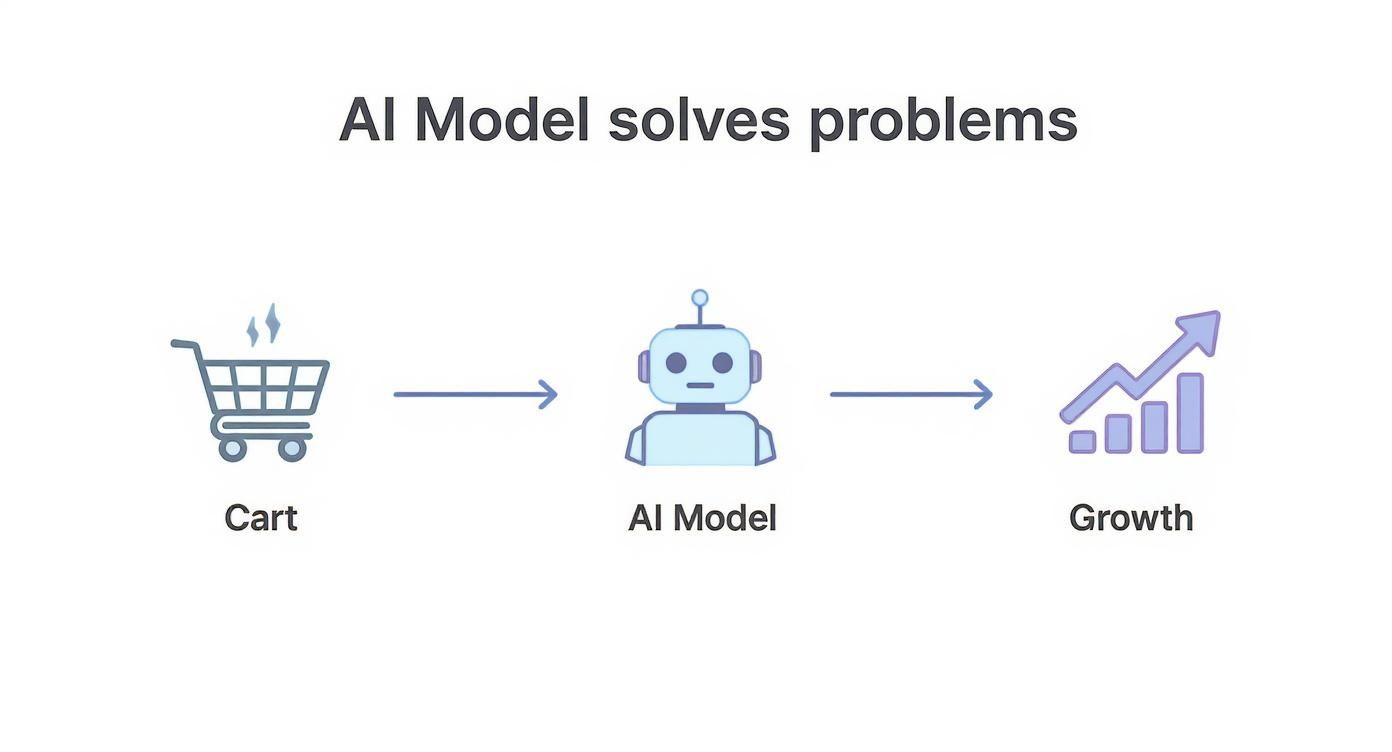
The flow is simple but incredibly powerful. AI steps in right where customers hesitate, turning that friction into a driver for both business growth and genuine customer satisfaction.
Generative On-Model Imagery
First up is Generative On-Model Imagery, the most accessible starting point for most Shopify stores. Imagine a full-blown digital photoshoot that happens in seconds, without the hassle of a studio, stylists, or sky-high costs. You just start with a basic photo of your product—a simple flat lay on a clean background or a shot on a mannequin works perfectly.
From that single image, the AI gets to work. It meticulously analyzes the garment’s shape, texture, and how the fabric drapes. Then, almost instantly, it generates a diverse gallery of photorealistic models wearing that exact item. This means you can showcase your apparel on a wide range of body types, ethnicities, and sizes, making sure every single visitor feels seen and represented.
This approach is a total game-changer for Shopify stores that need to produce high-quality, inclusive model photography at scale. It completely sidesteps the time-consuming and expensive traditional process, swapping it for a fast, automated, and incredibly effective solution.
Virtual Try-On Avatars
Next, we have Virtual Try-On Avatars. This is where things get really personal. This technology empowers your customers to literally become their own models by creating a digital version of themselves right on your site.
Shoppers can input their specific measurements—like height, weight, and general body shape—to generate a custom avatar. The AI then simulates exactly how your clothing would fit and hang on their unique proportions. This gives them a remarkably accurate preview of the fit, answering subtle questions that a standard size chart could never hope to address.
This isn’t just about overlaying a picture on a digital doll. It’s about simulating the actual physics of fabric on a specific body. When you do that, you’re directly tackling the #1 reason for returns: a poor fit.
For example, a customer wondering if a dress will be too tight across the hips can see a realistic simulation on their avatar before ever adding it to their cart. That level of detail builds immense trust and can dramatically slash your return rate.
Photo-Based Virtual Try-On
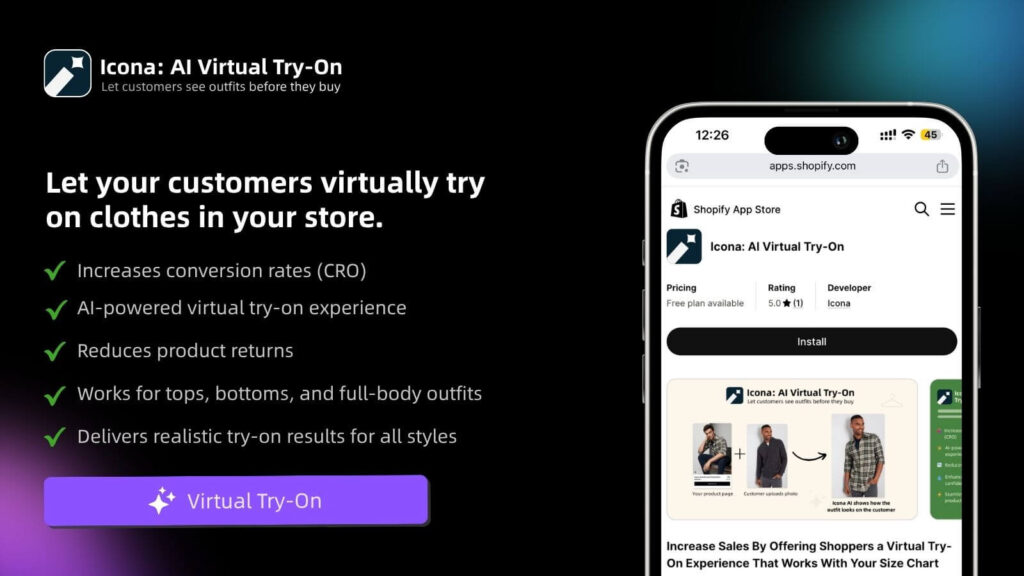
Finally, there’s Photo-Based Try-On, which might be the most direct and intuitive method of all. This is the technology that powers tools like Icona, allowing a shopper to upload a photo of themselves and see your product realistically placed right on their own body.
It’s an incredibly simple and natural process. A customer snaps a quick photo, and the AI model intelligently maps the clothing onto their image. Sophisticated algorithms account for their specific pose and body shape, preserving all the subtle nuances of how the fabric would naturally fall. The result is a “virtual mirror” that feels uncannily personal and real.
This method is brilliant at closing the imagination gap for good. When a shopper sees an item on their own photo, it’s no longer just an abstract product on a webpage; it instantly becomes their new top or their new dress. This creates an immediate emotional connection and provides that final nudge of confidence they need to click “Buy Now.”
How an AI Fashion Model Transforms Your Store’s Metrics
Putting an AI fashion model on your site isn’t just about adding a cool new gadget. It’s a direct investment in the metrics that actually matter—the ones that define whether your store thrives or just survives. This is where you see the real, tangible return, turning casual browsers into committed buyers and one-time customers into lifelong fans.
Let’s break down exactly how this technology will give your business a serious lift in 2025.

The biggest sales killer online is doubt. When a shopper sees a shirt on a model who looks just like them—or even better, on a virtual version of themselves—that wall of uncertainty crumbles. The thought process shifts instantly from “that’s a nice shirt” to “that shirt would look amazing on me.” This burst of confidence is the rocket fuel your sales funnel has been waiting for.
Skyrocket Your Conversion Rates
Think about every abandoned cart. Each one represents a moment of hesitation. A customer liked an item enough to add it, but something stopped them from pulling the trigger. More often than not, it’s that nagging uncertainty about fit and appearance.
AI fashion models tackle that hesitation head-on by giving shoppers the visual proof they crave. For example, a Shopify store selling dresses saw a 60% increase in add-to-carts for a new collection after implementing on-model AI imagery, simply because shoppers could finally visualize the fit on different body types. This confidence doesn’t just nudge them along; it propels them toward checkout.
It’s a powerful shift. In fact, some stores using virtual try-on technology have seen conversion rates jump by up to 250% on the product pages where it’s active. When you remove the guesswork, you build the confidence needed to buy.
“The single greatest friction point in online fashion is the inability to visualize fit. By solving this with AI, you’re not just improving the user experience; you’re fundamentally rewiring the path to purchase for your entire customer base.”
When you deliver a better, more personal shopping experience, you build a reputation as a brand that truly gets its customers. That’s what brings them back again and again. For those ready to go all-in, there are many fantastic eCommerce personalization tools that build on this very same principle.
Drastically Reduce Costly Returns
For any fashion brand, returns are more than just an annoyance—they’re a massive profit killer. The number one reason for returns is painfully simple: “it didn’t fit right.” Every single return eats into your revenue and adds operational costs for shipping, processing, and restocking an item that might already be out of season.
An AI fashion model hits this problem right at its source.
- Pre-Purchase Certainty: By showing a realistic preview of how a garment will look and fit on a similar body type, you erase the doubt that causes returns in the first place.
- Accurate Sizing: A virtual try-on gives a far better sense of an item’s drape and cut than a flat size chart ever could, guiding shoppers to the right size on the first try.
- Reduced Bracketing: You’ll see a big drop in “bracketing”—the costly practice of customers buying multiple sizes of the same item just to send most of them back.
Case in point: a dropshipping business that integrated a virtual avatar try-on saw its return rate for jeans drop from 35% to 20% in just three months. That’s pure profit that goes straight back to your bottom line.
Elevate Your Brand and Boost AOV
Beyond the hard numbers, using AI models says something powerful about your brand. In the crowded market of 2025, you’re not just another clothing store. You’re an innovative, inclusive brand that puts the customer’s experience first. That kind of forward-thinking approach builds incredible trust and loyalty.
And here’s the best part: that trust encourages people to buy more. Once a customer is confident that one item will fit them perfectly, they’re far more willing to add a second or third piece to their cart.
This naturally raises your Average Order Value (AOV) because the risk of trying something new feels so much lower. They aren’t just buying a product anymore; they’re building a whole wardrobe from a brand they know they can count on.
Impact of AI Fashion Models on Key Ecommerce Metrics in 2025
Let’s put this into perspective. The table below illustrates the kind of shift you can expect when you move from standard product pages to an experience enhanced by AI.
| Metric | Traditional Product Page | AI-Enhanced Product Page | Potential Uplift |
|---|---|---|---|
| Conversion Rate | 1-2% Average | 3-7% or Higher | 50-250% |
| Return Rate | 20-30% Industry Avg. | 12-18% | Up to 40% Reduction |
| Add-to-Cart Rate | 10% Average | 15-25% | 50-150% |
| Average Order Value | Baseline (e.g., $100) | Higher (e.g., $120-$135) | 20-35% |
| Customer Engagement | Low (short time on page) | High (interactive experience) | 3-5x Longer Session |
As you can see, the impact isn’t just marginal. It’s a fundamental improvement across the board, turning a good storefront into a great one by solving the core challenges of selling fashion online.
Your Step-by-Step Integration Plan
Ready to bring this powerful technology to your store? Getting started with an AI fashion model is far more straightforward than you might think. This isn’t some complex, technical ordeal reserved for massive brands; it’s an accessible upgrade designed for busy entrepreneurs like you.
Let’s walk through a clear, actionable plan to get you from idea to launch.
Step 1: Choose the Right AI Solution
First things first: you need to pick a partner that actually gets the unique needs of a Shopify store. With the boom in AI, the market is flooded with options, but they are not all created equal. You want a tool that feels like a natural extension of your business, not a clunky add-on that creates more problems than it solves.
Here’s what to look for in a top-tier solution for 2025:
- Seamless Shopify Integration: The best tools are built for Shopify. Look for an app that lives right inside your Shopify dashboard, requires zero custom coding, and won’t break your theme.
- A Truly User-Friendly Interface: You shouldn’t need a PhD in data science to use it. A great solution will have an intuitive dashboard that lets you upload photos, tweak settings, and apply models with just a few clicks.
- Transparent and Scalable Pricing: Steer clear of solutions with hidden fees or confusing credit systems. Look for clear, tiered pricing plans (ideally with a free or trial option) that can grow with your store.
- High-Quality, Realistic Models: The final image has to be believable. Make sure the provider’s AI generates photorealistic models that accurately show fabric drape, texture, and fit. This is how you build genuine customer trust.
Solutions like Icona are designed with these principles at their core, offering a Shopify-native experience that makes sophisticated technology feel surprisingly simple.
Step 2: Prepare Your Product Photos
Once you’ve found your app, it’s time to get your product images ready. You know the old saying, “garbage in, garbage out”? It’s especially true for AI. The quality of the photos you feed the system directly determines the quality of the on-model images it creates. But don’t panic—you don’t need a professional studio.
Pro Tip: Think of it like giving the AI a clean blueprint. The more detail and clarity you provide about the product’s shape, texture, and design, the more accurate and stunning the final on-model image will be.
Here is a simple checklist for prepping your photos:
- Use a Clean, Simple Background: A solid white or light gray background is perfect. It helps the AI easily separate the product from its surroundings.
- Ensure Good, Even Lighting: Avoid harsh shadows or bright hotspots that hide the details of the fabric and seams. Natural, diffused light is your best friend.
- Capture the Full Garment: Make sure the entire item is visible in the frame. Nothing should be cut off.
- Choose the Right Shot Type: Flat-lay (garment laid flat) or mannequin shots are ideal. They provide a clear, undistorted view of the product’s true shape, which is exactly what the AI needs.
Following these simple guidelines will set you up for success and ensure your AI-generated models look incredible.
Step 3: Launch and Optimize on Your Store
With your solution chosen and photos prepped, the final step is the launch! For a Shopify-native app, the process is incredibly straightforward.
Here’s how to do it:
- Install the App: Head to the Shopify App Store, find your chosen solution (like Icona!), and install it with one click.
- Configure Your Settings: Open the app right from your Shopify admin. This is where you’ll set your preferences for model diversity, background styles, and other display options.
- Upload and Generate: Select the product photos you prepared and upload them into the app’s dashboard. The AI will work its magic and generate your on-model photos.
- Publish and Test: Review the generated images, and once you’re happy, push them live to your product pages. Start with your top 5-10 best-selling products to test the impact before rolling it out store-wide.
Integrating a powerful AI fashion model isn’t a daunting project anymore. By choosing the right tool and following these clear steps, you can roll out a high-impact upgrade that boosts customer confidence and drives more sales. For a deeper dive into the mechanics, explore our guide to virtual try-on technology.
Merchandising Strategies That Drive Sales
Bringing an AI fashion model into your store is a fantastic first step, but the real magic happens when you weave it into your merchandising. Think of it like getting a world-class camera. The gear is amazing, but the photos only become art when you master the composition. In the same way, smart merchandising turns your AI tool from a cool feature into a powerful sales engine.
It all starts with making the technology impossible to miss. Your virtual try-on or AI-generated model images can’t be a hidden gem. They need to be front and center on your product pages.
Make Your Call-to-Action Irresistible
Your call-to-action (CTA) is the front door to the entire experience. A bland “Click Here” button won’t do. You need something compelling that instantly shows the shopper what’s in it for them. The goal is to spark curiosity and make them feel like they’re about to unlock a feature built just for them.
Here are a few powerful CTA examples that are resonating with shoppers in 2025:
- “See This on a Model Like You”: This language is warm, inclusive, and speaks directly to a customer’s biggest question.
- “Try It On Now”: It’s direct, actionable, and creates a sense of immediacy, capturing the feeling of stepping into a fitting room.
- “Visualize Your Fit”: This appeals to practical shoppers who hate the hassle of returns by focusing on the core benefit.
Place these CTAs right next to the “Add to Cart” button to make trying the garment on a natural step in the buying process. For a deeper dive into optimizing your layout, check out our guide on https://tryicona.com/shopify-product-page-customization/.
Champion Diversity and Inclusion
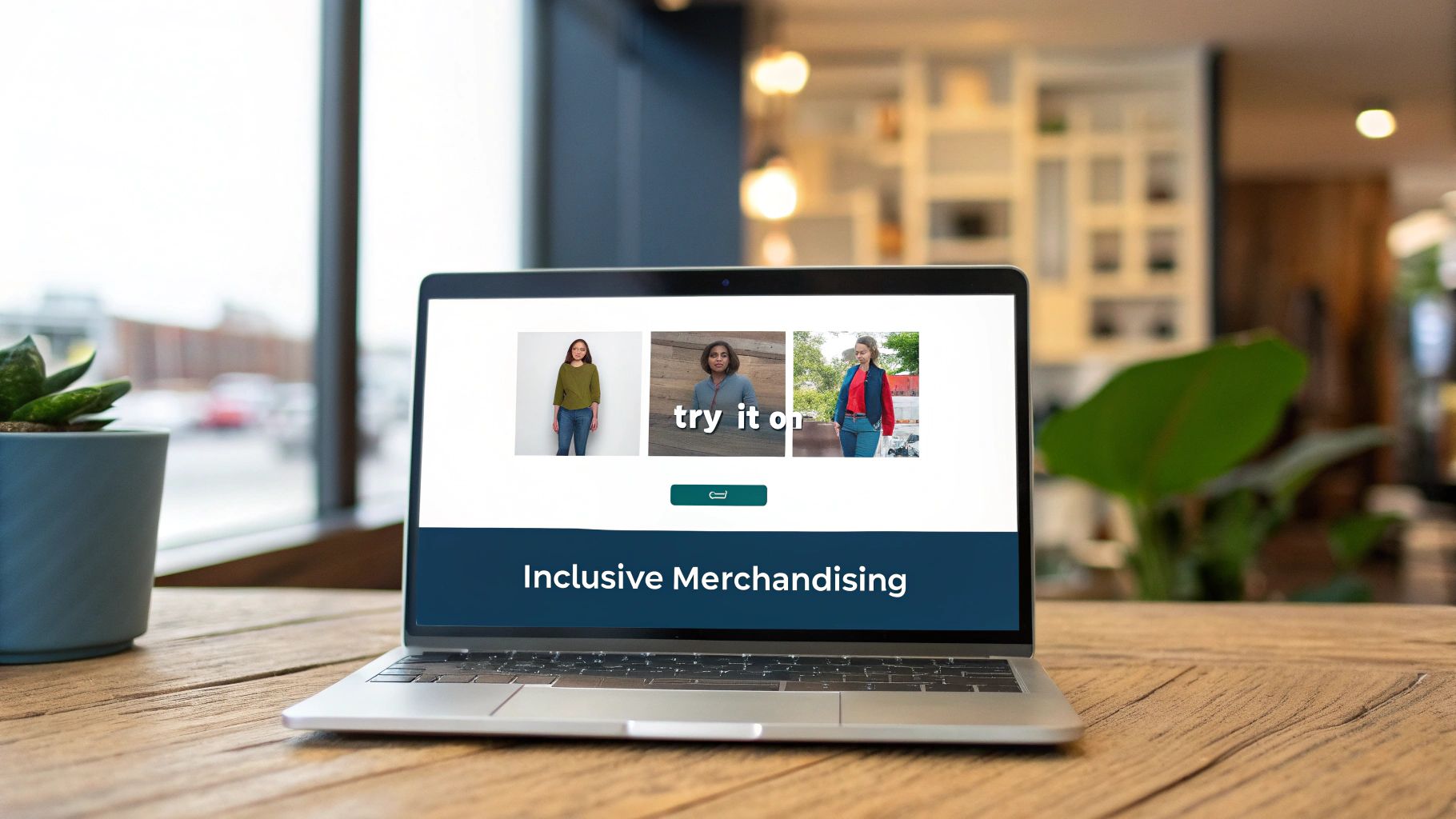
One of the most incredible advantages of AI fashion models is the power to showcase true diversity without the traditional roadblocks. Photoshoots are expensive and limited by model availability, which often leads to a very narrow look. AI completely shatters those barriers.
This isn’t just about doing the right thing; it’s smart business. When customers see models who reflect their own size, shape, and skin tone, it creates an instant, powerful connection. They feel seen, understood, and welcomed by your brand.
Use your AI tool to generate a beautiful spectrum of models that truly represents your customer base. A simple action, like showing a dress on a size 16 model as prominently as on a size 2, can have a massive impact. In fact, shoppers are 73% more likely to buy from a brand that offers a diverse and inclusive experience.
Use Data to Refine Your Strategy
Your work isn’t finished once the feature goes live. The best merchants are always learning and adapting. Modern AI tools, like Icona, come with analytics dashboards that give you a goldmine of information about how shoppers are actually using your virtual models.
Keep a close eye on these key performance indicators (KPIs):
- Engagement Rate: Which product pages are getting the most “try-on” clicks? This tells you which of your items benefit the most from this visualization.
- Conversion Lift: Look at the conversion rates of products with AI models versus those without. Run A/B tests to see which model poses or CTA placements are driving the most sales.
- Time on Page: Are people sticking around longer on pages with interactive features? More time spent on a page is a strong signal of genuine interest.
By digging into this data, you can spot trends and double down on what’s working. This feedback loop helps you continuously polish your merchandising strategy for maximum impact.
Takeaway: Your Next Step to eCommerce Growth
The AI fashion model isn’t some far-off idea; it’s a practical, powerful tool that ambitious brands are using right now to get ahead in 2025. We’ve walked through how this technology gives your conversions a serious boost, cuts down on the nightmare of returns, and creates a shopping experience so personal it builds true loyalty.
The future of online fashion is dynamic, inclusive, and far more profitable. Your journey starts with a simple step: stop making customers guess.
Make Your Move
The change is already happening. Your customers want to see themselves in the clothes you sell, and an AI model is the most direct way to make that happen. This is your chance to:
- Inspire real confidence by answering that crucial question: “But how will it look on me?”
- Cut down on operational headaches by dramatically lowering your return rates.
- Craft an experience people remember, turning first-time visitors into customers for life.
When you bring in a solution that puts your customer at the center of the story, you’re not just adding a new feature—you’re securing your brand’s future.
Ready to see how quickly you can bring this to life? Try Icona’s virtual try-on to boost your conversions.
Got Questions? We’ve Got Answers
Stepping into the world of AI can feel like exploring new territory, so it’s natural to have questions. Let’s clear up some of the most common things we hear from Shopify store owners just like you.
What’s the real cost of using an AI fashion model?
It’s probably much less than you’re imagining. Forget the budget for a traditional photoshoot—modern AI model solutions are designed to be incredibly cost-effective.
Most operate on a simple subscription basis, with tiers based on how many products you have. You can often get started for less than the cost of a single professional photo session, making it a smart move for everyone from one-person startups to established brands. Plus, many apps offer a free trial, so you can see the results for yourself without any risk.
Do I need to be a tech whiz to set this up?
Not at all. In 2025, the best tools are built for merchants, not developers. If you can install an app from the Shopify App Store, you have all the technical skill you need.
The whole process is designed to be intuitive. You’ll work through a simple, guided setup inside your store’s dashboard where you upload your product photos and choose the model looks you want. The AI does all the heavy lifting. Seriously, no coding is required.
Will AI models actually look real enough for my customers?
Yes, and the results are stunning. Today’s generative AI creates truly photorealistic, high-resolution models that look like they stepped right out of a professional studio.
The technology is sophisticated enough to capture the little things that matter—the texture of a linen shirt, the way a silk dress drapes, and the true fit of a pair of jeans. It gives your customers a genuine sense of the product.
The point isn’t to fool anyone. It’s about giving shoppers an accurate, helpful preview that lets them buy with confidence. The quality is so good that it builds trust, helping you bridge that critical gap between a great-looking product page and a happy customer.
This realism is what convinces a hesitant browser to click “add to cart.” It’s about creating a shopping experience that feels certain, personal, and trustworthy.
Ready to see how this could look on your own product pages? Stop wondering and start seeing the difference a more personal, confident shopping experience can make for your brand.
Explore what’s possible with Icona and start your journey with our virtual try-on solution today.