
We’ve all been there. You find the perfect dress online, stare at the confusing size chart, and click ‘buy’ with a hopeful guess. The package arrives, the fit is all wrong, and now you’re stuck printing a return label. This isn’t just a customer problem; it’s a multi-billion dollar headache for online stores.
But what if you could give your customers the confidence to know it will fit before they even add it to their cart? What if you could turn that guesswork into a moment of delight?
The End of Online Shopping Guesswork
That sinking feeling when a new outfit doesn’t fit is a universal pain point in eCommerce. It’s the friction that costs Shopify merchants a fortune in returns, lost sales, and eroded customer trust. For years, the only solution was a static size chart—a tool that barely accounts for the beautiful diversity of human body shapes.
A fundamental shift is happening in 2025. Imagine your customers trying on your latest collection from their living room, seeing exactly how a garment drapes on their unique body. This isn’t a sci-fi dream; it’s what virtual fitting rooms are making possible for Shopify stores right now.
This is where technology meets emotion, turning uncertainty into a confident “yes.”
Moving from Novelty to Necessity
For a long time, virtual try-on felt like a gimmick. Early versions were clunky, unrealistic, and frankly, more frustrating than helpful. But thanks to massive leaps in AI and augmented reality, that’s changing—fast. In 2025, virtual fitting rooms are moving from a quirky feature on a few big-brand sites to an accessible, essential tool for ambitious Shopify stores.
This guide will show you how this technology solves one of the biggest challenges in online fashion. You’ll learn how to:
- Build a stronger brand by offering an experience your competitors can’t match.
- Forge deeper customer connections by solving their biggest frustration.
- Drastically reduce costly returns, creating a more sustainable and profitable business.
Before we dive in, remember that success builds on solid foundations. If you’re strengthening your apparel business, our guide on essential tips for selling clothes online is a great starting point. Virtual try-on is the next step in that journey, transforming how you sell and how your customers shop.
Let’s explore what’s possible.
What Are Virtual Fitting Rooms, Really?
Let’s pull back the curtain. A virtual fitting room isn’t some single, mystical piece of tech. It’s a family of solutions designed to answer one simple, crucial question for every online shopper: “How will this look on me?”
Think of it as the next evolution of the shopping experience. For years, customers were stuck with flat, confusing size charts. Now, we have something far more personal—an interactive stylist, powered by AI, that lives right on your product page. It closes the gap between what a customer sees on their screen and what they’ll experience in reality, turning a hopeful guess into a confident “add to cart.”
This isn’t just a cool feature; it’s a direct solution to the core problems that eat away at an eCommerce store’s profits.
Take a look at this diagram. It lays out the common challenges online stores face, all stemming from a single source: fit uncertainty.
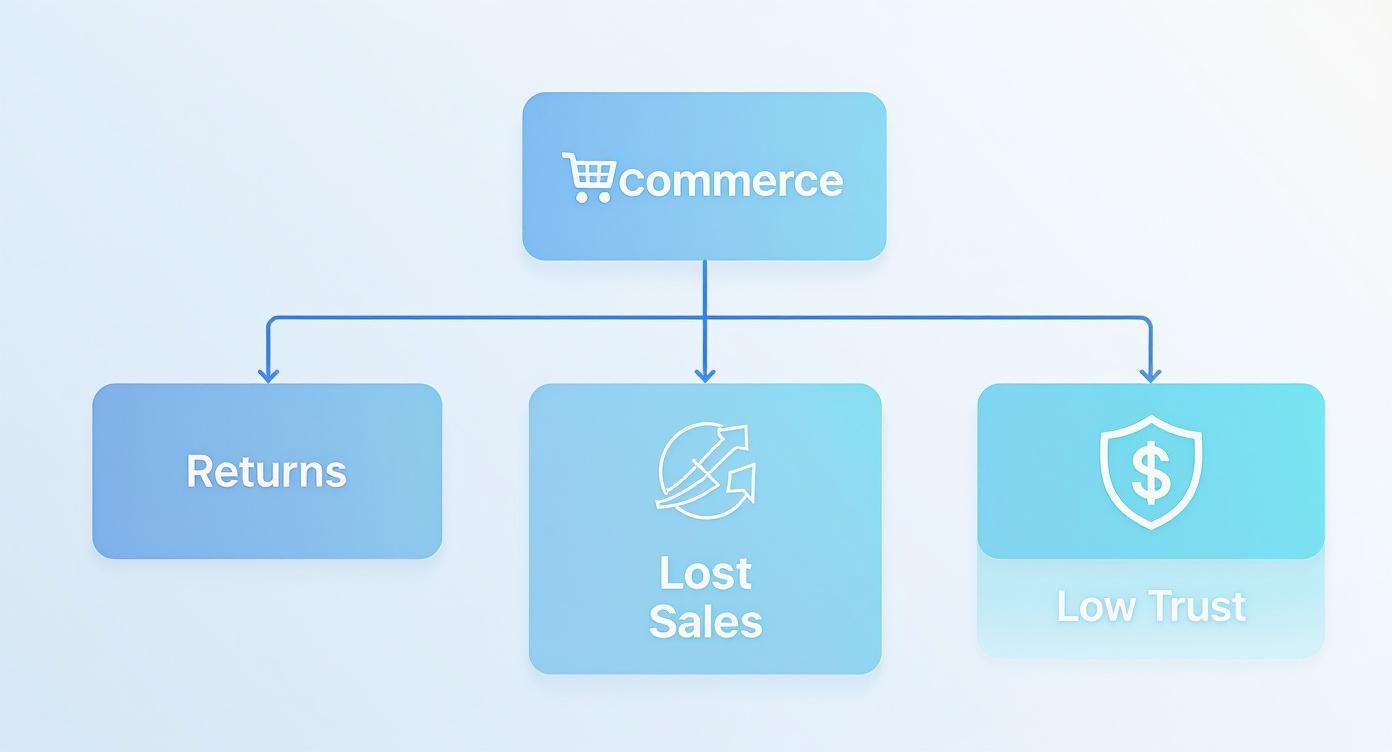
Sky-high returns, abandoned carts, and a lack of customer trust aren’t separate issues. They are all symptoms of the same root problem—a customer’s inability to truly visualize the product on their own body.
Three Types of Virtual Fitting Room Technology
While the end goal is always the same—giving customers confidence—the technology behind virtual try-ons comes in a few different flavors. Each one offers a unique experience and solves the “will it fit?” problem in its own way. Understanding them helps you choose the right tool for your store.
Here’s a quick look at the three main approaches.
| Technology Type | How It Works | Best For |
|---|---|---|
| Augmented Reality (AR) Try-On | Uses a phone’s camera to overlay a digital product onto a customer’s live video feed. Think of it as a “magic mirror.” | Accessories like glasses, hats, and jewelry where a quick, shareable visual is the main goal. |
| AI Body-Mapped Try-On | Customers provide photos or measurements, and AI creates a personalized 3D avatar. The garment is then simulated on the avatar. | Apparel where the drape, stretch, and true-to-life fit are critical. It offers the highest level of accuracy for clothing. |
| Image-Based Try-On | A customer uploads a photo, and the product image is realistically placed onto their body. It’s fast, simple, and requires no camera feed. | Apparel stores wanting a low-friction, high-impact solution. Solutions like TryIcona use this method to give a realistic preview without the complexity of 3D. |
Each path leads to a more confident customer, but the journey is a little different.
A clunky try-on experience can do more harm than good, frustrating a shopper instead of guiding them. The goal is to make the experience seamless and genuinely helpful, not just a flashy gimmick.
An Industry-Wide Shift Is Happening
This isn’t just an online trend. Virtual fitting room technology is being embraced by everyone, from nimble digital-native brands to established brick-and-mortar giants, to perfect the shopping journey and slash the massive cost of returns.
In fact, physical stores captured over 66% of the virtual fitting room market in 2024, retrofitting dressing rooms with smart AR mirrors that suggest accessories and gather priceless data on fit. For eCommerce stores, the growth is even more explosive, with a projected compound annual growth rate (CAGR) of 25.13% heading into 2025 and beyond. Every return avoided goes straight to your bottom line. You can explore more about these trends and see what they mean for the future of retail.
Ultimately, the right technology comes down to what you sell. For Shopify apparel merchants, AI-powered solutions that focus on accurate fit simulation offer the most direct path to reducing returns and boosting conversions. They tackle the core problem head-on, giving customers the one thing they’ve been missing all along: certainty.
Why Your Bottom Line Will Love Virtual Try-Ons
Adopting new tech can feel like a big leap, so let’s talk about what really matters: measurable results. When you think about a virtual fitting room, don’t just see a cool gadget—see a powerful engine for profitability. It’s a tool that directly tackles the most expensive problems in online fashion.
Slash Your Return Rates
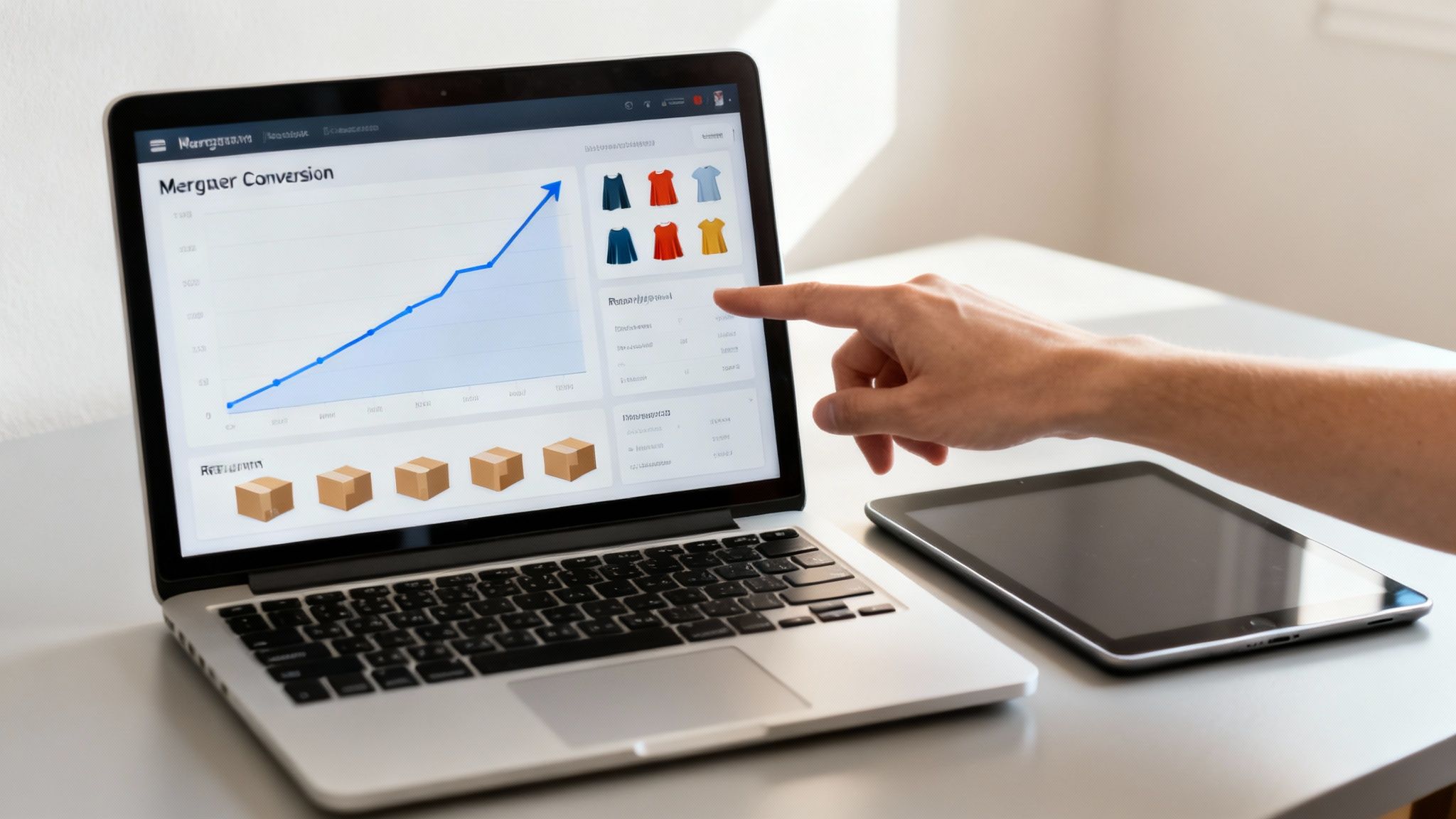
The single most powerful benefit? A massive drop in returns. The true cost of a return is so much more than just the refund. You have shipping labels, warehouse labor, inspections, restocking, and sometimes, items that are too damaged to resell. It all adds up.
When a customer uses a virtual try-on to choose the right size with confidence, that entire expensive, painful cycle vanishes. You’re not just saving cash; you’re building a more sustainable and efficient business.
And this isn’t a small change. The global virtual fitting room market was valued at about USD 6.21 billion in 2024 and is on track to explode to USD 32.29 billion by 2032. This incredible growth is happening for one simple reason: it works.
Boost Conversions by Curing Fit Anxiety
Think about it. How many shoppers have abandoned their cart because they were stuck between a medium and a large? This hesitation, what we call “fit anxiety,” is the silent killer of conversion rates in fashion eCommerce.
A virtual try-on tool is the perfect cure. It removes the biggest point of friction in the buying journey. By finally answering the question “Will this actually fit me?” you give customers the final nudge of confidence they need to click “buy.” In the same way that we’ve seen how AI-powered product photography can boost conversion rates by making products feel more tangible, virtual try-ons make the fit feel real.
It’s more than a tool. It creates a memorable, shareable shopping experience that builds brand loyalty and makes you stand out in a crowded market. It’s an investment in customer happiness.
Unlock Priceless Customer Insights
Beyond the immediate sales impact, a virtual fitting room becomes your secret weapon for data. Every time a customer “tries on” an item, you learn something valuable.
Imagine having a dashboard that shows you:
- Most Tried-On Styles: Pinpoint which products are grabbing attention, even if they aren’t your top sellers… yet.
- Common Fit Issues: See if a particular dress is consistently tried on but rarely purchased, hinting at a sizing or design flaw.
- Size Distribution Data: Understand the true size range of your engaged audience to make smarter inventory decisions.
This isn’t generic data; it’s a direct line into your customers’ thoughts. You can use these insights to perfect your next collection, fine-tune your inventory, and design products you know your audience is waiting for. This is how you shift from being reactive to proactive, building a brand that truly listens.
Inspiring Brands Winning with Virtual Fitting
Theory is one thing, but seeing this technology in action is where the magic happens. Let’s look at how forward-thinking Shopify stores are already creating incredible customer experiences and growing their businesses.
From High Returns to Happy Customers
Imagine running a swimwear brand. It’s one of the toughest products to sell online. Fit is everything, and a generic size chart can’t capture how a specific cut will look on a unique body. This is why customers often “bracket”—buying multiple sizes of the same item, knowing they’ll send most of them back.
Now, picture that same brand adding an AI-powered try-on tool. A shopper uploads a quick photo and instantly sees how different styles look on her body. She can see for herself that the high-waisted bottom gives her the coverage she wants, and the halter top provides the support she needs.
This isn’t a gimmick; it’s a genuine solution. The brand suddenly sees a massive drop in returns and a wave of glowing five-star reviews. They’re no longer just selling swimwear; they’re selling confidence.
Turning Social Browsers into Engaged Shoppers
The power of virtual fitting goes beyond your product page. Think about a fashion boutique dropping a new collection. They could post static photos to their Instagram Story, but what if they did something more?
With AR technology, they could add a “Try It On” sticker. A person casually scrolling taps the screen, their front-facing camera opens, and suddenly, they’re wearing the new statement blazer from the collection.
This simple interaction transforms a passive scroll into an active, memorable experience. The customer isn’t just seeing the product; they’re engaging with it. This is how you stop thumbs and start conversations.
That immediate, immersive connection is an incredible way to turn casual followers into interested shoppers, pulling them from social media right into your Shopify store with a real desire to buy.
Making Advanced AI Accessible
For a long time, this kind of tech felt out of reach—only for retail giants with massive budgets. That’s just not true anymore.
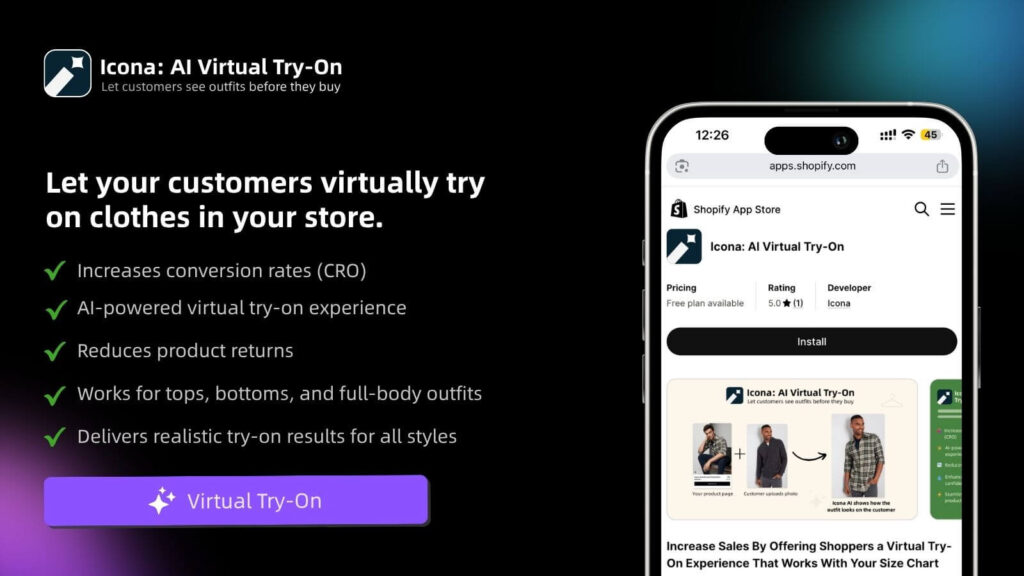
Solutions like TryIcona are built specifically for the Shopify platform, putting sophisticated AI try-ons within reach for ambitious brands of any size. By plugging directly into your store, you can add a branded “Try On” button to your product pages in minutes, without writing a single line of code.
This shift is part of a global movement. The virtual fitting room market is exploding in the Asia-Pacific region, projected to grow at a CAGR of 27.73% from 2025 to 2030. Tech-savvy shoppers are already embracing these tools, setting a new standard for what online shopping should feel like. You can read more about this global retail evolution and see what it means for merchants everywhere.
These stories aren’t just case studies; they’re a blueprint for what’s next. They prove that building trust and creating “wow” moments are the keys to winning your customers’ loyalty.
Your Shopify Implementation Playbook
Ready to bring a virtual fitting room to your store? It sounds intimidating, but it’s far more achievable than you might think. Getting started isn’t about a massive, complex overhaul. It’s about taking clear, intentional steps to create an experience that feels like a natural part of your brand.
Think of it like setting up a new display in a physical store. You wouldn’t just throw products on a shelf. You’d choose the perfect spot, get the lighting right, and make sure it looks fantastic. The same care applies here.
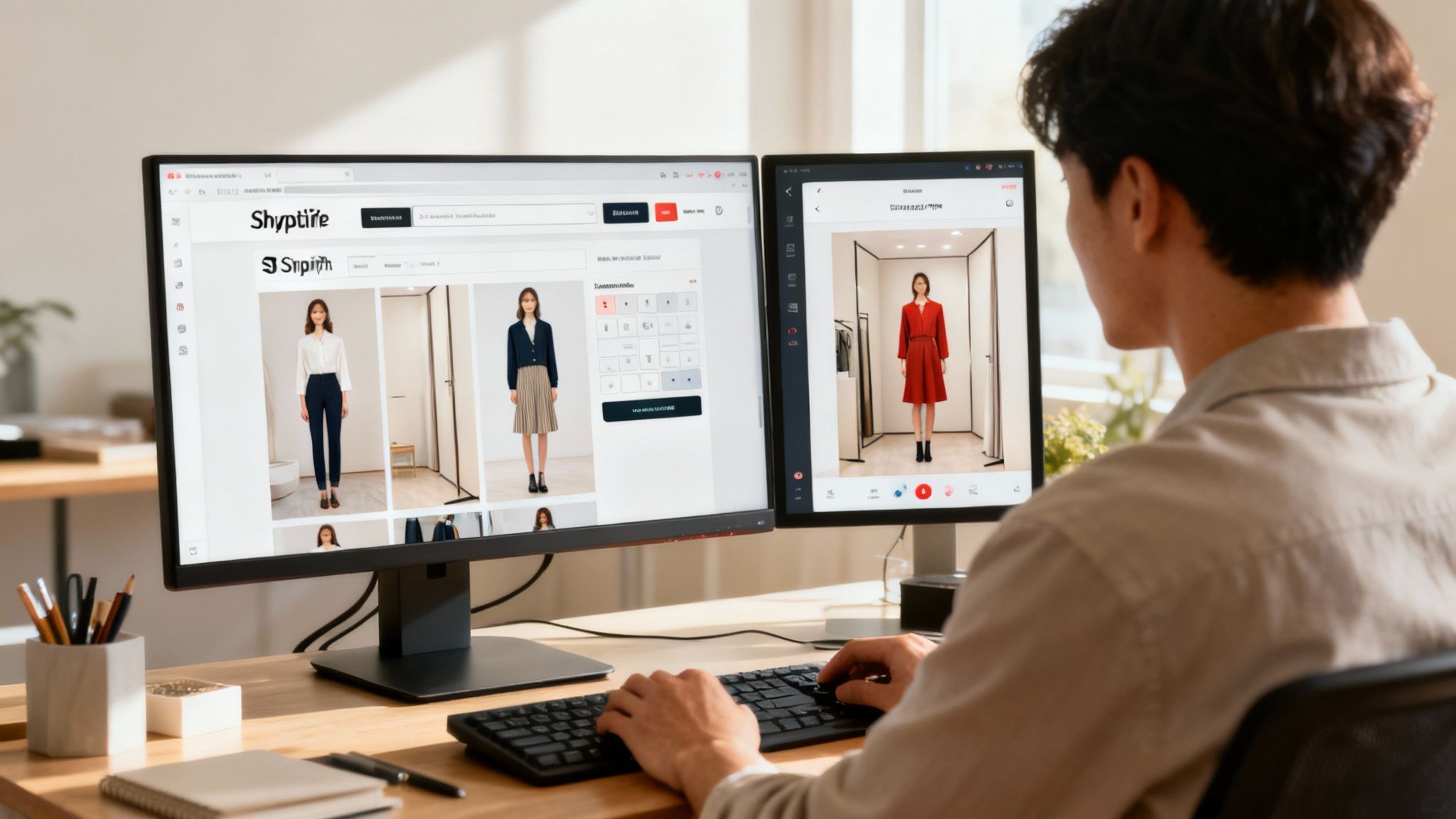
Step 1: Choose the Right Solution
First, you need to pick the right partner. Not all virtual fitting room solutions are built the same. You need a tool that feels native to your world.
Here’s what to look for in a Shopify-first solution:
- Seamless Integration: Does it install easily from the Shopify App Store? Can you manage everything from your admin dashboard?
- Performance Focus: Your site speed is sacred. The app must be lightweight and load asynchronously, meaning it won’t slow down your pages.
- Product Compatibility: Does the tech work well with your items? For most apparel, AI-powered image-based try-ons offer a fantastic sweet spot between realism and ease of use.
- Branding and Customization: The “Try On” button and its interface should be fully customizable to match your store’s colors, fonts, and vibe.
For a deeper dive, our guide on Shopify product page customization has great insights for creating a cohesive look.
Step 2: Set Up Your Digital Showroom
Once you’ve chosen your app, setup should be simple. With a solution like TryIcona, it’s often as easy as a few clicks—no coding required. The app will automatically sync with your product catalog.
Your main task is preparing your digital assets. This is critical. The quality of the try-on experience depends entirely on the quality of your product imagery. A great virtual fitting room needs clear, high-resolution photos to work its magic.
Pro Tip: Think of your product photos as the fabric of your virtual fitting room. High-quality, well-lit images on a clean background give the AI the best possible material to work with, resulting in a more realistic try-on.
For more advanced solutions, a key step is turning flat photos into interactive digital versions. Learning how to efficiently convert 2D images to 3D models can give you a major advantage, making your virtual catalog as lifelike as possible.
Step 3: Launch to Your Customers
You’ve built this amazing new feature—now show it off! A successful launch isn’t just about flipping a switch; it’s about guiding your customers to discover and love the new experience.
Consider a multi-channel launch strategy:
- Email Announcement: Send a dedicated email to your list. Use a GIF or short video to show how easy it is. Frame it as the solution to their biggest shopping problem.
- Social Media Buzz: Create posts and stories that showcase the feature in action. Encourage user-generated content by asking followers to share their virtual try-on looks.
- On-Site Guidance: Use a simple banner or pop-up on your homepage to announce what’s new. On product pages, a small, helpful tooltip next to the “Try On” button can offer a quick tutorial.
- Gather Feedback: After you launch, be proactive. Use a simple survey or follow-up email to ask customers about their experience. This feedback is gold for making improvements.
By following these steps, you can roll out your virtual fitting room smoothly and make it a valuable part of your customer’s journey from day one.
Your Shopify Virtual Fitting Room Checklist
Here’s a simple roadmap from idea to launch.
| Phase | Key Action | Pro Tip |
|---|---|---|
| 1. Research & Discovery | Define your goals (e.g., reduce returns by 15%). Research Shopify-native apps like TryIcona. | Focus on solutions that prioritize site speed. A slow VFR is worse than no VFR. |
| 2. Selection & Vetting | Schedule a demo. Confirm the app supports your product types and customization needs. | Ask about their support. You want a partner who will be there to help you succeed. |
| 3. Preparation | Audit and upgrade your product photography. Ensure you have clean, high-res front-facing images. | Create a simple style guide for your product photos to ensure consistency across your catalog. |
| 4. Implementation & Setup | Install the app from the Shopify App Store. Customize the button and interface to match your branding. | Test thoroughly on mobile! Most of your customers will use the feature on their phones. |
| 5. Pre-Launch Testing | Have your team and a small group of loyal customers test the experience. Gather initial feedback. | Ask testers: “Was it easy?” and “Did it make you feel more confident about buying?” |
| 6. Launch & Promotion | Announce the new feature via email, social media, and on-site banners. | Create a short video or GIF showing exactly how to use it—show, don’t just tell. |
| 7. Post-Launch Analysis | Monitor analytics: conversion rates, return rates, and feature engagement. Solicit customer feedback. | Set a reminder to review your key metrics 30 days after launch to measure the initial impact. |
This checklist breaks the journey into manageable steps, setting you up for a launch that wows your customers and delivers real results.
Your First Step Toward a Smarter Store
We’ve covered a lot, from the core concepts of virtual fitting rooms to the real-world impact they have on your bottom line. It’s clear this isn’t a passing trend—it’s a real shift in how customers connect with fashion online. The era of crossing your fingers and hoping for the best with sizing is over.
This change is about swapping uncertainty for confidence. It’s about building a smarter, more profitable business by solving the billion-dollar problem of returns. The future of online retail is personal, engaging, and built on trust.
Your Journey Starts Small
Getting started doesn’t mean you need a massive, store-wide project overnight. It can be as simple as exploring a solution designed for merchants on Shopify. The best way to grasp the power of this technology is to see it through your customers’ eyes.
The goal isn’t just to add a new feature. It’s to eliminate one of the oldest and most frustrating friction points in online shopping. When you solve your customer’s biggest headache, you earn their loyalty.
Think for a moment about the value this could unlock. A solution like TryIcona can be experienced with a simple demo, giving you a firsthand look at how smoothly an AI try-on can fit into your product pages. It’s a chance to see what the future of your brand looks like.
Leading the Way Forward
Bringing a virtual fitting room to your store is about more than keeping up with tech. It’s about taking the lead. It’s about building a brand that truly listens and solves problems with empathy and creativity.
The tools to make this happen are more accessible and powerful than ever. By giving your customers the certainty they’ve always wanted, you build a brand they won’t just buy from—they’ll trust it, love it, and come back time and time again. Your smarter store is waiting.
Common Questions Answered
You’ve got questions, and that’s a great sign. It means you’re thinking seriously about how a virtual fitting room can elevate your store. Let’s dig into the common concerns we hear from Shopify merchants like you.
Will a Virtual Fitting Room Slow Down My Shopify Store?
Performance is everything, and this is the first question you should ask. The good news is that modern solutions are built to be incredibly lightweight.
A Shopify-first app like TryIcona loads asynchronously. This means your most important content—your product images, description, and “Add to Cart” button—all load first. The try-on magic only kicks in when a shopper clicks the button, so it never bogs down your initial page load speed.
Is This Technology Accurate Enough for Customers?
Accuracy has come a long way. AI-powered body mapping can now reach an incredible level of precision, making it far more trustworthy than a generic size chart.
The secret is feeding the system high-quality digital versions of your garments. While no tech is 100% perfect, the aim is to give shoppers a drastically better idea of fit than they could ever get from guessing. This is what turns uncertainty into confidence and puts a major dent in fit-related returns.
The goal isn’t to be flawless—it’s to be genuinely helpful. A well-designed virtual try-on replaces a customer’s anxious guess with a confident choice.
What Happens to My Customers’ Data and Photos?
Privacy is non-negotiable. Any reputable provider builds their solution with data security as the foundation.
Typically, customer photos are either processed on their own device or are encrypted for secure processing on a server, but they are not stored long-term. Always choose a solution that’s transparent about its data policies and complies with standards like GDPR. The data used for fit analysis should always be anonymized and aggregated, never tied back to an individual without consent.
How Much Does a Virtual Fitting Room Cost?
This is where things have really changed for the better. The cost has become much more accessible for Shopify merchants thanks to subscription models. Instead of a massive upfront investment, most solutions run on a flexible monthly fee.
Pricing is usually tiered based on your store’s traffic or catalog size. You’ll find that many apps on the Shopify App Store offer free trials or affordable starter plans, which is perfect for proving the ROI for yourself before you commit.
Ready to see how an AI-powered try-on can change your customer experience? Explore TryIcona and discover a virtual fitting room built to blend seamlessly with your Shopify store, build shopper confidence, and drive more sales. Get started with a free plan today.