
Are you struggling to turn store visitors into loyal customers? This isn’t about some far-off, futuristic concept reserved for the giants of the industry. Integrating fashion and AI is a practical, powerful advantage that savvy Shopify stores like yours are using right now to increase conversions and carve out their space. Here’s how you can do it too.
The New Reality of AI in Your Fashion Store
Let’s demystify AI. Forget images of robots taking over. Instead, picture the smartest, most intuitive assistant you could ever hire for your store—one that never sleeps. It’s a set of brilliant tools designed to tackle the very challenges you face every single day as a fashion entrepreneur.
This assistant works quietly in the background, making your business sharper, your marketing more resonant, and your customer experience truly special.
Forget the intimidating jargon. At its heart, AI for your store is about using data to make smarter decisions, automate the repetitive work that drains your time, and create those “wow” moments for your shoppers. It’s the difference between guessing what your customers might like and knowing what they’ll fall in love with.
What AI Really Means for Your Store
So, what does this actually look like on a day-to-day basis? It’s about creating a new reality where you can:
- Predict Future Trends: Stop reacting to what’s already trending. AI helps you get ahead of the curve, anticipating the next big thing so your inventory is always fresh and desirable.
- Create Perfect Product Photos: Imagine generating stunning, on-model images without the huge cost and coordination of a professional photoshoot. You can finally show off every piece in your collection exactly as it deserves to be seen.
- Deliver True Personalization: Give every visitor their own unique shopping journey. We’re talking product recommendations so spot-on it feels like you’re their personal stylist, guiding them to pieces they’ll adore.
- Build Unshakeable Buyer Confidence: Allow customers to virtually try on your clothes from the comfort of their own home. This single feature demolishes one of the biggest hurdles to buying apparel online.
This isn’t science fiction anymore. This is the new benchmark for a thriving online fashion brand.
The global AI in fashion market was valued at around $2.23 billion in 2024. But it’s projected to rocket to over $89.41 billion by 2035. That kind of explosive growth tells you one thing: AI is quickly becoming a non-negotiable part of the industry’s backbone.
This incredible adoption isn’t fueled by hype; it’s driven by tangible results. Integrating artificial intelligence is now a core strategy for growth, and you can explore more data on this incredible market expansion to see just how fast this wave is moving.
And here’s the best part: you don’t need a team of data scientists to ride it. Many of the most powerful AI tools—from personalization engines to virtual try-on solutions—are built specifically for platforms like Shopify and can be set up in just a few clicks. This guide will show you exactly how you can use these tools to drive real, measurable growth for your business.
4 Ways AI Can Reshape Your Shopify Fashion Store
Now that you see the big picture, let’s get into the nitty-gritty. How can AI actually make a difference for your Shopify store, today? Think of these AI applications as your new superpowers—the secret weapons that will drive real, measurable growth. Let’s explore how AI stops being a buzzword and starts becoming the smartest part of your business strategy.
1. Build Unshakable Confidence with Virtual Try-On
One of the oldest hurdles in selling fashion online is that nagging customer question: “But how will it look on me?” It’s the moment of doubt that kills countless sales. Virtual try-on (VTO) technology completely erases that uncertainty.
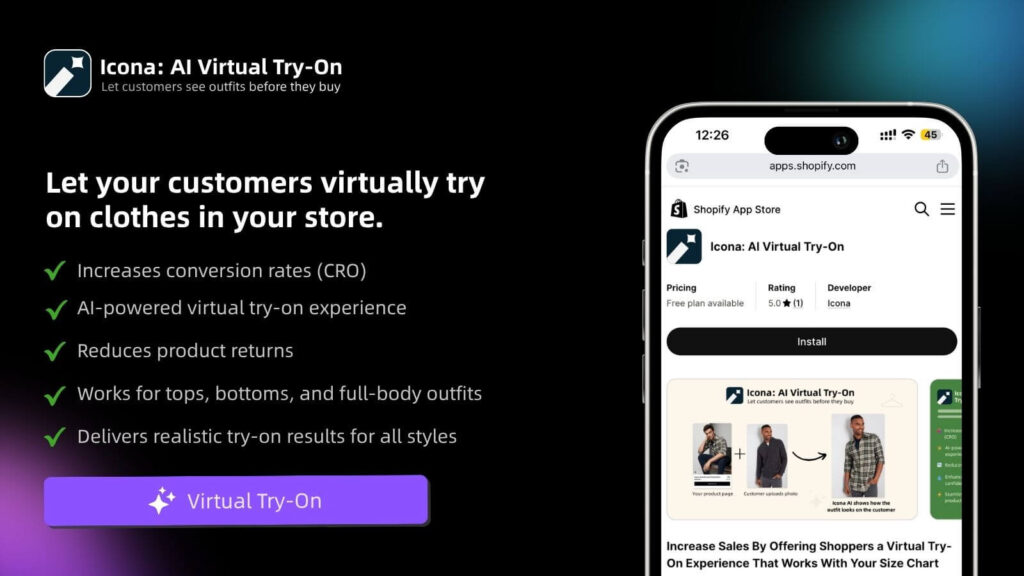
Tools like Icona plug right into your Shopify store, letting your shoppers upload a photo and instantly see your clothes on their own bodies. Suddenly, the guesswork is gone. This simple, interactive experience smashes through purchase anxiety, builds incredible trust, and directly tackles the #1 reason for returns: bad fit.
Actionable Takeaway: You’re no longer just showing a product; you’re creating an experience. By turning your product page into a personal fitting room, you give customers the confidence they need to click “Add to Cart.” A Shopify store that implemented VTO saw a 67% increase in conversion rates by giving shoppers this confidence.
2. Deliver Hyper-Personalization That Feels Like a Private Stylist
Imagine every single person who lands on your site gets a shopping experience built just for them. That’s the magic of AI-powered personalization.
AI acts like a brilliant personal stylist for your store, analyzing a customer’s browsing habits, past purchases, and even how they navigate your store in real-time. It then intelligently surfaces the exact products they’re most likely to fall in love with, creating a shopping journey that feels intuitive and exciting.
This isn’t just a nice-to-have; it’s a massive market driver. In fact, product recommendations and personalized shopping are the leading applications of AI in fashion retail. As of 2024, this segment captured a commanding 26.40% market share—proving that your customers don’t just want personalization, they expect it.
3. Generate On-Model Imagery Without the Photoshoot Price Tag
Let’s be honest: professional photoshoots are a huge pain. They’re expensive, slow, and a logistical nightmare. But what if you could get stunning, on-model imagery without ever booking a studio or hiring a photographer?
That’s exactly what AI-generated product imagery delivers.
With just a single flat-lay or mannequin photo of your garment, AI can generate a virtually endless variety of professional shots. You can showcase your collection on a diverse range of models, place them in beautiful settings, and capture every angle. This gives your store that high-end, polished look for a tiny fraction of the cost and effort.
4. Use Smart Forecasting to Prevent Stockouts and Waste
Few things hurt more than running out of a bestseller during a sales spike or getting stuck with a warehouse full of duds. AI forecasting tools are designed to stop both of these nightmares from happening.
By analyzing your historical sales data, watching market trends, and even monitoring social media buzz, these systems predict future demand with stunning accuracy. This allows you to:
- Order Just Right: Stop tying up your cash in items that won’t sell.
- Prevent Stockouts: Never miss out on a sale because your most popular item is gone.
- Spot the Next Big Thing: Get ahead of the curve by seeing what’s about to take off.
This turns inventory management from a stressful guessing game into a sharp, strategic advantage.
Your 4-Step AI Integration Roadmap
Feeling inspired but a little unsure where to even begin? I get it. The good news is that weaving the power of fashion and AI into your Shopify store doesn’t require a computer science degree. Let’s walk through a practical, step-by-step guide to get you started, focusing on the easiest wins that deliver the biggest impact.
Think of this as a phased rollout, not an overnight overhaul. The secret is to choose one key area, implement a smart AI tool, measure your results, and then build on that success.
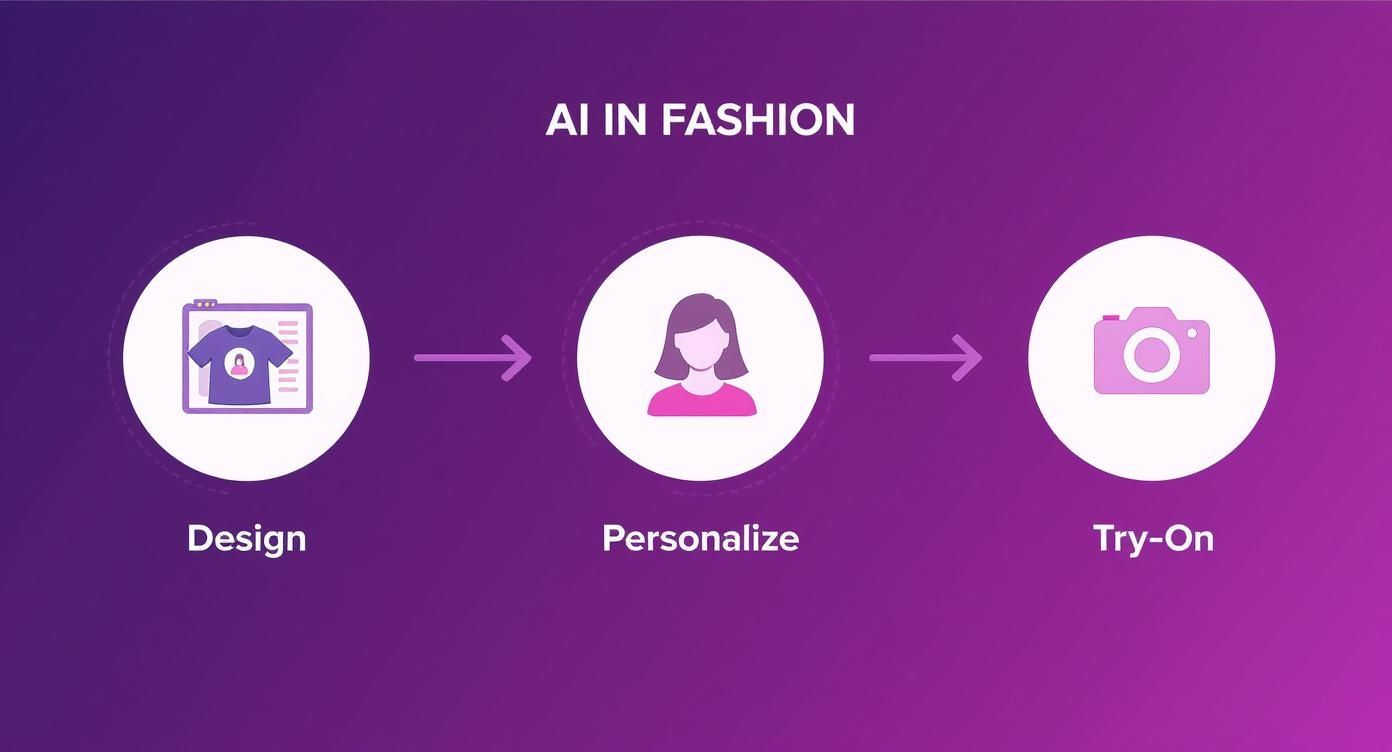
This workflow shows how AI seamlessly connects your creative vision with your customer’s real-world needs, making their entire shopping journey smarter and far more engaging.
Step 1: Start with One Clear Business Goal
Before you even glance at a single Shopify app, stop and ask yourself one simple question: “What is the biggest challenge or opportunity in my store right now?”
Your answer to that question becomes your North Star. By starting with a specific, tangible problem, you make sure your first venture into AI is focused, measurable, and meaningful.
Here are a few common goals I see with fashion stores:
- Reduce High Return Rates: If items are constantly coming back due to poor fit, your mission is to build purchase confidence.
- Increase Conversion Rates: If shoppers are browsing but hesitating to buy, your goal is to remove that friction and get them to click “add to cart.”
- Boost Average Order Value (AOV): If customers typically buy just one thing, your job is to show them other products they’ll love.
- Lower Marketing Costs: If photoshoots are eating your entire budget, you need a more efficient way to create stunning product visuals.
Seriously, just choose one. Trying to solve everything at once is a classic recipe for overwhelm.
Step 2: Choose Your First AI Application
Okay, you’ve got your goal. Now you can pick the right tool for the job. The Shopify App Store is full of incredible “plug-and-play” AI solutions that require zero coding.
Let’s match a tool to each of the goals we just talked about:
To Reduce Returns: Your best bet is a virtual try-on (VTO) tool. When you let customers see how clothes look on their own bodies, you eliminate the guesswork. A solution like Icona adds a simple try-on button right on your product page, giving shoppers the confidence to buy the right size the first time.
To Increase Conversions: Implement an AI-powered personalization app. These tools act like a personal stylist for every single visitor. They analyze browsing behavior to recommend products that customer is most likely to adore, guiding them toward a purchase.
To Boost AOV: Look for an app with AI-driven “Shop the Look” or bundling features. These systems are smart enough to suggest the perfect top to go with that skirt, making it incredibly easy for customers to add more to their cart.
To Lower Marketing Costs: This is where AI image generation tools are a game-changer. These platforms can take a single flat-lay photo of your product and generate a whole photoshoot’s worth of on-model images. You can showcase your collection on a diverse range of models without the time and expense of a physical shoot. See just how accessible this is when you create an AI fashion model.
Step 3: Launch and Measure Your Impact
Once you’ve installed your chosen app, this next step is absolutely crucial: measure its impact. Don’t just set it and forget it. You have to know if your investment of time and money is actually paying off.
Before you launch, take a snapshot of your baseline metrics. Jump into your Shopify Analytics and look at the 30 days before you installed the AI tool.
Your Pre-AI Checklist:
- What is your current conversion rate?
- What is your average order value?
- What is your return rate for apparel?
- How much are you spending on product photography per collection?
After the AI tool has been live for 30 days, pull those exact same numbers again.
The comparison will give you a clear, data-backed answer on how it’s performing. Seeing a 15% drop in returns or a 20% lift in conversions isn’t just a nice-to-have; it’s the hard proof you need to validate your strategy.
Step 4: Expand and Iterate
Once you’ve seen the value from your first AI application, you’re ready to tackle the next challenge on your list. This is how you build a smarter store—not in one giant leap, but through a series of smart, informed decisions.
Maybe you started with virtual try-on and solved your returns problem. Fantastic. Now you can shift your focus to boosting AOV with a personalization engine. This is how you build an intelligent, AI-powered brand: one strategic step at a time.
Measuring Your Return on AI Investment (ROI)
Bringing powerful new AI into your store is an incredible feeling. But let’s be honest—excitement doesn’t pay the bills. The real question is always: is it actually working?
To really get a grip on what your fashion and AI strategy is doing for you, you have to dive into the numbers that truly matter. Proving your return on investment (ROI) is about focusing on the key performance indicators (KPIs) that directly signal the health and growth of your business.
Pinpointing the Right KPIs for Each AI Tool
Different AI tools are built to solve different problems, which means they move the needle on different metrics. You have to connect the tool to the specific KPI it was designed to improve.
Here’s a simple way to track what matters for each AI application:
- For Virtual Try-On (VTO): Track your Conversion Rate and Return Rate. When a VTO tool is working, conversions should climb because shoppers feel more confident, and returns should plummet because they’re getting the right fit.
- For AI Personalization: Keep your eyes glued to Average Order Value (AOV) and Customer Lifetime Value (CLV). Smart personalization inspires customers to add more to their cart and builds the loyalty that keeps them coming back.
- For AI-Generated Imagery: The most immediate KPI is your Cost Per Collection. Add up what you’re saving on photographers, models, and studio rentals. Another huge win to track is Time to Market—how much faster you can get a new collection live.
By isolating these specific metrics, you go from guessing to knowing. You can draw a straight line from launching a virtual try-on feature to seeing a 15% decrease in returns, proving its value in a language everyone understands: the bottom line.
Your Simple Framework for A/B Testing
So, how do you know for sure that your new AI tool is behind that sales lift? The answer is A/B testing, and it’s way less complicated than it sounds. The whole idea is to create a controlled comparison: your store with the AI versus your store without it.
You can often set this up using an app from the Shopify App Store. For example, with a new personalization engine, you might show the AI-driven recommendations to 50% of your website traffic while the other 50% sees your standard product grid.
After letting the test run for a few weeks, just compare the results. Did the group who saw the AI recommendations have a higher AOV? This kind of head-to-head comparison gives you rock-solid proof of the tool’s real-world impact.
Tracking Engagement to Understand the Why
Beyond the big financial KPIs, it’s also incredibly insightful to keep an eye on engagement metrics. These numbers tell you the story of how your customers are interacting with the new technology.
For a tool like virtual try-on, you’d absolutely want to track:
- Try-On Button Clicks: Are people using the feature? This tells you if it’s visible and appealing.
- Conversion Rate of VTO Users: This is the kicker. Do the shoppers who use the virtual try-on convert at a higher rate than those who don’t? (Spoiler: the answer is almost always a resounding yes!)
These engagement stats help you understand the narrative behind the numbers and double down on what’s working.
Weaving AI into Your Brand, Responsibly
As you start blending the incredible possibilities of fashion and AI into your Shopify store, one thing is non-negotiable: earning and keeping your customers’ trust. Bringing AI into your brand isn’t just a tech move; it’s a promise to uphold your brand’s integrity. Getting this right is what separates a short-lived gimmick from a genuinely great, trusted brand.
Championing Data Privacy and Transparency
Your customers have a right to know how their information is being used. Real transparency isn’t about burying details in dense legal documents. It’s about clear, honest communication that makes your customers feel safe.
Here are a few straightforward ways to be transparent:
- Make Your Privacy Policy Human: Ditch the legalese. Use plain English to explain what data you collect and how AI uses it to make their shopping journey better.
- Give AI a Name Tag: A small, friendly note like “Personalized for you by our style AI” next to product recommendations is an easy, honest touch.
- Pick Partners Who Share Your Values: When you choose an AI tool, dig into its privacy policies. For example, a virtual try-on tool like Icona was built with privacy as a cornerstone—customer photos are encrypted and automatically deleted for good after use.
Tackling Algorithmic Bias Head-On
An AI system is only as good as the data it learns from. In fashion, this can surface as algorithmic bias, where the technology might unintentionally favor certain body types or skin tones, leaving other customers feeling invisible.
For your brand, championing inclusivity isn’t just the right thing to do—it’s brilliant business. You want every single person who lands on your store to feel seen and welcomed.
Actively working against bias means you’re not just selling clothes; you’re building a community. It shows your customers that you care about representing the real world.
Your Action Plan for Responsible AI
So, how do you turn these principles into practice?
- Audit Your AI-Generated Content: Regularly look at the product images your AI creates. Do they feature a diverse range of models that reflect your customer base?
- Test for Fairness: When using personalization tools, are they recommending products across your entire range of sizes and styles? Make sure the algorithm isn’t just creating an echo chamber for your bestsellers.
- Listen to Your Community: Ask your shoppers for feedback. Their input is the ultimate compass for ensuring your AI is serving all of your customers.
By embracing these responsible practices, you’re building a modern, trustworthy brand that uses AI to create a better, more inclusive shopping experience.
The Future is Here: Your First Step into AI Fashion
You’ve seen what’s possible when fashion and AI come together. This isn’t about futuristic ideas anymore; it’s about a real, tangible roadmap for growing your Shopify store. The time for thinking is over—it’s time to act.
So, where do you begin? Start with a single, clear goal. Pick an AI tool that solves a genuine problem you’re facing today. Then, keep a close eye on your results.
What’s Your Next Move?
Take a moment and think about the one challenge that’s giving you the biggest headache right now. Is it the constant cycle of returns eating into your profits? Or the struggle to create beautiful, on-brand imagery without spending a fortune?
Whatever it is, pick one AI application from this guide that hits that problem head-on.
- Drowning in returns? It’s time to seriously look into a virtual try-on tool. This is your most direct path to helping customers choose the right size the first time.
- Struggling with photoshoot costs? Your next step should be exploring the world of AI product photography. Just like TryIcona helps customers visualize products before purchase, popups help them take the next step in their journey.
The future of fashion is smarter and more personal. Your journey to the forefront of this new era starts not with a giant leap, but with a single, focused step. Go on, take it.
FAQ: Your Questions About AI in Fashion, Answered
Still have a few things you’re wondering about? That’s completely normal. This world of fashion and AI is moving fast. Here are some real-world answers to the questions I hear most often from Shopify store owners just like you.
Do I Need to Be a Tech Whiz to Use AI?
Absolutely not. This is the biggest myth holding people back. Many of the most powerful AI tools for Shopify are “plug-and-play.” You can install an app for personalized recommendations or integrate a service like Icona for virtual try-on with just a few clicks—no code, no headaches. The trick is to start with a clear goal and pick a tool designed to solve that one specific problem.
Is AI Too Expensive for a Small Business?
It doesn’t have to be. While you hear about giant companies spending millions, there are tons of affordable and scalable options perfect for growing brands. A lot of Shopify apps run on a simple monthly subscription, often priced based on your store’s size.
Think of it as an investment, not an expense. For example, if you could save thousands a year by cutting down on returns, a modest monthly fee for a virtual try-on tool suddenly looks like a brilliant financial move.
How Does AI Actually Help Me Sell More?
AI drives sales in a few very direct and powerful ways by making the shopping experience better for every single customer.
Here’s a simple breakdown of how it happens:
- It Lifts Your Conversion Rate: Personalization engines act like a skilled personal shopper, showing each visitor the exact products they’re most likely to buy.
- It Creates Real Buyer Confidence: Tools like virtual try-on tackle the single biggest hesitation in buying clothes online: “Will this actually fit me?” When your customer feels certain, they’re much more likely to purchase.
- It Bumps Up Your Average Order Value (AOV): AI is a natural at upselling. It can intelligently suggest other items that complete an outfit (“Shop the Look” features), nudging shoppers to add just one more thing to their cart.
At the end of the day, AI works by making your store smarter and more personal. It creates a genuinely better shopping trip that naturally leads to more sales.
Ready to give your customers the confidence to click “Add to Cart”? Icona adds a virtual try-on button to your Shopify store in minutes, helping you slash returns and boost conversions. Start your free trial at tryicona.com and see the difference for yourself.