
The best camera for your products isn’t just about megapixels. It’s about reliability, dead-on color accuracy, and the flexibility of your lenses. Think of your camera as the most dedicated salesperson you’ll ever hire—it shows your products in their absolute best light, turning a casual browser on your Shopify store into a confident buyer.
Why Your Camera Is Your Best Salesperson
I get it. Staring at a wall of camera specs feels like trying to read a foreign language. Let’s cut right through that noise. This guide is your roadmap to finding a camera that doesn’t just snap pictures but actively works to sell your products.
A great camera transforms your product shots from simple images into powerful conversion tools for your Shopify store.
High-quality photos build a bridge of trust. When a customer can zoom in and see the intricate details on a piece of jewelry or the true texture of a knit sweater, they feel a surge of confidence in their decision to buy. You’re giving them the closest possible experience to putting the product directly into their hands, right through their screen.
The Power of Professional Images
Your product photography is the visual heartbeat of your brand. It sends a message of quality, care, and professionalism long before a customer even glances at your product description. Investing in the right camera is a direct investment in your business’s success. Here’s how:
- You Build Customer Trust: Crystal-clear, detailed photos show you’re proud of your product’s quality. This transparency is key to winning over skeptical shoppers.
- You Increase Conversions: Did you know shoppers are 75% more likely to purchase after seeing high-quality photos? It’s a game-changer for your sales numbers.
- You Reduce Returns: When what your customers see is what they get, they’re happy. Accurate images set proper expectations, leading to fewer disappointments and returns.
- You Build a Stronger Brand: Consistent, professional photos make your store look polished and trustworthy, setting you miles apart from the competition.
The goal isn’t just to show what your product looks like. It’s to make your customer feel like they absolutely need it. Great photography closes the gap between simply seeing and truly wanting.
Ultimately, your camera is the tool that captures and communicates your product’s true value. And while amazing new tech offers alternatives, like exploring AI product photography to create stunning lifestyle scenes, it all starts with a great source image. Those core photos must be sharp, color-accurate, and compelling.
In the next sections, we’ll dive deep into the specific features—from sensors and lenses to lighting—that give you the power to create these essential, sales-driving images.
Understanding the Heart of Your Camera: The Sensor
Before we even get into brands and models, let’s talk about the single most important part of any camera for getting incredible product shots: the sensor.
Think of the sensor as the camera’s digital film. It’s the part that actually captures the light and turns it into an image. The size and quality of this little chip dictate everything—from the sharpness of your product’s texture to how your photos look in different lighting conditions. A better sensor literally sees your product more clearly, and that clarity translates directly to your customer’s screen.
Choosing the right camera starts here. A great sensor is the foundation for photos that don’t just show your product, but actually help sell it.
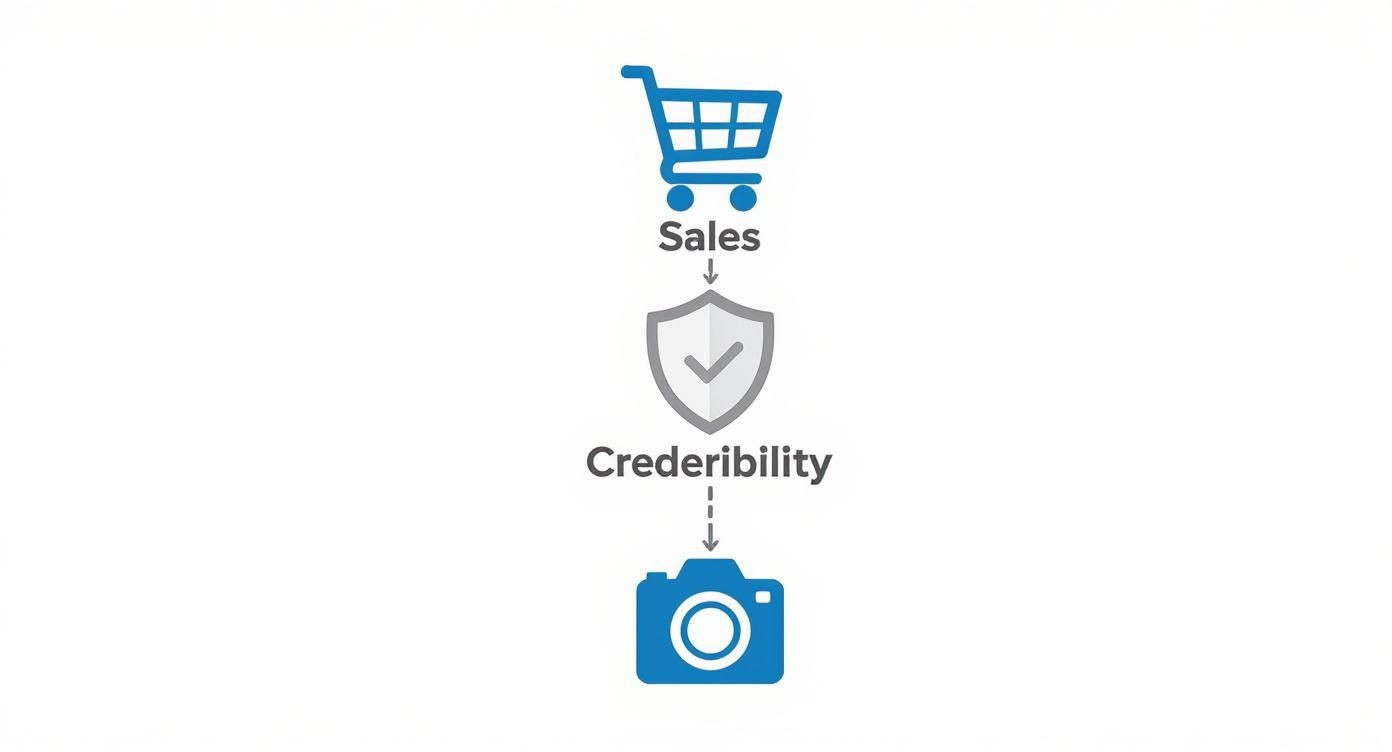
When you get the photography right, you build trust. And trust is what turns a browser into a buyer on your store.
Camera Sensor Size Comparison for Product Photography
To help you visualize the difference, here’s a quick comparison of the most common camera sensor sizes and how their characteristics impact product photos for your Shopify store.
| Sensor Type | Key Advantage for Product Photography | Best For | Typical Price Range |
|---|---|---|---|
| Full-Frame | Superior light capture, beautiful background blur (bokeh), highest detail. | Brands seeking a premium, high-end look; works well in all lighting. | $1,500 – $6,000+ |
| APS-C (Crop) | Excellent balance of quality, size, and cost. Professional results are very achievable. | Most e-commerce stores, from startups to established brands. | $600 – $2,000 |
| Micro Four Thirds | Very compact and lightweight system with a huge lens selection. | Small product photography, on-the-go shoots, and video content. | $500 – $1,800 |
| 1-inch Sensor | Better than a smartphone, but limited by smaller size. Found in premium compact cameras. | Beginners on a tight budget or as a secondary/backup camera. | $400 – $1,300 |
Ultimately, while Full-Frame is the top-tier choice for that unmistakable professional polish, a modern APS-C camera is a powerful tool that will absolutely deliver stunning, sales-driving images for your store.
Full-Frame vs. APS-C: The Simple Breakdown
You’ll hear two terms thrown around a lot: “Full-Frame” and “APS-C.” Don’t let the jargon intimidate you. It just refers to the physical size of the sensor we’ve been talking about, and it’s a key factor for your product shots.
Here’s a simple analogy: imagine you have two buckets out in the rain. One is a big, wide bucket (Full-Frame) and the other is a smaller one (APS-C). The big bucket is naturally going to catch more rain. A camera sensor works the exact same way with light.
Full-Frame Sensors: These bigger sensors drink in more light, which means cleaner, less “grainy” images. They also excel at creating that soft, out-of-focus background (called bokeh) that makes your product pop and gives your photos a luxurious, professional feel.
APS-C (Crop) Sensors: These are smaller, more affordable, and incredibly common in a huge range of fantastic cameras. They are more than capable of producing brilliant product shots, but they capture a bit less light and have what’s called a “crop factor,” which makes your lens view seem a little more zoomed in.
Do Megapixels Really Matter for Your Store?
Ah, megapixels. It’s the number every brand slaps on the box, but more isn’t automatically better for your business. A megapixel is just one million pixels—the tiny dots that build your digital image.
Think of it like having a bigger canvas. More megapixels let you print a giant billboard or crop in super tight on a photo without it falling apart. But for your Shopify store, where images are viewed on screens, you hit a point of diminishing returns pretty quickly. For most online stores, 24 to 30 megapixels is the absolute sweet spot.
Don’t get lost in the megapixel race. A 24MP camera with a high-quality sensor and a sharp lens will always outperform a 60MP camera with a mediocre sensor and lens. Focus on the sensor size and glass quality first.
The demand for high-quality cameras isn’t slowing down. The digital photography market was valued at USD 55.74 billion in 2025 and is projected to keep growing, largely because every business online needs amazing visuals. You can discover more insights about the photography market to see just how big this trend is.
Choosing the Right Lens: Your Creative Vision
If the camera sensor is the heart of your setup, then the lens is its creative eye. Honestly, the quality of your glass often has a more dramatic impact on your final image than the camera body itself. It’s what dictates sharpness, controls perspective, and shapes the entire mood of your product photos.
Choosing the right lens is what separates a flat, uninspired snapshot from a dynamic, professional image that makes customers stop scrolling. Think of it like choosing the perfect paintbrush for an artist—different brushes create entirely different strokes, and the same holds true for lenses.
Prime Lenses vs. Zoom Lenses for Product Shots
As you start exploring, you’ll quickly run into two main camps: prime and zoom. Knowing the difference here is key to getting what your store really needs.
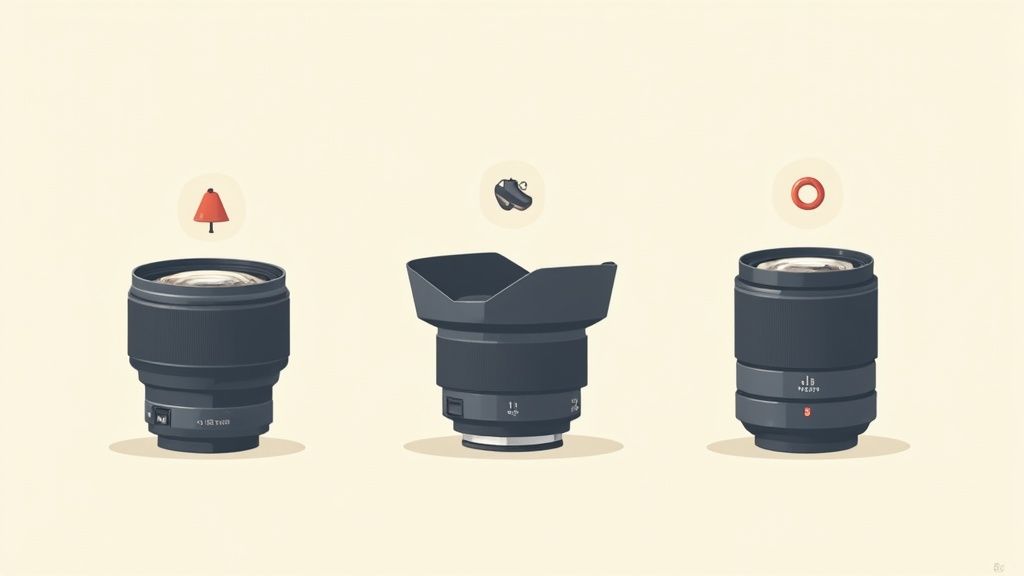
Prime Lenses: These have a fixed focal length (like 50mm or 100mm). You can’t zoom in or out with the lens; you have to physically “zoom with your feet” by moving the camera. While that might sound limiting, their simple design allows for superior optics, leading to exceptionally sharp and crisp images. For pure image quality, they are the gold standard.
Zoom Lenses: These give you a variable focal length (like 24-70mm), so you can reframe your shot without moving your entire setup. This flexibility is incredible, especially if you’re shooting products of all different sizes. The trade-off? That convenience can sometimes come at the cost of the absolute, pristine sharpness you get from a prime lens.
For most Shopify store owners just starting out, investing in a high-quality prime lens is a brilliant move. The incredible sharpness it delivers will make your products look their absolute best, straight out of the camera.
Understanding Focal Length
Focal length, measured in millimeters (mm), is a bit more than a technical number. It determines your field of view and, more importantly, how it portrays your product. Get this wrong, and your product can look weirdly distorted instead of true-to-life.
A wide-angle lens (think 24mm) can make products look stretched and warped, especially near the edges of the photo. It’s almost never the right choice for product photography.
On the other hand, a telephoto lens (something like 100mm) beautifully compresses the background and gives you a flattering, realistic perspective. This is exactly what you want for most product shots.
For product photography, your sweet spot is typically between 50mm and 100mm. This range gives you a natural perspective that closely mimics how the human eye sees things, ensuring your products look accurate and appealing.
The Magic of Aperture and F-Stop
Aperture is the opening inside your lens that lets light pass through to the sensor. It’s measured in “f-stops” (like f/1.8, f/8, f/11), and it controls one of the most powerful creative tools in all of photography: depth of field.
Simply put, depth of field is how much of your image is in sharp focus from front to back.
A Low f-stop (e.g., f/2.8): This means the aperture is wide open, letting in a ton of light. The result is a shallow depth of field, where only a small slice of your product is tack-sharp, and the background melts away into a beautiful, creamy blur. This is perfect for creative lifestyle shots where you want the product to be the undeniable hero.
A High f-stop (e.g., f/11): This creates a tiny pinhole opening in the lens. This gives you a deep depth of field, keeping everything from the front of your product to the very back in crisp focus. This is your go-to setting for those classic, clean product-on-white photos for your catalog.
Mastering aperture gives you total creative freedom. You get to decide whether to isolate your product against a dreamy background or show off every single intricate detail with crystal clarity. For most standard e-commerce shots, an aperture between f/8 and f/11 is the ideal starting point for getting maximum sharpness.
Essential Gear That Creates Professional Shots
A great camera and lens are your starting point, but the real secret to consistently jaw-dropping product photos? It’s all in the supporting cast. The right accessories are what will take your images from “good enough” to truly professional, building a studio setup that pays for itself over and over again.
Think of it like this: your camera simply captures the image, but your gear creates the entire scene. This is where you gain absolute control over light, stability, and consistency—the three pillars of incredible product photography.

The Unsung Hero: A Sturdy Tripod
Before you even think about lights, get a tripod. Seriously. This isn’t just a friendly suggestion; it’s the bedrock of professional product photography. Why? Because it kills camera shake, freeing you up to use slower shutter speeds and lower ISO settings for the cleanest, sharpest images imaginable.
Even more importantly, a tripod guarantees consistency. When you’re shooting the same product from five different angles, a tripod ensures every shot has the exact same framing, height, and perspective. This is the key to a polished, cohesive look across your entire product page.
Lighting: Your Most Powerful Tool
Lighting is everything. It carves out the shape of your product, shows off its texture, and sets the entire mood. While that beautiful light from a nearby window is lovely, it’s also wildly inconsistent. For a growing business, you need control.
You’ll generally run into two types of studio lighting:
Continuous Lights: These are your “what you see is what you get” option. They stay on the whole time, so you can see precisely how the light and shadows are hitting your product before you ever snap a photo. This makes them incredibly friendly for beginners. LED panels are a fantastic, affordable choice that don’t get too hot.
Strobes (or Flashes): These pack a serious punch. They deliver a powerful, instantaneous burst of light that freezes motion and provides a massive amount of clean, bright illumination. They have a bit of a learning curve, but they’re the industry standard for a reason—their power lets you overpower any other light in the room, giving you the final say.
A simple two-light kit is a perfect place to start. This gives you a main “key” light to do the heavy lifting and a secondary “fill” light to soften any harsh shadows, creating that balanced, pro-level look.
Shaping the Light With Modifiers
A bare bulb throws harsh, ugly shadows. That’s where light modifiers come in. These are tools you pop onto your lights to soften, diffuse, and shape the beam, giving your photos that high-end, polished feel.
The single most essential modifier for any product photographer is a softbox. It’s just a fabric box that fits over your light, but its magic lies in how it diffuses the light, creating a soft, even, and flattering glow that wraps beautifully around your products.
This soft, gentle light is the secret sauce behind the clean, premium images you see on all the top eCommerce sites. It makes things look desirable.
Essential Workflow Accessories
Finally, there are a few small tools that will make a massive difference in your day-to-day shooting, saving you tons of time and headaches.
- Remote Shutter Release: Even on a tripod, the simple act of pressing the shutter button can cause a microscopic vibration that ever-so-slightly blurs your shot. A remote shutter—whether it’s a simple cable or a wireless clicker—lets you fire the camera without touching it, guaranteeing maximum sharpness.
- Tethering Cable: This is a game-changer. A tethering cable connects your camera directly to your computer, so your photos pop up on the big screen the instant you take them. No more squinting at the tiny camera display to check focus—you see everything clearly and can make adjustments on the fly.
- Backdrops: A clean, seamless background makes your product the undeniable star of the show. A simple white sweep is a timeless classic, but don’t be afraid to find something that fits your brand. You can learn more about choosing the right photography background cloth to really nail your aesthetic.
By investing in this essential gear, you’re not just buying equipment; you’re setting your store up to compete at the very highest level.
Finding the Right Camera for Your Budget
You’ve got the theory down—sensors, lenses, and lighting are no longer a mystery. Now for the fun part: picking the right camera to bring your brand’s vision to life. The global digital camera market is huge, valued at an estimated USD 24.08 billion in 2024, which is great news for you. It means there’s a perfect camera out there for every ambition and budget.
We’re going to walk through three practical tiers to help you find your match. Think of this less as a technical spec sheet and more as a field guide to making a smart investment in your store’s visual identity. You can always dig into the full research on the digital camera market if you’re curious about the industry’s growth.
Entry-Level Powerhouses (Under $1,000)
Starting on a budget doesn’t mean you have to compromise on quality. Today’s entry-level cameras are packed with features that, just a few years ago, were strictly pro-level. These are ideal for new Shopify merchants who need crisp, clean product shots from day one without breaking the bank.
Canon EOS R50: This is a brilliant first step into serious photography. Its APS-C sensor and Canon’s legendary color science mean your products will look true-to-life right out of the camera. The autofocus is quick and sticky—even on tiny items like jewelry—and the flip-out screen is a lifesaver for shooting awkward angles like flat lays.
Sony a6400: An absolute workhorse that has earned its reputation. The a6400 is famous for one thing above all else: its incredibly fast and reliable autofocus. It just locks onto your product and stays there, which saves a ton of time and frustration during a shoot. The image quality from its APS-C sensor is sharp, detailed, and perfect for your product pages.
Mid-Range Champions ($1,000 – $2,500)
This is the sweet spot where most growing ecommerce brands find their perfect tool. Moving into this tier gets you a significant leap in image quality, durability, and creative control. You’re getting into bigger sensors and more advanced features that empower you to create truly high-end commercial imagery.
Fujifilm X-T5: A photographer’s camera, through and through. The X-T5 boasts a super-high-resolution 40MP APS-C sensor that captures stunning detail. But its secret weapon is Fujifilm’s famous “Film Simulations.” These built-in color profiles can give your photos a gorgeous, distinctive look with minimal editing—a massive shortcut in your workflow.
Canon EOS R8: Want the magic of a full-frame sensor without the typical full-frame price? This is your camera. A full-frame sensor gives you amazing performance in lower light and that beautiful, creamy background blur (bokeh) that makes lifestyle shots pop. The R8 is a fantastic choice if you’re shooting both still photos and video for your brand.
Professional-Grade Workhorses ($2,500+)
When your business is scaling fast and every single pixel is a reflection of your brand, it’s time to invest in a professional tool. These cameras deliver the absolute pinnacle of image quality, speed, and rock-solid reliability. They’re built to perform, day in and day out, in a demanding studio environment.
A professional camera isn’t just about more megapixels. It’s about unwavering reliability, flawless color accuracy, and features like dual card slots that protect your valuable work during a high-stakes photoshoot.
Sony Alpha 7 IV (A7 IV): Many pros call this the ultimate “do-it-all” camera, and for good reason. The A7 IV is an absolute beast for product photography. Its 33MP full-frame sensor captures breathtaking detail and dynamic range, meaning you can pull information out of the brightest highlights and the darkest shadows. The autofocus is arguably the best on the market, and you can customize nearly every button to fit your exact workflow.
Nikon Z7 II: If your work demands the highest possible resolution, the Z7 II is an absolute titan. Its 45.7MP full-frame sensor is engineered to capture every last thread, texture, and detail. This makes it perfect for shooting intricate products or for clients who need massive files for print or large-format displays. It’s a tough, reliable tool built for the rigors of commercial photography.
Bringing Your Product Photos to Life
Alright, you’ve absorbed the theory. You know what makes a camera tick, you can talk lenses, and your gear list is ready. Now comes the exciting part: putting all that knowledge into practice and capturing the incredible product shots your Shopify store needs to thrive.
This is where the magic really happens. It’s the moment you stop thinking about equipment and start thinking about creating an experience—transforming a simple item in your inventory into something a customer absolutely has to own. Your camera is just the tool; your vision is what builds that critical first impression.
Your Action Plan for Amazing Photos
Getting those pro-level shots is more straightforward than you might think. Just follow these key steps as you start shooting.
- Step 1: Focus on What Matters Most. Your sensor and your lens are the two most critical pieces of the puzzle. They will have the single biggest impact on your image quality, so invest wisely here.
- Step 2: Build a Rock-Solid Foundation. A tripod isn’t optional. Seriously. It’s the secret to getting consistently sharp, perfectly aligned photos, shot after shot.
- Step 3: Become the Master of Light. Great lighting is everything. It’s not a bonus, it’s a necessity. Even a basic two-light kit with softboxes hands you the power to shape how your product looks and feels.
After you’ve captured your images, they need to be perfectly prepped for your storefront. If you find your photos aren’t quite big enough for Shopify’s zoom feature or other high-detail placements, a good online image upscaler can increase the resolution without losing that crisp quality you worked so hard for.
Your goal isn’t just to take a picture. It’s to create a visual handshake that makes a shopper feel confident enough to click “Add to Cart.” Every image is a chance to prove your product’s worth.
Just like a tool such as TryIcona helps customers visualize your products before purchase, your photography is what provides the high-quality, trustworthy foundation for that entire experience. You now have the complete roadmap to pick the right gear and set up a process that creates images that don’t just show your products—they sell them. Your journey to inspiring confidence and driving more sales starts right now.
Common Questions About Good Cameras for Product Photography
Let’s tackle some of the most common questions Shopify owners ask when they’re ready to get serious about their product photos. I’ll give you the straight-up advice you need to make a confident choice and start taking pictures that truly sell.
Can I Just Use My Smartphone to Take Product Photos?
Honestly, for your first-ever batch of photos, a modern smartphone can definitely get the job done. But as your brand finds its footing and starts to grow, you’ll pretty quickly run into some hard limits that can cap your store’s professional feel and even hurt your sales.
It all comes down to physics. Smartphones have tiny sensors, which means they struggle to capture rich detail and often produce grainy images in less-than-perfect light. Their built-in wide-angle lenses can also subtly distort your products, making them look a little “off” compared to how they look in real life.
When should you upgrade? The moment brand consistency becomes a priority, it’s time for a dedicated camera. A real camera gives you the manual control you need over focus, lighting, and perspective, which is the secret to making every product on your site look like it belongs in the same high-end collection.
What Are the Best “Set It and Forget It” Camera Settings?
Diving into manual mode can feel like learning a new language, but the good news is you only need to master three key settings for about 90% of your product shots. Think of this as your starting recipe for crisp, clean images.
Here are the go-to settings to dial in from day one:
- Aperture (f-stop): f/8 to f/11. This is your sweet spot. It gives you a deep depth of field, which means your entire product will be perfectly sharp from front to back. No more blurry edges.
- ISO: 100-200. Keep this number as low as your camera will go. A low ISO is the key to getting noise-free, ultra-clean images packed with detail.
- Shutter Speed: Adjust this last. Since your camera will be on a tripod, you don’t have to worry about shaky hands. Simply adjust the shutter speed up or down until your exposure looks just right.
These three settings are the foundation for almost all fantastic product-on-white photography.
Should I Buy a DSLR or a Mirrorless Camera?
While you can get beautiful results from both, if you’re building an eCommerce business in 2025, a mirrorless camera is the smarter long-term investment. The big difference is how you see the picture before you click the shutter.
A DSLR has an optical viewfinder, which is like looking through a small window. You see what the lens sees, but you can’t see how your settings are changing the final photo until after you’ve taken it.
Mirrorless cameras, on the other hand, have an electronic viewfinder (EVF). This is a tiny screen inside the eyepiece that shows you a live preview of exactly what the sensor is capturing—exposure, white balance, and all. This “what you see is what you get” feedback is a huge time-saver. It takes the guesswork out of the equation and makes it much faster and more intuitive to get that perfect shot, especially when you’re just starting out.
Ready to create stunning product visuals without the hassle of a traditional photoshoot? Icona offers Icona Studio, allowing you to generate high-quality AI product images in minutes. Plus, our virtual try-on technology boosts conversions by letting shoppers see how your apparel looks on them, building confidence and reducing returns.