
Are you putting endless hours into your Shopify store but struggling to get the traffic you deserve? The solution is often hidden in plain sight: search engine optimization. SEO isn’t just about keywords; it’s about making your store the best possible answer for a customer’s search. Think of it as building a direct bridge between your products and the people actively looking to buy them.
This guide is your blueprint for constructing that bridge. You’re about to learn ten specific SEO tips for Shopify designed to move the needle, from optimizing product pages that convert to fixing the technical details that search engines love. We’ll cover everything from image optimization and structured data to content strategy and earning valuable backlinks. You won’t find vague theories here—just clear, step-by-step instructions to help you climb the search rankings and grow your sales.
By the end of this article, you will have a clear roadmap to attract more qualified buyers, turn your store into a trusted authority, and drive sustainable, organic growth. Let’s start turning those search queries into sales.
1. Optimize Your Product Titles and Meta Descriptions
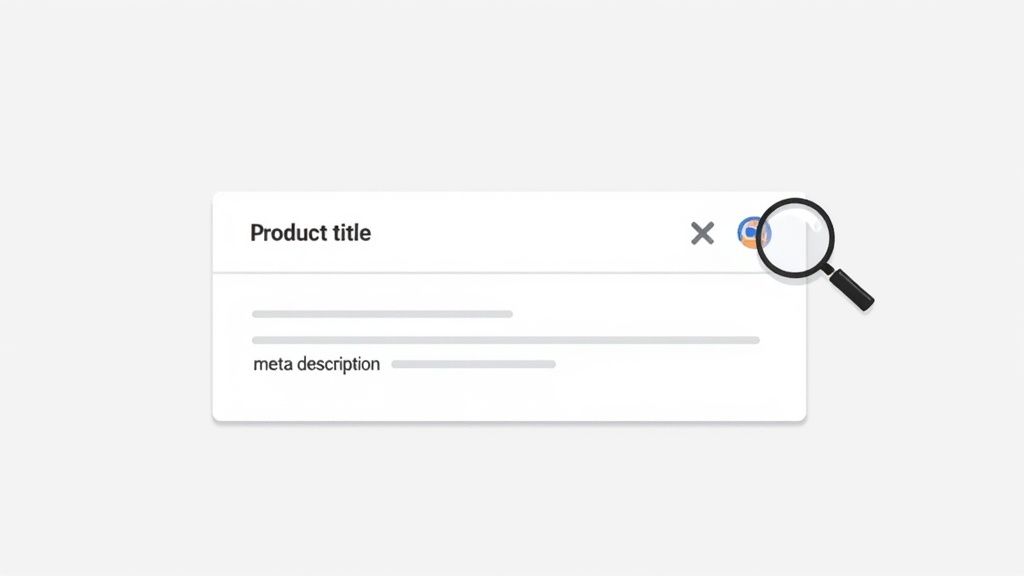
Your product titles and meta descriptions are your front-line soldiers in the battle for clicks on search engine results pages (SERPs). Think of them as your digital storefront window; they must be compelling enough to entice a potential customer to step inside. This is one of the most fundamental yet powerful seo tips for shopify because it directly influences both your search engine ranking and your click-through rate (CTR). Search engines use these elements to understand what your product is, while you use them to convince shoppers your product is what they need.
Why It’s Your SEO Power Play
A well-crafted title and description combo doesn’t just describe; it sells. It bridges the gap between a user’s search query and your product page, signaling to both Google and the user that you have the perfect solution. A generic title like “Blue Shirt” is a missed opportunity. A powerful title like “Men’s Coastal Blue Performance Dress Shirt – Wrinkle-Free & Moisture-Wicking” immediately communicates value, features, and target audience, dramatically increasing its relevance and appeal. A Shopify store in the fashion niche saw a 22% increase in organic CTR just by rewriting their top 20 product titles with this benefit-driven approach.
Your Action Plan for 2025
Ready to transform your product listings? Here’s exactly how you can do it:
- Step 1: Structure Your Titles for Impact. Follow a clear formula like Brand – Product Type – Key Feature/Benefit – Keyword. For example, instead of just “Allbirds Shoes,” use “Allbirds – Men’s Wool Runners – All-Day Comfort – Grey.” Place your primary keyword within the first 60 characters to ensure it’s always visible on SERPs.
- Step 2: Write Meta Descriptions that Convert. Your meta description is your 150-160 character sales pitch. Don’t just list features; highlight benefits and include a call-to-action (CTA). Instead of “Made of organic cotton,” try “Experience unmatched softness with our 100% organic cotton tee. Shop now for free shipping!“
- Step 3: Leverage Shopify’s SEO Preview. Use the built-in “Search engine listing preview” on your product pages. This tool is your best friend, allowing you to see exactly how your title and description will appear in Google search results before you even publish.
2. Implement Strategic Internal Linking
Think of your Shopify store as a well-organized library. Your internal links are the signs and pathways that guide both your customers and search engine crawlers from one section to another, creating a seamless and logical journey. Strategic internal linking is one of the most underrated seo tips for shopify because it creates a powerful web of connections that distributes authority, enhances navigation, and helps Google understand the relationships between your products, collections, and content. Without it, you have isolated pages that are much harder for search engines to find and rank.
Why It’s Your SEO Power Play
A smart internal linking strategy does more than just connect pages; it builds a strong site architecture that search engines love. When you link from a high-authority page (like your homepage or a popular blog post) to a key product page, you pass some of that “link equity” or “SEO juice,” boosting the destination page’s ranking potential. For your customers, it means effortlessly discovering related products or helpful guides, which keeps them on your site longer and guides them down the conversion funnel—just as Amazon does with its “Frequently bought together” suggestions.
Your Action Plan for 2025
Ready to build a powerful web of links that boosts your SEO? Here’s your game plan:
- Step 1: Be a Matchmaker. On each product page, manually link to 2-5 highly relevant, complementary products. For example, if you’re selling a “Waterproof Hiking Jacket,” link to your “All-Weather Hiking Boots” and “Moisture-Wicking Base Layers” directly in the description.
- Step 2: Use Descriptive Anchor Text. Avoid generic phrases like “click here.” Instead, use anchor text that clearly describes the destination page, such as “Shop our collection of organic cotton tees.” This gives both your customers and search engines clear context about the linked page.
- Step 3: Create Breadcrumb Navigation. Enable breadcrumbs on your Shopify theme (e.g., Home > Men’s Apparel > Shirts). This simple feature clarifies your site hierarchy for Google and makes it incredibly easy for your customers to navigate back to parent categories, improving their overall experience.
3. Optimize Your Images with Alt Text and File Names
Your product images are often the deciding factor for a sale, but they’re also a goldmine for SEO that many merchants overlook. Image optimization is a critical component of a holistic strategy for seo tips for shopify. It’s not just about making your site look good; it’s about telling search engines what your images represent, improving your chances of appearing in image searches, and ensuring your site loads lightning-fast for a better user experience.
Why It’s Your SEO Power Play
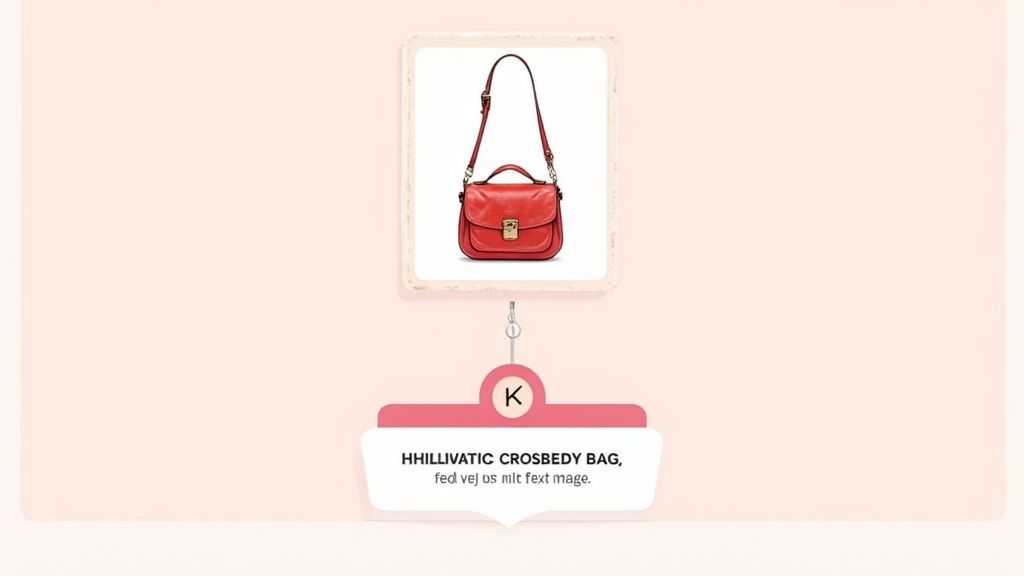
Properly optimized images do double duty: they help Google understand your product’s context, and they make your site accessible to visually impaired users. Instead of a generic file name like IMG_8871.jpg, a descriptive name like red-leather-crossbody-bag-womens.jpg immediately informs search crawlers about the product. This simple change can propel your products into Google Images, a massive source of high-intent traffic, and boost your page’s overall relevance.
Your Action Plan for 2025
Ready to turn your images into SEO assets? Here’s your step-by-step guide:
- Step 1: Create Descriptive File Names. Before uploading, rename your image files to describe the product using keywords separated by hyphens. Think like your customer: what would they search for?
- Step 2: Write Compelling Alt Text. Your alt text should describe the image for someone who can’t see it. Be specific and include your target keyword naturally. Instead of “jacket,” write “Men’s Patagonia down jacket in deep red, front view.” This improves both SEO and accessibility.
- Step 3: Compress and Format for Speed. Use tools like TinyPNG to compress images without losing quality. In Shopify, leverage modern formats like WebP to dramatically decrease load times, a key ranking factor.
- Step 4: Master Your Visuals. High-quality images are non-negotiable for conversions. If you’re looking to elevate your product photography, check out our guide on selecting a professional photography background cloth.
4. Create Unique Product Descriptions & Keyword Strategy
Duplicate content is the silent killer of eCommerce SEO. Relying on generic manufacturer descriptions not only bores your customers but also tells search engines that your page is just a copy of dozens of others. Crafting unique, compelling product descriptions is one of the most impactful seo tips for shopify because it allows you to connect with shoppers, answer their questions, and strategically target valuable keywords that drive conversions.
Why It’s Your SEO Power Play
A truly great product description does more than just list specs; it tells a story and sells a solution. It’s your chance to infuse your brand’s voice, highlight what makes your product superior, and naturally weave in the exact search terms your ideal customers are using. Think of it as your 24/7 digital salesperson. For example, a description for a blanket that targets the long-tail phrase “affordable organic cotton baby blankets” will attract highly qualified traffic with clear purchase intent, leading to higher conversion rates and better search rankings.
Your Action Plan for 2025
Ready to turn your product pages into SEO powerhouses? Here’s your step-by-step guide:
- Step 1: Map Keywords to Products. Before you write a single word, map a primary keyword and 2-3 secondary, long-tail keywords to each product page. Use these to guide your copy, ensuring every description is optimized for relevant search queries.
- Step 2: Structure for Scannability. Start with a benefit-driven opening paragraph. Follow with bullet points covering key features, specifications (materials, dimensions, care instructions), and unique selling points. This scannable format helps both your customers and search engine crawlers quickly understand the product’s value.
- Step 3: Write for Humans, Optimize for Robots. Write in a natural, persuasive tone that speaks directly to your customer’s needs. Avoid “keyword stuffing.” Instead, integrate your target keywords smoothly into your copy, headers, and bullet points. For a deeper dive, explore expert advice on Shopify product page customization to maximize your impact.
5. Build High-Quality Backlinks and Earned Media
If your on-page SEO is the engine of your Shopify store, high-quality backlinks are the high-octane fuel that powers it to the top of the search rankings. Backlinks are essentially votes of confidence from other websites, signaling to Google that your content is credible, authoritative, and valuable. This is one of the most powerful seo tips for shopify because it moves beyond your own site to build external authority, a critical factor in competitive search landscapes.
Why It’s Your SEO Power Play
Each relevant, high-authority backlink you earn acts as a powerful endorsement that boosts your domain authority and improves your search rankings. It’s not about getting hundreds of low-quality links; a single link from a major industry publication like Vogue or a top-tier blog can be more impactful than a thousand links from unknown sites. For example, when the mattress brand Casper was featured in a high-authority sleep blog, they saw a 40% jump in organic traffic to the linked product page within a week. This strategy also drives highly qualified referral traffic directly to your store.
Your Action Plan for 2025
Ready to earn the links that will set your store apart? Here’s how to build a powerful backlink profile:
- Step 1: Create Link-Worthy Content. Develop assets that people want to link to. This could be original research (like a survey on consumer trends in your niche), an ultimate guide (e.g., “The Complete Guide to Sustainable Fashion”), or a viral piece of content like Dollar Shave Club’s famous launch video.
- Step 2: Build Relationships, Not Just Links. Connect with journalists, bloggers, and influencers in your industry long before you need to ask for anything. Engage with their content and offer genuine value. When you have a story or new product, you’ll have a warm audience to pitch to, just as Glossier did by building a community of beauty bloggers.
- Step 3: Leverage Brand Mentions. Use tools like Google Alerts or Mention.com to find unlinked mentions of your brand. When you find one, simply reach out to the author or webmaster and politely ask if they would consider making that mention a clickable link back to your store. It’s one of the easiest link-building wins.
6. Optimize for Mobile and Core Web Vitals
In today’s mobile-first world, your Shopify store’s performance on a smartphone is not just an option; it’s the main event. Google prioritizes mobile-friendly sites, and its Core Web Vitals (CWV) are critical ranking signals that measure user experience. This is one of the most vital seo tips for shopify because it directly impacts how both your customers and search engines perceive your store’s speed, responsiveness, and stability, which heavily influences rankings and sales.
Why It’s Your SEO Power Play
A slow, clunky mobile experience is a conversion killer. Shoppers will abandon a page that takes too long to load or shifts around unexpectedly. By optimizing for mobile and acing your Core Web Vitals (LCP, INP, and CLS), you’re telling Google your site offers a superior user experience. This not only boosts your search rankings but also significantly improves user engagement and reduces bounce rates, turning more mobile browsers into buyers.
Your Action Plan for 2025
Ready to make your store a mobile performance champion? Here’s your game plan:
- Step 1: Audit and Optimize Your Images. This is your quickest win. Compress all product and theme images using tools like TinyPNG before uploading. Use modern formats like WebP and enable lazy loading so images only load as a user scrolls down the page.
- Step 2: Conduct an App Takedown. Unused or poorly coded apps are notorious for slowing down Shopify stores. Audit every app you have installed. If it’s not essential for your customer experience or operations, uninstall it.
- Step 3: Leverage Google PageSpeed Insights. Use this free tool to analyze your store’s performance. It will provide a detailed report on your Core Web Vitals and give you specific, actionable recommendations to improve your score.
- Step 4: Choose a Performance-Focused Theme. Not all themes are created equal. Start with a lightweight, well-coded theme like Shopify’s free Dawn theme, which is built with performance and CWV in mind from the ground up.
7. Implement Structured Data (Schema Markup)
Structured data, or schema markup, is like a secret language you speak directly to search engines. It’s code you add to your Shopify store that translates your content into a format Google understands instantly, allowing it to display enhanced search results called rich snippets. This is one of the most impactful seo tips for shopify because it transforms a standard blue link into a visually appealing, information-packed listing with ratings, price, and availability, directly on the search results page.
Why It’s Your SEO Power Play
Rich snippets make your listings stand out, commanding more attention and earning more clicks than your competitors. When a shopper sees your product with five gold stars, a clear price, and “In Stock” text right in the search results, it builds immediate trust and relevance. This increased click-through rate sends a powerful signal to Google that your page is a valuable result, which can positively influence your overall search rankings over time.
Your Action Plan for 2025
Ready to make your products shine on the SERPs? Here’s your game plan:
- Step 1: Use a Shopify App for Simplicity. Don’t get lost in code. Install a trusted app from the Shopify App Store that handles structured data. These tools automatically generate the necessary JSON-LD code for your products, reviews, and FAQs without you needing to edit your theme.
- Step 2: Focus on Key Schema Types. Prioritize implementing Product schema (price, availability, SKU), Review/AggregateRating schema (star ratings, review count), and FAQ schema for your product pages. If you have a physical location, add LocalBusiness schema.
- Step 3: Test and Validate Everything. Once implemented, use Google’s Rich Results Test to ensure your markup is error-free. Regularly check the “Enhancements” report in Google Search Console to monitor for any issues and see how Google is processing your structured data.
8. Develop a Content Marketing & Blog Strategy
Your Shopify store is more than just a place to sell products; it’s a platform to build a brand and become a trusted voice in your niche. A powerful blog and content marketing strategy is your engine for achieving this. This is one of the most transformative seo tips for shopify because it moves you beyond transactional selling, allowing you to attract customers by solving their problems, answering their questions, and building a community around your brand. It’s how you capture traffic from users who aren’t yet ready to buy but are actively seeking information your expertise can provide.
Why It’s Your SEO Power Play
Content marketing establishes your store’s topical authority. When you consistently publish high-quality content that addresses your customers’ pain points, you signal to Google that you are an expert in your field. This authority helps your entire site, including your product and collection pages, rank higher. Each blog post is a new opportunity to rank for long-tail keywords, create valuable internal links to your product pages, and draw visitors into your marketing funnel. A store selling high-performance running shoes, for example, can attract customers with articles like “5 Best Stretches to Prevent Shin Splints” or “How to Choose the Right Running Shoe for Your Foot Type.”
Your Action Plan for 2025
Ready to turn your store into an authority hub? Here’s your game plan:
- Step 1: Adopt the Topic Cluster Model. Build your content around core themes. Create one comprehensive “pillar page” on a broad topic (e.g., “The Ultimate Guide to Skincare Routines”) and surround it with 10-20 “cluster” posts on related, specific subtopics (e.g., “Best Moisturizers for Dry Skin,” “How to Use Vitamin C Serum”). This structure proves your expertise to search engines.
- Step 2: Target Long-Tail Keywords. Focus your articles on specific, multi-word search phrases like “best eco-friendly yoga mats for beginners.” These queries have lower competition and are often used by searchers with higher purchase intent, making them conversion goldmines.
- Step 3: Publish and Promote Consistently. Create a content calendar and stick to it, aiming for at least one new post per week. Don’t just publish and pray; promote every article to your email list and across your social media channels to drive initial traffic and engagement. Remember to also update your most popular posts annually to keep them fresh and relevant for 2025.
9. Fix Technical SEO Issues & Improve Crawlability
Think of your Shopify store as a massive library and search engines as the librarians trying to catalog every book. If the aisles are blocked, pages are missing, or books are in the wrong section, the librarian gets confused and might give up. Technical SEO is the art of organizing your library perfectly, ensuring search engines can easily crawl, understand, and index your entire store without any friction. This is one of the most crucial seo tips for shopify because it forms the very foundation your entire strategy is built upon.
Why It’s Your SEO Power Play
A technically sound website is a trustworthy website in Google’s eyes. By fixing issues like broken links, duplicate content, or crawl errors, you’re telling search engines that your store is a high-quality, reliable resource. This directly impacts how favorably they view and rank your pages. For example, using a canonical tag on a product page with multiple color variants prevents Google from seeing them as duplicate content, consolidating your SEO authority into a single, powerful URL.
Your Action Plan for 2025
Ready to give your store a technical tune-up? Here’s how you can ensure it’s in peak condition:
- Step 1: Conduct Regular Audits. Use Google Search Console as your primary diagnostic tool. Check the “Coverage” report weekly for errors or warnings that prevent pages from being indexed. A quick fix here can bring a valuable page back into search results.
- Step 2: Master Your Redirects. When you discontinue a product, don’t just delete the page and create a 404 error. Implement a 301 redirect to a similar product or relevant category page. This passes the old page’s SEO value to the new one and keeps the user experience smooth.
- Step 3: Leverage Canonical Tags. Shopify collections with filters can create multiple URLs with the same content, which is a major red flag for duplicate content. Ensure your theme properly uses
rel="canonical"tags to point all filtered versions back to the main category page, consolidating your ranking power.
10. Encourage and Leverage Customer Reviews and Social Proof
Your customers are your most powerful marketing asset. Encouraging and showcasing their reviews is more than just good customer service; it’s a strategic SEO play that builds immense trust and authority. Think of customer reviews as a constant stream of fresh, user-generated content that signals to Google your product pages are active, relevant, and valued by real people. This is one of the most authentic seo tips for shopify because it directly addresses search engine ranking factors like trust, content freshness, and user engagement.

Why It’s Your SEO Power Play
Social proof turns passive browsers into confident buyers. When a potential customer sees genuine reviews and photos from others who love your product, it eliminates doubt and builds credibility far more effectively than any marketing copy ever could. For search engines, this user activity and unique text (filled with natural, long-tail keywords) tells them your page offers significant value. Implementing review schema can also unlock rich snippets like star ratings directly in the SERPs, making your listings stand out and dramatically improving click-through rates.
Your Action Plan for 2025
Ready to turn customer feedback into an SEO goldmine? Here’s how you can get started today:
- Step 1: Automate Your Review Requests. Use a Shopify app to send automated email or SMS requests 1-2 weeks after a customer receives their order. This timing is crucial; it gives them enough time to experience the product but is recent enough that their excitement is still high.
- Step 2: Implement Review Schema. This is a non-negotiable step. Use a review app like Judge.me or Loox that automatically adds the correct structured data to your pages. This technical step is what enables Google to display those eye-catching star ratings in search results, giving you an immediate competitive edge.
- Step 3: Showcase Reviews Strategically. Don’t just leave reviews at the bottom of the page. Feature the best testimonials and user-generated photos directly on your product pages, homepage, and even in your marketing emails. This creates a powerful and immediate trust signal for new visitors.
- Step 4: Engage with Every Review. Make it a policy to respond to all reviews, both positive and negative, within 48 hours. This shows prospective customers you are an engaged and trustworthy brand that values feedback.
10-Point Shopify SEO Comparison
| Item | Implementation Complexity 🔄 | Resource Requirements ⚡ | Expected Outcomes 📊 | Ideal Use Cases 💡 | Key Advantages ⭐ |
|---|---|---|---|---|---|
| Optimize Product Titles and Meta Descriptions | Low 🔄 — simple CMS edits | Low ⚡ — content time, basic SEO tools | ⭐⭐⭐ — Higher CTR and clearer relevance in SERPs | New or small catalogs; quick SEO wins | Improves click-throughs and search relevance |
| Implement Strategic Internal Linking | Medium 🔄 — requires strategy & audit | Medium ⚡ — content updates, SEO tools | ⭐⭐⭐⭐ — Better crawlability, session duration, topical authority | Medium/large sites, stores with many related SKUs | Distributes link equity and improves navigation |
| Optimize Images with Alt Text and File Names | Medium 🔄 — per-image work + compression | Medium ⚡ — image tools, manual edits | ⭐⭐⭐ — Faster pages, accessibility, image search traffic | Image-heavy catalogs, mobile-first stores | Improves load times, accessibility, image SEO |
| Create Unique Product Descriptions & Keyword Strategy | High 🔄 — original copy per product | High ⚡ — writers, research tools, time | ⭐⭐⭐⭐ — Stronger rankings and higher conversions | Differentiated products or high-value SKUs | Provides unique indexable content and conversion lift |
| Build High-Quality Backlinks and Earned Media | High 🔄 — outreach and content creation | High ⚡ — PR effort, relationships, tools | ⭐⭐⭐⭐⭐ — Significant long-term ranking and referral traffic | Competitive niches and brand-awareness goals | Increases authority and drives referral visits |
| Optimize for Mobile and Core Web Vitals | High 🔄 — technical performance work | High ⚡ — developers, audits, performance tooling | ⭐⭐⭐⭐ — Improved rankings, conversions, lower bounce | Mobile-first commerce and high-traffic stores | Direct ranking factor; better UX and conversion rates |
| Implement Structured Data and Schema Markup | Medium 🔄 — JSON-LD or app setup | Low–Medium ⚡ — developer or Shopify app | ⭐⭐ — Higher CTR potential via rich snippets (not guaranteed) | Product pages with ratings, price, FAQ content | Enables rich SERP features and clearer search display |
| Develop a Content Marketing and Blog Strategy | High 🔄 — editorial planning and production | High ⚡ — writers, SEO tools, promotion | ⭐⭐⭐⭐ — Long-term traffic growth and topical authority | Brands aiming to scale organic acquisition | Builds topical authority and internal linking opportunities |
| Fix Technical SEO Issues and Improve Crawlability | Medium–High 🔄 — audits and fixes | Medium ⚡ — dev time, audit tools | ⭐⭐⭐⭐ — Reliable indexation and fewer search issues | Stores with crawl/index problems or large catalogs | Prevents duplicate/content issues and loss of equity |
| Encourage and Leverage Customer Reviews & Social Proof | Low–Medium 🔄 — systems + processes | Medium ⚡ — review apps, email automation | ⭐⭐⭐⭐ — Higher conversions and fresh user content | Consumer products, trust-sensitive categories | Boosts trust, conversion rates, and review-rich snippets |
Your Next Step to Shopify SEO Success
You now have a complete roadmap. This isn’t just a list of ideas; it’s a powerful toolkit filled with actionable SEO tips for Shopify designed to transform your store from just another online shop into a dominant force in your niche. We’ve moved beyond generic advice and delved into the specifics: from structuring your product titles for maximum click-through rates to implementing schema markup that makes your listings irresistible in search results.
The journey to the top of Google’s rankings is a marathon, not a sprint. The sheer volume of information can feel overwhelming, but progress doesn’t require doing everything at once. The key is to start. Choose one single, manageable task from this guide and commit to implementing it this week. Will you start by optimizing the alt text on your top ten product images? Or will you focus on crafting unique, keyword-rich descriptions for a single collection? Small, consistent actions are the engine of sustainable growth.
Remember, you’re not just optimizing for algorithms; you’re optimizing for people. Every technical fix and keyword-optimized blog post you create contributes to building trust with your customers long before they even land on your site. Just like TryIcona helps customers visualize products before purchase, great SEO helps them find your store in the first place.
Pick your first tip, take that initial step, and start building your momentum today.
Ready to boost conversions and reduce returns? While great SEO brings qualified traffic to your store, Icona helps turn that traffic into confident sales. Just as you optimize your site for trust, Icona’s virtual try-on technology gives shoppers the confidence to click “Add to Cart” by letting them visualize your products perfectly. Learn how Icona can elevate your customer experience and increase your conversion rate.