
Ever wonder how some Shopify stores seem to grow effortlessly while others struggle to turn visitors into cash? The secret isn’t a bigger ad budget or a viral TikTok video. It’s a well-oiled ecommerce marketing funnel.
Think of your funnel as the ultimate roadmap for your customer’s journey. It’s the exact path someone takes from being a complete stranger who stumbles upon your store to becoming a loyal fan who buys from you again and again. Getting this right isn’t just about making one sale; it’s about building a predictable, automated system for growth. This guide will show you how to build one, step by step.
Why Your Shopify Store Needs a Marketing Funnel
Trying to market your store without a funnel is like building a house without a blueprint. You can have all the best materials—slick ads, beautiful social posts, killer emails—but without a clear plan, you’re just creating a chaotic mess. You’re wasting time and money because you have no idea what’s actually working.
An ecommerce marketing funnel provides that essential structure. It helps you guide potential customers through a series of logical steps, moving them from “Who are you?” to “I need that now!”
From Buzzword to Your Business Plan
Let’s be real: “funnel” can feel like just another marketing buzzword. But in practice, it’s the most logical way to connect with your customers. A person who just found your brand through a Facebook ad needs a completely different conversation than someone who abandoned their cart ten minutes ago. A one-size-fits-all message just doesn’t cut it anymore.
Here’s what a solid funnel strategy will do for your store:
- Stop Wasting Ad Spend: You’ll deliver messages that actually resonate with people at the right moment, dramatically improving your return on investment (ROI).
- Build Real Relationships: Instead of just shouting “buy now,” you’ll nurture potential customers with helpful content, building trust long before you ever ask for the sale.
- Boost Conversion Rates: By understanding and addressing your customers’ hesitations at each stage, you make the path to purchase incredibly smooth and compelling.
- Create Customers for Life: The journey doesn’t end at the first purchase. A great funnel is designed to turn one-time buyers into repeat customers and brand advocates.
This visual breaks down how a wide audience of potential customers gets narrowed down into a core group of converted buyers.
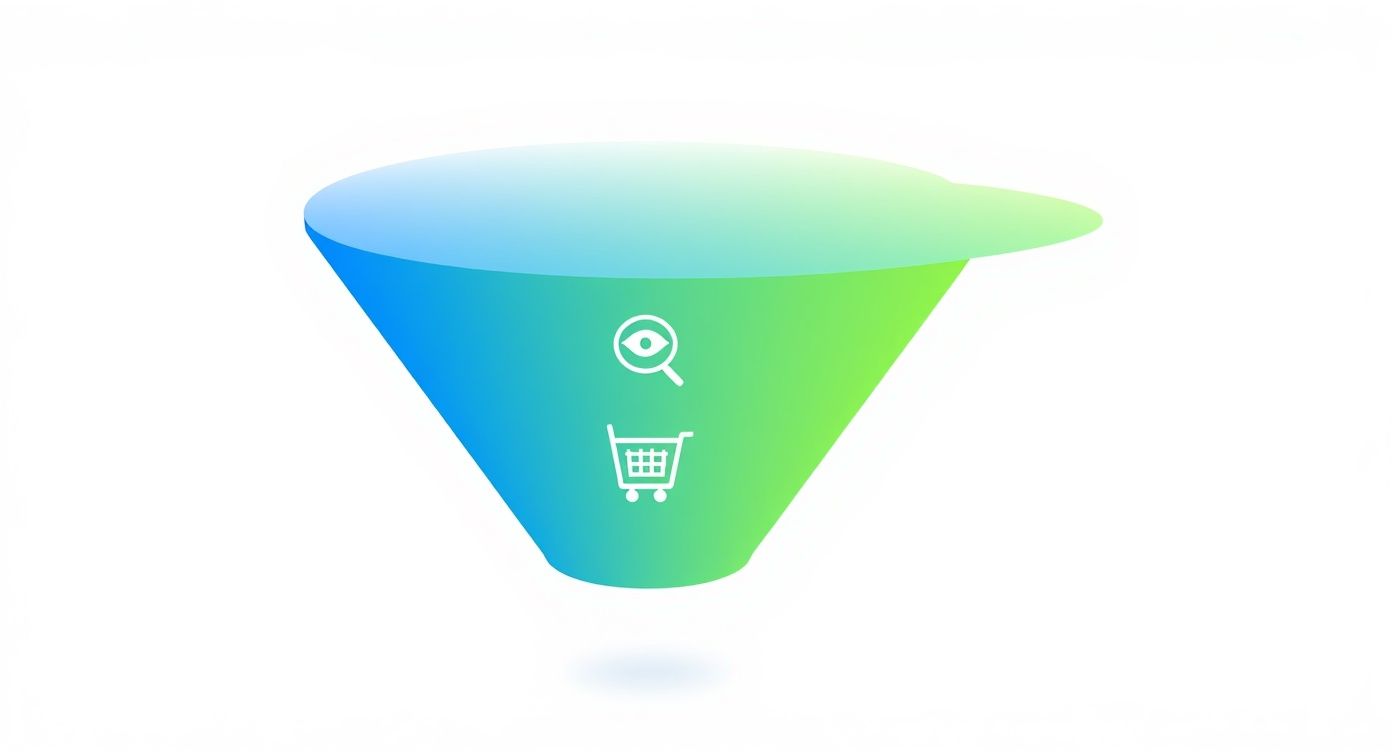
As you can see, it’s all about guiding your most interested and qualified visitors toward that final purchase.
To make this even clearer, here’s a quick overview of how each stage works for your Shopify store.
The Ecommerce Funnel At A Glance
| Funnel Stage | Customer Mindset | Your Marketing Goal | Actionable Steps for Your Store |
|---|---|---|---|
| Top of Funnel (TOFU) | “I have a problem or a desire, but I’m just exploring.” | Attract: Grab their attention and introduce your brand. | Run awareness ads, post helpful blog content, create engaging social media videos. |
| Middle of Funnel (MOFU) | “I’m comparing options and looking for the best choice.” | Nurture: Build trust, educate, and showcase why you’re the best option. | Use email popups to capture leads, send a welcome email series, retarget visitors with ads. |
| Bottom of Funnel (BOFU) | “I’m ready to buy, but I need a final push.” | Convert: Overcome last-minute objections and make the purchase irresistible. | Send abandoned cart emails, optimize your checkout, offer upsells and cross-sells. |
This table shows the shift in your customer’s mindset and how your marketing needs to adapt. It’s a simple but powerful way to frame your entire strategy.
The Real Impact on Your Bottom Line
So, what kind of difference can this really make for your store? The average ecommerce conversion rate across all industries sits somewhere between 1.9% to 3.65%. That means for every 100 visitors, only two or three actually make a purchase. It’s a tough game.
But here’s the inspiring part: stores that master their ecommerce marketing funnels often see conversion rates of 4–5% or even higher. They’re not just getting more traffic; they’re effectively doubling their sales from the same amount of traffic. If you’re curious about where you stand, you can explore more detailed eCommerce conversion benchmarks to see how your store stacks up.
Key Takeaway: An ecommerce marketing funnel isn’t an abstract concept—it’s a practical framework for sustainable growth. It forces you to get inside your customer’s head, creating a shopping experience that feels intuitive, persuasive, and leads directly to more sales for your Shopify store.
Stage 1: Attracting Visitors at the Top of the Funnel (TOFU)
This is where your customer’s journey begins. The top of your ecommerce marketing funnel (what we call TOFU) is your grand introduction. You’re reaching out to a huge audience of potential customers—people who have a problem your product solves, but they probably haven’t even heard of you yet.
Forget the hard sell. Seriously. Your only job right now is to attract and engage.
Think of it like hosting a great party. You don’t shove a sales pitch in your guests’ faces the moment they walk in. You welcome them, make them feel comfortable, and show them why they’ll have a great time. Your goal here is simple: drive quality traffic to your Shopify store and get your brand name stuck in their heads.
Actionable Steps for TOFU:
1. Win the Social Media Game: In 2025, your social media profiles are your new front door. Just posting sterile product shots won’t cut it anymore. You have to create content that stops the endless scroll and actually gives people something valuable.
- Instagram & TikTok: These are visual playgrounds. Think short-form video. If you sell apparel, create quick “style hack” Reels. If you’re a kitchenware brand, post those oddly satisfying recipe tutorials. Show your products in the wild, making life better or more beautiful.
- Pinterest: This isn’t just a social network; it’s a discovery engine. People come here actively looking for ideas. A home decor brand could create boards like “2025 Cozy Living Room Inspo,” strategically featuring their products. It’s about inspiring, not just selling.
- Influencer Partnerships: Find creators who genuinely love what you’re about. Partnering with them puts your brand in front of an audience that already trusts them. For example, a skincare brand could team up with an influencer for an authentic “get ready with me” video. It’s instant credibility.
2. Get Smart with Paid Ads: Organic reach is amazing, but it can be a slow burn. Paid ads on platforms like Facebook, Instagram, and Google are your fast-pass to getting in front of your exact ideal customer.
At this awareness stage, your ads should focus on grabbing attention, not making a direct sale. Instead of a pushy “Buy Now” button, use a softer call-to-action like “Learn More” or “Discover the Collection.”
Actionable Tip: User-generated content (UGC) is pure gold for top-of-funnel ads. An ad featuring a real customer’s photo or video review feels less like an ad and more like a trusted recommendation. It just works. For instance, a Shopify store selling pet supplies saw a 28% lower cost-per-click using UGC ads compared to their studio shots.
3. Build Authority with Your Blog: Search Engine Optimization (SEO) is the ultimate long game for your store. It’s how you attract free, high-intent traffic for years to come. By creating blog content that answers the specific questions your audience is typing into Google, you become the go-to expert in your niche.
Imagine you sell sustainable home goods. An article titled “10 Simple Swaps for a Greener Kitchen in 2025” is going to attract exactly the right kind of person—someone already interested in the lifestyle you support. They’re not just visitors; they’re qualified leads.
Success at the top of the ecommerce marketing funnel comes down to one thing: making a memorable first impression on the right people.
Stage 2: Nurturing Leads in the Middle of the Funnel (MOFU)

Alright, you’ve grabbed their attention. So, now what? Welcome to the middle of the funnel (MOFU), that critical space where casual browsers decide if you’re the real deal.
They aren’t strangers anymore. They’re actively looking for solutions, and you’ve made their shortlist. Your job isn’t to go for the hard sell just yet. Instead, it’s all about building a genuine relationship, proving your value, and making them want what you have.
Actionable Steps for MOFU:
1. Turn Visitors into Subscribers with a Popup: One of the smartest moves you can make is getting their email address. Why? Because an email list is an asset you actually own. Unlike social media followers, this is a direct, unfiltered line to your most promising prospects. But people are protective of their inboxes, so you need to give them a great reason to subscribe. This is where a simple popup form comes in.
- Discount Popups: A classic for a reason. An exit-intent popup offering 10% off their first order can work wonders. It’s a simple, high-value trade that feels like a win for the shopper. A Shopify beauty store recently implemented an exit-intent popup and captured 32% more emails in the first month.
- Exclusive Content: Selling skincare? Offer a beautifully designed PDF guide like, “The 5-Step Morning Routine for Glowing Skin” in exchange for their email. This instantly positions you as a trusted expert, not just another retailer.
- Quiz Funnels: These are incredibly engaging. A fashion brand could build a “Find Your Signature Style” quiz using a Shopify app. To get their results and personalized recommendations, they just need to enter their email. Simple and effective.
2. Craft a Welcome Email Series That Wows: Once you have that email, the clock is ticking. The first few messages a new subscriber gets are your golden opportunity to make a lasting impression. Your welcome series is where you tell your brand’s story and gently guide them toward that first purchase. Here’s a simple, proven three-part flow you can set up with any email marketing app:
- Email 1 (Immediate): The Welcome & Reward. Deliver that discount code or guide you promised right away. Add a short, heartfelt thank you and a brief intro to your brand’s mission.
- Email 2 (Day 2): Showcase Your Best. This is where you introduce your heavy hitters—your best-selling products. Use stunning images and pull quotes from 5-star customer reviews to build that all-important social proof.
- Email 3 (Day 4): Share Your Story. Why did you start this brand? People connect with purpose. Sharing your “why” builds an emotional bond that goes way beyond a simple transaction.
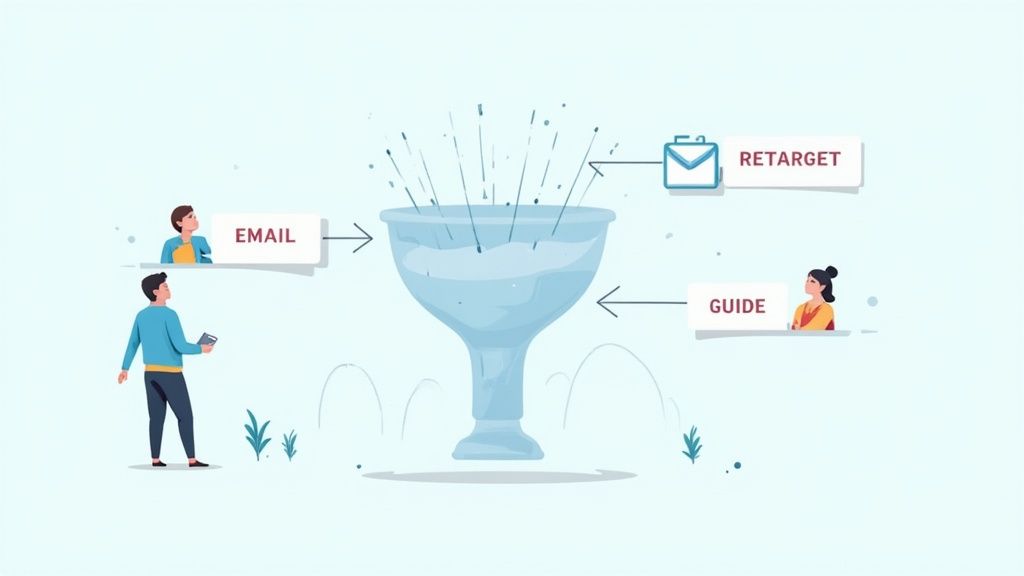
3. Use Retargeting Ads to Stay Top-of-Mind: Not everyone will subscribe on their first visit, and that’s okay. For this segment, retargeting ads are your secret weapon. By placing a pixel on your Shopify store, you can serve up highly relevant ads to people who visited specific pages but left without buying. Imagine someone browsed a particular blue dress. You can then show them a Facebook or Instagram ad featuring that exact dress, maybe even with a testimonial from someone who loves it. This isn’t just advertising; it’s a helpful, personalized reminder.
Expert Insight: Personalization isn’t just a buzzword; it’s the engine of a high-performing ecommerce marketing funnel. It’s about making every single shopper feel like you’re speaking directly to them.
The middle of the funnel is all about building trust. When you deliver real value, share your story, and create personalized moments, you give shoppers the confidence they need to finally click “Add to Cart.”
Stage 3: Driving Conversions at the Bottom of the Funnel (BOFU)
This is it. The moment of truth. After all your hard work guiding them through the ecommerce marketing funnel, your potential customer is at the finish line, credit card in hand. They’ve done their research, they feel a connection to your brand, and they’re ready to make a choice.
Your job now is to make it incredibly easy—and totally compelling—for them to choose you. It’s time to iron out every last bit of friction, quiet any lingering doubts, and give them that final, confident nudge they need to hit “Complete Purchase.”
Actionable Steps for BOFU:
1. Recover Lost Sales with Abandoned Cart Emails: Let this sink in: the average cart abandonment rate hovers right around 70%. That’s a jaw-dropping number, but I don’t see it as a loss. I see it as a massive opportunity. This is where automated abandoned cart emails become your secret weapon. A thoughtfully timed sequence can recover a huge chunk of that potential revenue.
Here’s a powerful three-part flow you can automate:
- Email 1 (1 hour after abandon): The Gentle Reminder. Keep it simple and helpful. A subject line like “Did you forget something?” works wonders. Show them a picture of the item they left behind. No discounts yet—just a friendly tap on the shoulder.
- Email 2 (24 hours after abandon): Add Social Proof. Now, gently dial up the persuasion. Remind them of the product again, but this time, feature a glowing 5-star review or a snippet of UGC with that exact item. Seeing that other people love it is powerful validation.
- Email 3 (48 hours after abandon): The Final Offer. If they’re still on the fence, it’s time for a small, strategic incentive. A modest discount like 10% off or free shipping can be the final push that overcomes price sensitivity and closes the deal.
2. Optimize Your Product and Checkout Pages: Think of your product page as your final sales pitch. It needs to be so clear and convincing that the customer has no reason to leave. This means stunning images, compelling descriptions, and crystal-clear shipping and returns info. You also need to build unshakable trust. Just like TryIcona helps customers visualize products before purchase, your product page needs to help them feel confident in their decision. If you want to really dig in, we have a complete guide on https://tryicona.com/shopify-product-page-customization/ that will help you nail every last detail.
Once they hit “Add to Cart,” the journey must be seamless.
Key Takeaway: A complicated checkout is the ultimate conversion killer. Research shows that about 17% of shoppers ditch their carts just because the process was too long or confusing. Your goal is to make it so simple they barely have to think.
Here’s how to design a checkout that converts:
- Offer Guest Checkout: Don’t force people to create an account. For 24% of shoppers, this is an immediate dealbreaker.
- Display Trust Badges: Make sure security seals (like SSL certificates) and familiar payment logos (Visa, PayPal, Apple Pay) are front and center.
- Keep It Simple: Strip it down to the essentials. Cut out any unnecessary form fields or extra steps.
3. Increase Average Order Value with Upsells: Getting the sale is fantastic. But getting a bigger sale? That’s even better. Upsells and cross-sells increase your Average Order Value (AOV) by suggesting relevant products at just the right moment.
- Upsell: Suggesting a better, more premium version of the product they’re already considering. (Think: “Upgrade to the deluxe version for just $10 more.”)
- Cross-sell: Recommending complementary items that enhance their purchase. (For example: “Customers who bought this dress also loved these earrings.”)
You can place these offers on the product page, in the cart, or on the post-purchase thank you page using various Shopify apps. This isn’t just a small tweak; it’s a fundamental growth lever.
Stage 4: Creating Loyalty and Repeat Purchases
A lot of Shopify owners breathe a sigh of relief when a customer clicks “buy.” Funnel complete, right? Wrong. The most profitable brands know that sustainable growth happens after the first sale.
This is your moment to transform a one-time buyer into a lifelong fan. The game now shifts from acquisition to retention. Think about it: it costs five times more to land a new customer than to keep an existing one. By going the extra mile, you don’t just make another sale; you create brand ambassadors who do your marketing for you.
Actionable Steps for Loyalty:
1. Nurture New Customers with a Post-Purchase Email Flow: The time right after a purchase is pure potential. Your new customer is excited for their order to arrive. Your inbox is the perfect place to reinforce that they made a brilliant choice.
Here’s a simple, effective sequence you can automate:
- Email 1 (Immediately): The Enthusiastic Thank You. This shouldn’t look like a receipt. Send a beautifully designed email that genuinely thanks them for joining your community and reminds them of your brand’s mission.
- Email 2 (When Shipped): The Anticipation Builder. Their order is on its way! Include the tracking link, but also add value. If they bought a dress, link to a blog post on “Three Ways to Style Your New Dress.”
- Email 3 (A Week After Delivery): The Check-In & Review Request. Ask them how they’re loving the product. This is the perfect time to ask for a review—and make it dead simple by linking them directly to the product page.
2. Build a Community with a Loyalty Program: You want your customers to feel like they’re part of an exclusive club. A loyalty program is one of the best ways to foster that feeling. Data shows a huge 79% of customers are more likely to stick with a brand that has a loyalty program.
Actionable Tip: Don’t just reward purchases. Use a Shopify loyalty app to give out points for things like following you on social media, writing a product review, or referring a friend. This creates a powerful feedback loop of engagement that fuels your entire funnel.
3. Re-Engage Past Customers to Fuel Growth: Your list of past customers is one of your most valuable marketing assets. These are people who already know, like, and trust you. Create email segments for customers who haven’t shopped in 60 or 90 days. Hit them with a friendly “We Miss You” campaign that includes an exclusive offer to tempt them back. This turns your funnel into a self-sustaining cycle, where past buyers become your next wave of revenue.
Your Ecommerce Funnel Questions Answered
Building your first ecommerce marketing funnel can feel like a big project, but it’s really just a series of small, intentional steps. Let’s tackle the most common questions so you can move forward with confidence.
How Long Does It Take To Build A Funnel?
You can get a basic funnel up and running in a single afternoon. Seriously. With the right Shopify apps, you can launch the essential pieces—like a simple lead capture popup and an automated three-part email welcome series—in just a few hours.
The real work isn’t the initial setup; it’s the ongoing optimization. Think of your funnel as a living part of your business. A foundational funnel can go live today, but a high-performing one is built through constant testing and learning.
Which Stage Of The Funnel Is Most Important?
The honest answer is: they all are. A funnel is a connected system. A weak link at any stage will impact the whole process.
- You could have the most amazing products (BOFU), but if nobody knows you exist (TOFU), you’ll never make a sale.
- You could drive a ton of traffic (TOFU), but if you don’t build trust and capture leads (MOFU), that ad spend is wasted.
Instead of asking which stage is most important, ask yourself: “Where is my funnel weakest right now?” That’s the spot that deserves your immediate attention.
What Is A Good Conversion Rate For A Funnel?
You’ll see the average ecommerce conversion rate floating around 2-3%, but that number can be misleading. A “good” conversion rate depends entirely on your industry, price point, and traffic source. For instance, you’d expect traffic from an email campaign to loyal customers to convert at a much higher rate than cold traffic from a brand awareness ad on TikTok.
My Advice: Don’t get obsessed with hitting a universal benchmark. Focus on improving your own baseline. If your site-wide conversion rate is 1.5% today, getting it to 2% is a massive win. That’s the game.
How Do I Know If My Funnel Is Working?
Your funnel’s health is about more than just final sales. To truly understand what’s going on, you have to track key metrics at each stage.
- Top of Funnel (TOFU): Are you seeing a healthy increase in website traffic and social media engagement?
- Middle of Funnel (MOFU): What’s your email signup rate from popups? How many people are opening your welcome emails?
- Bottom of Funnel (BOFU): What percentage of visitors add a product to their cart? And how many of those abandoned carts are you successfully recovering?
By keeping an eye on these specific KPIs, you can pinpoint exactly where potential customers are dropping off. This data-driven approach turns optimization from a guessing game into a clear, actionable strategy for your store.
Ready to boost conversions on your product pages? With Icona, you can add a virtual try-on experience to your Shopify store in minutes. It’s the confidence boost shoppers need to click “Add to Cart.” Start converting more visitors into happy customers by exploring our plans.
SEO Meta Description:
Ready to grow your Shopify store? This guide breaks down the ecommerce marketing funnel into 4 actionable stages to attract visitors, capture leads, and boost sales.
Featured Image Idea:
A Shopify store owner looking at a laptop screen that shows a visual diagram of the 4-stage ecommerce marketing funnel (Attract, Nurture, Convert, Loyalty).