
Ever watched a customer hesitate on a product page, wondering, “But how will it actually look on me?” This single moment of doubt is the biggest hurdle every online fashion store faces, creating a gap between a customer loving your product and clicking “Add to Cart.” The good news is, there’s a practical way to bridge that gap and turn that hesitation into a confident sale.
A virtual fitting room is the actionable solution to this age-old problem. It gives your shoppers the power to digitally “try on” clothes right from their living room, combining the convenience of online shopping with the confidence of an in-person fitting. By implementing one, you can directly address the main reasons for abandoned carts and costly returns.
What Is a Virtual Fitting Room and Why Does It Matter in 2025?
Simply put, a virtual fitting room is an eCommerce tool that lets customers see how clothes will look on them without touching the fabric. It’s the practical answer to the most significant challenge in online fashion: uncertainty about size, fit, and style. This uncertainty is a massive driver of lost sales and expensive returns.
For your Shopify store, this is much more than a cool gadget—it’s a conversion-boosting tool. By 2025, shoppers expect interactive, personal experiences that help them make confident buying decisions. A virtual try-on tool helps you deliver exactly that.
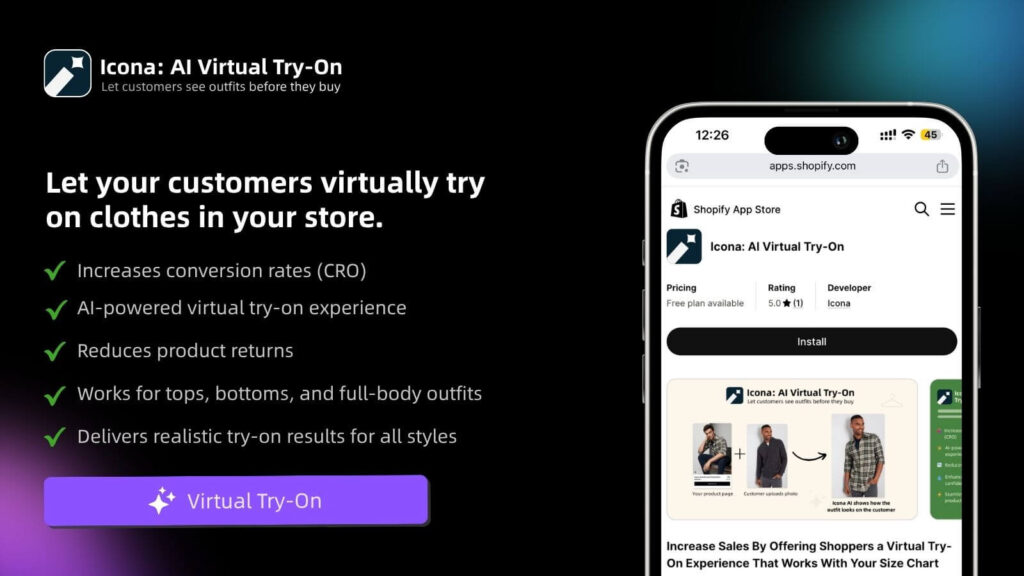
Imagine one of your customers scrolling through your latest collection. Instead of guessing based on a generic size chart, they use a tool like Icona to upload a photo and instantly see your new dress on their own body. That immediate, personal connection erases doubt and makes the decision to buy almost effortless.
The Core Problem Solved by a Virtual Fitting Room
Let’s be direct: the traditional way of buying clothes online is filled with friction. A shopper finds a product they love, but then the questions begin. “Will the medium be too snug?” “Is that color right for my skin tone?” This hesitation creates a perfect storm of problems for store owners:
- Sky-High Return Rates: An eye-watering 71% of shoppers are more likely to send back clothes they bought online, almost always because of a poor fit. Returns actively eat into your profits through shipping costs, restocking labor, and sometimes, damaged inventory.
- Low Conversion Rates: Doubt is the ultimate conversion killer. When a customer can’t feel sure about how an item will look, they are far more likely to abandon their cart and leave your site.
- Eroding Customer Loyalty: Receiving an item that doesn’t fit is a disappointing experience. That frustration can break a customer’s trust in your brand and make them hesitant to buy from you again.
A virtual fitting room tackles these issues head-on. It replaces guesswork with genuine confidence, transforming a hesitant browser into a decisive buyer who trusts your brand.
By integrating this technology, you are fundamentally upgrading the entire shopping journey. You’re giving your customers the tools to make smart, happy decisions, which builds the kind of trust that turns first-time shoppers into loyal fans. This is how you win in the competitive 2025 eCommerce landscape.

How Does a Virtual Fitting Room Actually Work?
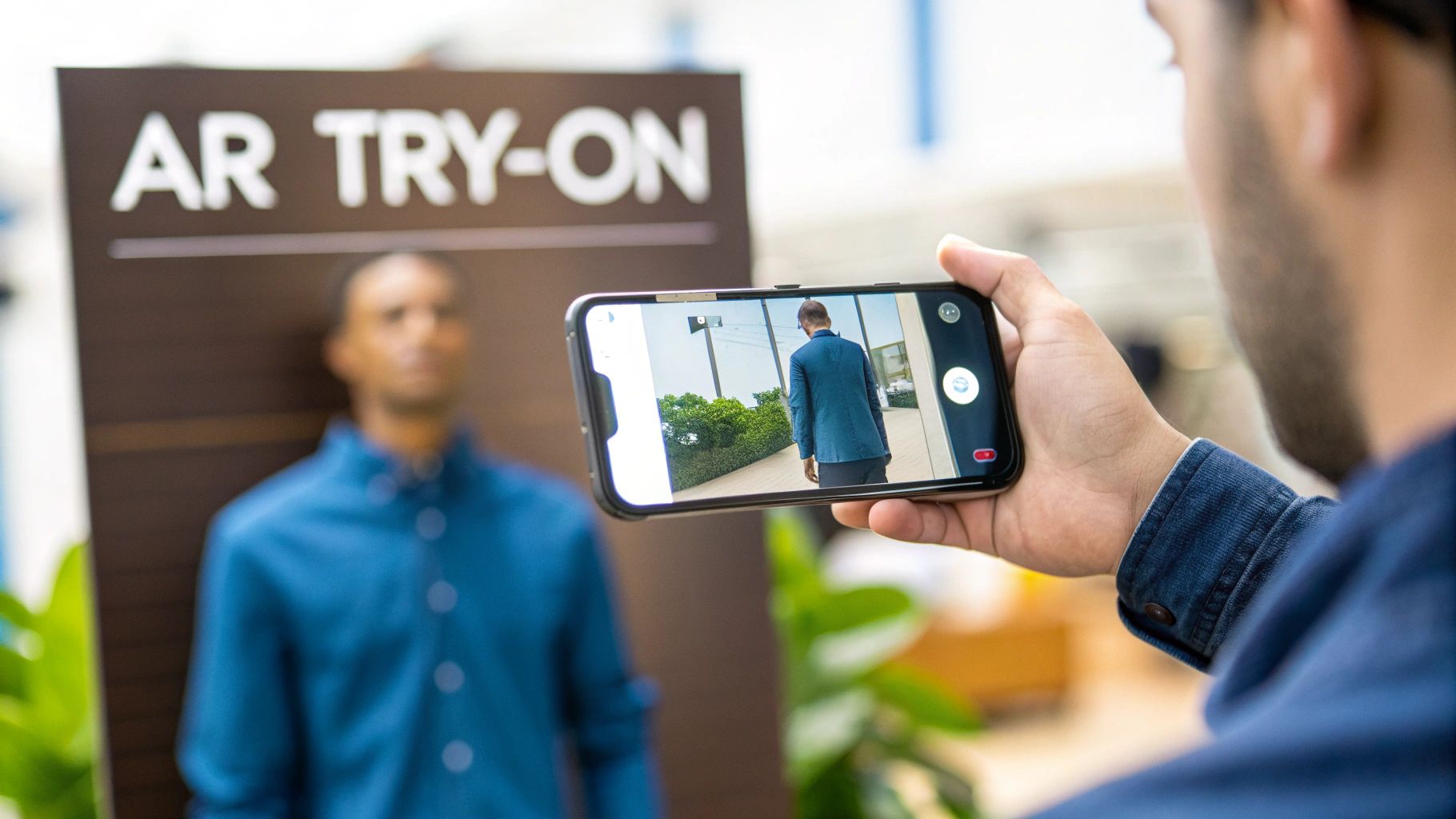
So, what’s the technology behind this powerful tool? A virtual fitting room might seem complex, but its goal is simple: give your customers the same “this is the one” feeling they get in a physical dressing room.
It’s not a single piece of tech, but a smart system where a few powerful tools work together to create a seamless, confidence-boosting experience. The whole process is powered by two main technologies: Artificial Intelligence (AI) and Augmented Reality (AR). You can think of AI as the expert personal stylist who knows all the right questions to ask, and AR as the full-length mirror that shows the final look.
The Two Pillars of Virtual Try-On Technology
Understanding these two concepts is key to seeing how a virtual fitting room brings your products to life. They often work together, but they can also function independently depending on the tool you choose.
AI Size Recommendations: This is the brains of the operation. The AI engine takes in information—like your product’s measurements, a customer’s height and weight, or their body shape from a photo—and predicts the best size for them. It’s all about moving beyond generic “S, M, L” tags to deliver a personalized recommendation.
Augmented Reality (AR) Visualization: This is where the magic becomes visible. AR technology takes a digital image of your product and overlays it onto a real-world image from the customer’s camera. Instantly, they can see how that dress will drape or how that color will look against their skin tone.
When a customer uses a tool like Icona, these two pillars work in harmony. The AI intelligently analyzes their photo to understand their body shape. Then, the AR kicks in, draping a realistic digital version of your garment onto their image. The result is a stunningly accurate preview that helps them buy with confidence.
Common Types of Virtual Fitting Rooms
Not all virtual try-on tools are the same. The technology ranges from simple quizzes to fully immersive experiences. Here’s a practical breakdown of the main types you’ll find for your Shopify store in 2025.
1. Size Recommendation Quizzes
This is the most straightforward entry point. The customer answers a few simple questions—height, weight, maybe the size they wear in a well-known brand—and an algorithm suggests the best fit. While not a visual try-on, it’s a great first step to reduce fit-related returns.
2. Photo-Based Try-On (2D)
This is where things get visual. A customer uploads a full-body photo, and the technology overlays a 2D image of the product onto their picture.
Practical Example: A customer shopping for a new spring dress uploads a picture of themselves. Within seconds, the photo-based try-on tool shows them exactly how the dress will look on their body, helping them decide between two styles. Solutions like Icona use this method because it’s highly effective and accessible—customers don’t need the latest smartphone or have to build a 3D avatar.
3. Augmented Reality (AR) Live Try-On
This is the real-time “magic mirror.” Using their phone’s live camera, a shopper can see a product on their body as they move. It’s incredibly engaging for accessories like sunglasses, jewelry, or makeup where seeing different angles is crucial.
4. 3D Model Avatars
With this method, the customer creates a personalized 3D avatar by inputting precise body measurements. They can then dress this digital twin in 3D versions of your clothes. It offers incredible accuracy but requires you to invest in creating 3D models for your entire collection. For more on AI-powered model creation, check out our guide on the AI fashion model.
Measuring the Real-World Impact on Your Store
The technology is cool, but what really matters is what it does for your bottom line. Integrating a virtual fitting room into your store is a strategic investment that directly boosts your most critical business metrics. This is where a shopper’s confidence turns into measurable growth for your business.
The market data confirms this trend. The global virtual fitting room space was valued at around $6.21 billion in 2024 and is projected to reach between $6.87 billion and $8.21 billion in 2025. This growth is driven by stores like yours solving the core problems of online fashion. You can see the full research on this market trend for more details.
This represents a fundamental shift in how people shop online. It’s about closing the gap between browsing and buying.
Skyrocket Your Conversion Rates
The biggest killer of online fashion sales is uncertainty. A shopper can love a dress on your product page, but if they can’t picture how it will look on them, they’ll hesitate. That hesitation is the number one reason for abandoned carts.
A virtual fitting room eliminates that barrier. When a customer sees an item on their body in seconds, hesitation is replaced with excitement.
Case Study Example: A Shopify boutique, “Boho Chic Threads,” implemented a photo-based virtual fitting room. Within three months, they saw a 45% increase in conversion rates on products with the try-on feature. Customers who used the tool were 2.5 times more likely to complete their purchase because they felt confident in their choice. This simple change turned passive “window shoppers” into active buyers.
Drastically Reduce Costly Returns
Returns are a nightmare. They’re a logistical headache and a direct hit to your profits, eating away at margins with shipping costs, processing fees, and unsellable inventory. The top reason for all this waste? The fit was wrong.
By giving customers an accurate size recommendation and a clear visual preview, you empower them to get it right the first time.
We’ve seen brands cut their return rates by as much as 40% after integrating a virtual fitting room. For a Shopify store, that’s a game-changer, leading directly to a healthier, more sustainable business.
Fewer returns also mean happier customers. When they trust that what they buy from you will fit perfectly, they come back again and again.
Boost Your Average Order Value
A confident shopper is a curious shopper. Once a customer knows an item fits them well, they feel free to explore. “What else would look good with this?” becomes a question they can actually answer.
A virtual fitting room invites experimentation. A shopper tries on the blouse they came for, loves it, and then thinks, “Why not try on those pants, too?” Before you know it, they’re building an entire outfit.
Here’s how it works:
- Zero Friction: Trying on another piece is just a click away.
- Effortless Styling: Customers can see how different items work together on their body, not a model’s. This encourages them to buy a complete look.
- Confident Spending: The certainty that multiple items will fit makes a larger purchase feel like a smart investment, not a gamble.
This cycle of confidence and discovery naturally leads to a higher Average Order Value (AOV). Many stores report seeing a 10-20% lift.
Virtual Fitting Room ROI Projections for a Shopify Store in 2025
This table illustrates the potential financial impact of implementing a virtual fitting room, based on 2025 industry benchmarks.
| Metric | Industry Average (Without VFR) | Projected Impact (With VFR) | Business Outcome |
|---|---|---|---|
| Conversion Rate | 1.5% | 2.5% – 3.0% | More sales from the same amount of traffic. |
| Return Rate | 25% | 15% – 18% | Lower costs and improved profit margins. |
| Average Order Value | $80 | $88 – $96 | Increased revenue per customer transaction. |
When you look at the numbers, the conclusion is clear. A virtual fitting room isn’t just an expense; it’s a high-return investment in your customer experience that pays for itself over and over again.
Choosing The Right Solution For Your Shopify Store
Picking the perfect virtual fitting room for your Shopify store is an exciting decision. The great news is there’s a solution for every kind of business, whether you’re a dropshipper just starting out or an established fashion brand ready to scale. The key is finding the tool that aligns with your budget, products, and goals for 2025.
Think of it this way: a store selling graphic tees has different needs than a boutique crafting bespoke jackets. Your job is to pick the tech that gives you the biggest return on investment.
Understanding Your Options
Virtual fitting room technology isn’t one-size-fits-all. Different approaches create different customer experiences and require different levels of effort to implement. Let’s break down the main options.
AI Size Recommenders: This is often the simplest and most affordable way to start. Customers input their height, weight, and perhaps the size they wear in another brand. An AI algorithm then suggests the best size. It’s a quick, powerful way to reduce fit-related returns.
Photo-Based (2D) Try-On: For many Shopify stores, this is the sweet spot. A customer uploads a photo, and the tech overlays a realistic image of your clothing onto their body. This provides that crucial “aha!” moment of visual confirmation. Apps like Icona are built on this model because it’s intuitive for shoppers and doesn’t require them to build a 3D avatar.
AR Live Try-On: Using a smartphone camera, this tech lets shoppers see products on themselves in real-time. It’s fun and engaging, especially for items like sunglasses, jewelry, or makeup.
3D Model Visualization: This is the most immersive experience. Customers create a detailed 3D avatar and “dress” it in 3D versions of your clothes. It’s fantastically accurate but requires a significant investment to create 3D models for your collection.
Making the right call comes down to a simple cost-benefit analysis, as this decision tree illustrates.
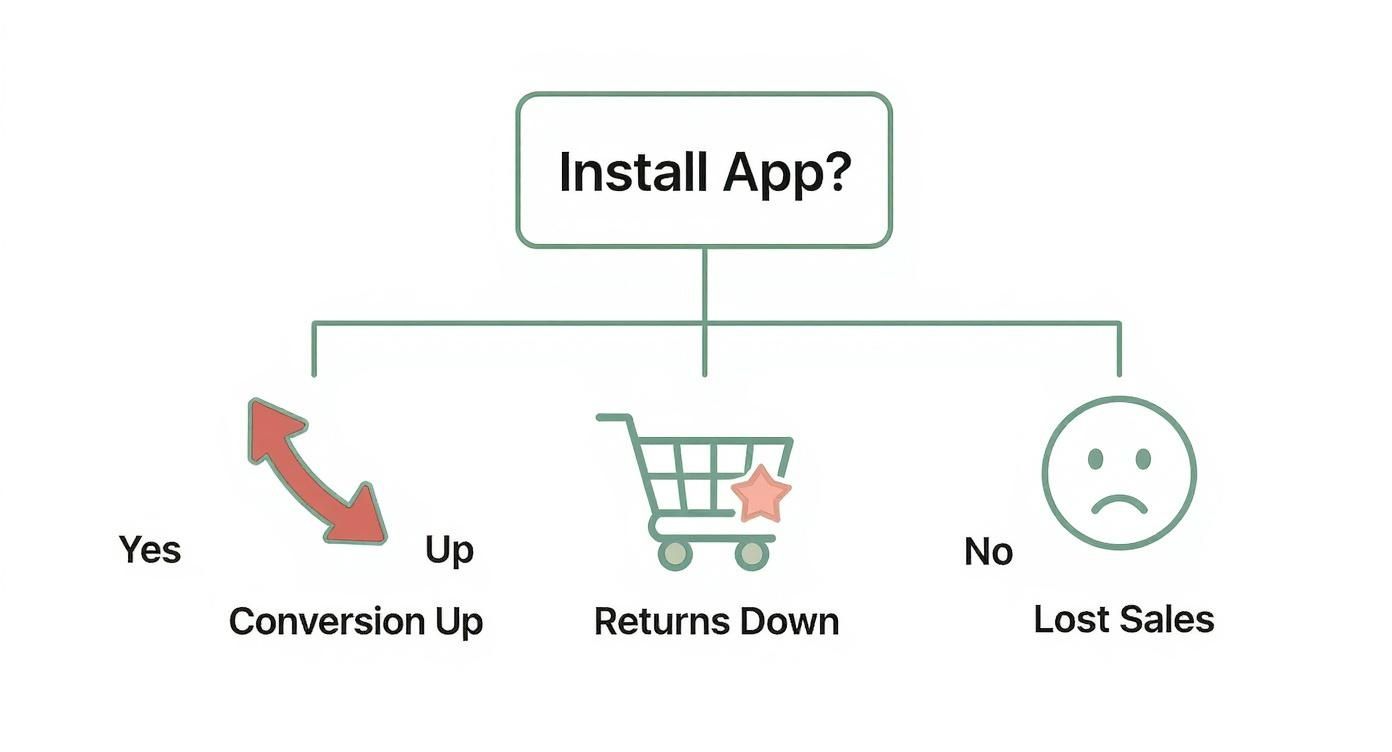
As you can see, adding a VFR is a direct path to boosting your most important metrics. Standing still means leaving money on the table.
A Practical Comparison For Your Store
To help you see things more clearly, let’s put these solutions head-to-head. This table breaks down each option based on what matters to a growing Shopify business.
Comparing Virtual Fitting Room Solutions for Your Store
| Solution Type | Best For | Implementation Effort | Typical Cost | Key Benefit |
|---|---|---|---|---|
| AI Size Recommender | Stores with standard sizing; dropshippers; beginners. | Low | $ – $$ | Quickly reduces returns with minimal setup. |
| Photo-Based Try-On | Apparel brands wanting a visual boost without high costs. | Low – Medium | $$ – $$$ | Balances powerful visuals with ease of use. |
| AR Live Try-On | Accessories, jewelry, and makeup brands. | Medium | $$$ – $$$$ | Creates a highly interactive and engaging experience. |
| 3D Model Visualization | High-end fashion; brands with significant resources. | High | $$$$ – $$$$$ | Offers the highest level of fit accuracy and immersion. |
For most Shopify merchants, a photo-based solution like Icona hits the perfect balance. It delivers the visual confidence shoppers want, integrates easily into your store without needing complex 3D models, and delivers a clear ROI through more sales and fewer returns. It’s a huge leap forward from a basic size chart without the massive investment of full 3D rendering.
Understanding these different technologies is a huge step in creating a better shopping experience and is just one of the many ecommerce personalization tools you can use to grow your business.
Your Step-by-Step Implementation Guide

Ready to bring the future of shopping to your store? It’s far more achievable than you might think. We’ve broken down the process into seven clear, actionable steps, turning what might feel like an intimidating project into a simple roadmap for success.
Step 1: Define Your Core Goals (The “How to Do It”)
Before installing any app, you need to know what success looks like for your brand. What specific problem are you trying to solve with a virtual fitting room? These goals will guide every decision you make.
Start by setting clear, measurable objectives for 2025:
- Actionable Step: Aim to reduce return rates by a specific target, like 20%, within the first three months.
- Actionable Step: Set a goal to increase the conversion rate on your top 10 product pages by 15%.
- Actionable Step: Plan to grow your Average Order Value (AOV) by 10% by making it easier for shoppers to buy complete outfits.
Having these Key Performance Indicators (KPIs) makes it easy to measure your return on investment later.
Step 2: Audit Your Product Data
A virtual try-on tool is only as good as the data you feed it. Now is the perfect time to get your digital house in order. For a tool like Icona, which uses your existing product photos, the most important thing is having high-quality, consistent images.
Actionable Step: Review your product catalog. Do you have crisp, front-facing photos of your apparel on a clean background? This is essential for the AI to accurately place the garment onto a customer’s photo. If not, schedule a photoshoot to update your key product images.
While you’re at it, double-check that your sizing charts are detailed and up-to-date. A visual try-on is powerful, but it becomes unstoppable when paired with precise sizing data.
Step 3: Choose the Right Shopify App
With your goals set and your product assets ready, it’s time to pick your technology partner. Look for a solution built specifically for Shopify to ensure a seamless integration that won’t slow down your site.
For most clothing stores, a photo-based app like Icona is the perfect starting point. It’s intuitive for customers and installation is usually a one-click process from the Shopify App Store. Do your homework: read recent reviews, compare pricing plans, and choose a tool that can grow with you.
Step 4: Configure and Customize the Experience
Once installed, it’s time to make the virtual fitting room truly yours. This is where you dive into the settings and align the experience with your brand’s look and feel.
Actionable Step: Customize the try-on button’s color, text, and placement on your product pages. Ensure it’s prominent but not intrusive. We share tips on this in our guide to Shopify product page customization. The goal is to make it feel like a natural, helpful part of the shopping journey.
Step 5: Launch and Promote Your New Feature
This is the fun part! But don’t just quietly flip the switch. You’ve added an amazing feature, so let your customers know.
Here are a few simple promotional steps:
- Announce the launch with a dedicated email to your subscriber list.
- Create short videos or social media posts showing customers exactly how to use it.
- Add a bold banner to your homepage to grab every visitor’s attention.
Step 6: Analyze the Performance Data
After the launch, it’s time to let the data roll in. This is where the goals from Step 1 pay off. Start tracking your KPIs. Are conversion rates climbing? Are return rates dropping?
Most apps, including Icona, have a built-in analytics dashboard. Use it to see which products get the most try-ons and how that engagement translates into sales.
Step 7: Iterate and Optimize
Your launch is just the beginning. The final step is to use your findings to make things even better. The data might reveal that certain product photos perform best, or that customers are trying on a specific jacket but not completing the purchase.
These insights are pure gold. Use them to refine your product pages, reshoot some photos, or even guide future inventory decisions. This is how you turn a great feature into an engine for sustainable growth.
Where Virtual Try-On Is Heading (And How to Stay Ahead)
Integrating a virtual fitting room is not just about solving today’s challenges; it’s a strategic move to get ahead of what’s next. This technology is evolving rapidly, and knowing where it’s going will give you a serious edge in 2025 and beyond.
The clearest indicator of the future? The Asia-Pacific region. It has become the fastest-growing market for virtual fitting room tech, with a staggering CAGR of 27.73%. This isn’t just growth; it’s a fundamental shift in shopper behavior driven by a massive, mobile-first population. Their expectations are setting a new global standard for what an interactive online store should be. You can dive deeper into these global market dynamics to see the full picture.
The Next Wave: Hyper-Personalization and Jaw-Dropping Realism
So, what does this mean for your store? Two major trends are about to redefine the virtual try-on experience.
1. AI-Powered Personal Stylists
The future isn’t just about showing if a shirt fits. It’s about giving smart, personal styling advice. Imagine an AI that not only shows a customer how a dress looks but also suggests the perfect pair of shoes from your catalog to complete the outfit, all based on their style and shopping history.
We’re moving from a simple fitting tool to an intelligent shopping assistant. The magic happens when you can anticipate a customer’s needs and delight them with ideas they hadn’t even thought of.
2. Immersive, True-to-Life Realism
The technology is also getting unbelievably realistic. As AI and AR models become more sophisticated, digital versions of your clothes will look and move just like they do in real life. We’re talking about capturing the subtle texture of linen, the way silk drapes, and creating realistic lighting. This push toward photorealism will make virtual try-on a non-negotiable part of the shopping journey.
Common Questions About Virtual Fitting Rooms
Adding a powerful new tool to your store naturally brings up questions. Here are the straightforward answers to what we hear most often from Shopify merchants.
Will It Slow Down My Shopify Store?
This is a critical question. We all know that in eCommerce, speed is everything. A slow site kills conversions.
Thankfully, modern virtual fitting room apps, especially those built for Shopify like Icona, are engineered to be lightweight. They are designed to load their scripts asynchronously, meaning the try-on feature loads in the background without holding up the rest of your page. Your site stays fast, and your customers get an amazing experience.
Is This Technology Expensive to Implement?
When you hear “AR,” you might see dollar signs. But the cost has dropped dramatically, making it accessible for stores of all sizes in 2025. You no longer need a massive budget.
Simple AI size finders are very affordable, and even advanced solutions offer flexible pricing. Most apps have tiered plans that grow with you. The best part? It pays for itself by boosting sales and cutting down on costly returns.
Think of it less as an expense and more as an investment. The return you get from reduced returns and increased conversions often provides a clear and rapid payback.
Do I Need 3D Models of All My Products?
No, you don’t. This is a common myth. While full 3D models create a top-tier experience, many of the most effective solutions today work perfectly with what you already have: your standard product photos. This flexibility means you can get a powerful visual try-on experience running fast, without a massive investment in creating new assets.
How Do I Measure the Success of My Virtual Fitting Room?
You measure success using the numbers you already track every day. Before you launch, take a snapshot of your key metrics: conversion rate, return rate, and average order value.
Once you go live, monitor those same KPIs. A successful implementation is a matter of data. You should see a measurable lift in conversions, a drop in returns, and a bump in your AOV. Plus, most apps come with their own analytics to show you how customers are engaging with the feature.
Takeaway
Implementing a virtual fitting room is one of the most impactful actions you can take in 2025 to increase conversions, reduce returns, and build customer loyalty. By replacing uncertainty with confidence, you empower shoppers to make better decisions and transform your store into a trusted destination for online fashion.
Ready to turn shopper doubt into confident purchases? Try Icona’s virtual try-on to boost your conversions.
Start your free trial of Icona today.
Featured image idea: A stylish split-screen image. On the left, a diverse group of people are happily using their smartphones to try on clothes virtually. On the right, a Shopify store’s sales analytics chart shows a clear upward trend for “Conversions” and “AOV” with a “Virtual Fitting Room Launched” marker on the timeline for 2025.